
Capistrano
Capistrano is a free, open-source tool for scripting remote server tasks, including web application deployments.
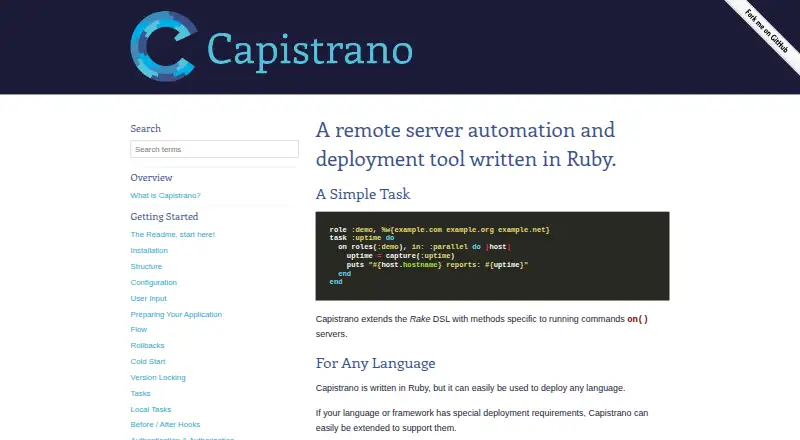
What Capistrano is
Capistrano is a free, open-source tool for scripting remote server tasks, including web application deployments. It sends commands over SSH using SSHKit and requires key-based SSH authentication. Deployments can target multiple machines simultaneously, in sequence, or as a rolling set, with stages for environments such as QA, staging, and production. Tasks extend the Rake DSL, can run concurrently across application servers, and can be assigned to server roles. Version 3 includes deployment and rollback flows with extensible hook tasks. Capistrano is written in Ruby but can deploy applications in any language. Built-in source-control plugins support Git, Subversion, and Mercurial; official plugins cover tools and frameworks such as Bundler, Composer, Drupal, Laravel, npm, Rails, and Symfony. The Rails plugin adds asset-pipeline and database-migration support. Capistrano is distributed as a Ruby gem and requires Ruby 2.0 or newer; deployment servers need a POSIX shell such as Bash or Sh. It deploys code but does not itself run applications or provision supporting server software. It is available for Linux, macOS, and Windows under the MIT License, without warranty.
Good
- Free and open source under the MIT License.
- Supports deployments to multiple machines and environments.
- Includes deployment and rollback flows.
- Plugins support several source-control systems and tools.
Watch out
- Requires Ruby 2.0 or newer.
- Requires key-based SSH authentication.
- Deployment servers need a POSIX shell.
- Does not run applications or provision server software.
Who it suits
Capistrano may suit developers comfortable with SSH and the command line who need to automate code deployments to remote servers. It can serve applications written in any language, but it does not run them or provision supporting server software.
Verdict
Capistrano provides customizable remote deployment workflows, including rollback, across multiple machines and environments. It is most relevant to users comfortable with SSH and server command lines, and its rollback behavior should be tested for each application and plugin setup.
The facts
Each one read from Capistrano's own pages, with the date it was checked.
What it does
- Audience fit
- The project says Capistrano may not suit users who are not comfortable using SSH and the command line on Linux servers.checked 11 Oct 2026
- Deployment
- It can deploy web applications to multiple machines simultaneously, in sequence, or as a rolling set.checked 11 Oct 2026
- Deployment limits
- Capistrano deploys code but does not know how to execute the application or provision supporting server software by itself.checked 11 Oct 2026
- Deployment stages
- A deployment can be parameterized for multiple environments such as QA, staging, and production.checked 11 Oct 2026
- Deployment tasks
- It extends the Rake DSL with methods for running commands on servers.checked 11 Oct 2026
- Deployment workflow
- Capistrano v3 provides deployment and rollback flows with hook tasks that users can extend.checked 11 Oct 2026
- Language support
- Although Capistrano is written in Ruby, it can be used to deploy any language.checked 11 Oct 2026
- License
- The project is distributed under the MIT License and states that it is provided without warranty.checked 11 Oct 2026
- Official plugins
- Official plugins are listed for Bundler, Composer, Drupal, Laravel, npm, Phusion Passenger, Ruby version managers, Rails, and Symfony.checked 11 Oct 2026
- Parallel execution
- Deployment tasks can run concurrently across application servers, using connection pooling.checked 11 Oct 2026
- Plugins
- Official plugins cover Bundler, Composer, Drupal, Laravel, npm, Phusion Passenger, Ruby version managers, Rails, Symfony, and other tools.checked 11 Oct 2026
- Purpose
- Capistrano is a remote server automation and deployment tool written in Ruby.checked 11 Oct 2026
- Rails support
- The capistrano-rails gem provides asset pipeline and database migration support.checked 11 Oct 2026
- Remote execution
- Capistrano executes remote commands over SSH using SSHKit.checked 11 Oct 2026
- Requirements
- The quick start lists Ruby 2.5 or higher locally and source control; Git, Mercurial, and Subversion support is built in.checked 11 Oct 2026
- Rollback limitation
- Rollback behavior depends on the application and assembled plugins, so users are advised to test their procedure beforehand.checked 11 Oct 2026
- Security
- The documentation recommends SSH keys, ideally passphrase-protected and used with an SSH agent, for workstation-to-server authentication.checked 11 Oct 2026
- Security limitation
- The documentation notes that sharing one deployment user among team members may be unsuitable or against regulations in some jurisdictions.checked 11 Oct 2026
- Security reporting
- The project directs suspected vulnerability reports to [email protected] instead of GitHub issues.checked 11 Oct 2026
- Server roles
- Servers can be assigned roles to control where tasks run.checked 11 Oct 2026
- Shell support
- Capistrano 3 expects a POSIX shell such as Bash or Sh on deployment servers.checked 11 Oct 2026
- Source control
- The built-in source control plugins support Git, Subversion, and Mercurial, and custom SCM plugins are possible.checked 11 Oct 2026
- SSH authentication
- Capistrano requires key based SSH authentication to deployment servers.checked 11 Oct 2026
- Support
- The site links to Stack Overflow and a mailing list for community help.checked 11 Oct 2026
Alternatives to Capistrano
- 1

Coolify
Free planOpen sourceAndroidiOSWebAPI8.6From $5 a month - 2

Railway
Free planAndroidiOSWebAPI8.3From $5 a month - 3

Northflank
Free planWebAPILinuxmacOS8.0From $2.70 a month - 4

fastlane
Free planAndroidiOSLinuxmacOS7.4Free plan - 5

Octopus Deploy
Free planWebAPILinuxSelf-hosted7.3From $4,330 a year - 6

Ploi
Free planAndroidiOSWebAPI7.3From $10 a month