CAMAai
CAMAai is an AI-assisted property assessment system for county and local assessor offices.
What CAMAai is
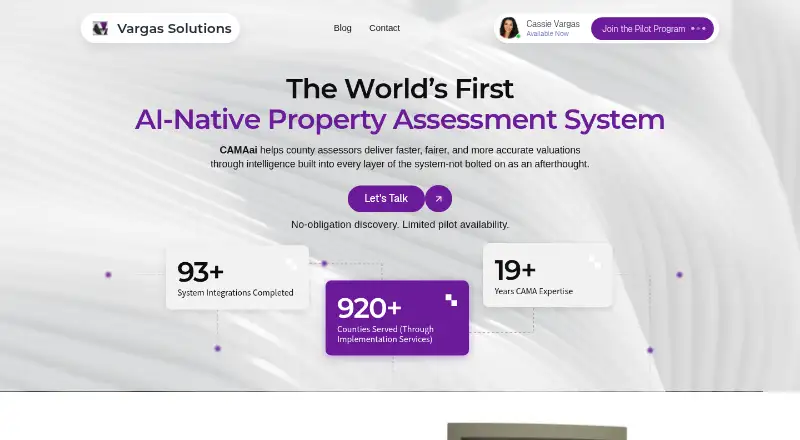
CAMAai is an AI-assisted property assessment system for county and local assessor offices. It supports workflows such as ownership changes, supplemental rolls, and appeals, with deed data extraction and suggested valuations for assessor review. Valuation explanations can include comparable selections, contributing characteristics, confidence indicators, and rationale. Aerial imagery and GIS data help flag properties for review and create prioritized worklists alongside mobile tools for field assessors. Other listed features include constituent and staff AI chat, year-over-year value insights, anomaly tagging, and generated reports and analysis. A configurable rules engine is described as adapting workflows to jurisdiction-specific statutes, with examples for California, Florida, Colorado, and Maryland. The product also describes compliance monitoring and automated compliance workflows. Assessors retain final decision authority, with AI providing supporting evidence. CAMAai is web-based and mobile-first; its deployment approach allows parallel operation with existing systems and phased rollout without a forced cutover. Pricing is available on request. A pilot has limited county availability, early access, dedicated implementation support, and pricing described as a fraction of standard licensing costs.
Good
- Supports ownership changes, supplemental rolls, and appeals.
- Valuations include explanations and confidence indicators.
- GIS and aerial imagery inform prioritized field worklists.
- Deployment can be phased alongside existing systems.
- Assessors retain final decision authority.
Watch out
- Pricing is available only on request.
- Pilot availability is limited to a number of counties.
- Product-data handling details require contacting the maker.
Who it suits
CAMAai is designed for county and local assessor offices, assessment and appraisal teams, and GIS and data management teams. Its pilot is aimed at counties modernizing workflows and seeking to reduce manual review and compliance risk.
Verdict
CAMAai combines assessment workflows with AI-supported review while leaving final decisions to assessors. Its stated deployment approach allows parallel operation and phased rollout rather than a forced cutover.
Plans and prices
From CAMAai's own pricing page, checked 7 Oct 2026.
| Plan | Price | What it gives you |
|---|---|---|
| Pilot program | Priced on request | Limited county availability · early access · dedicated implementation support · pricing described as a fraction of standard licensing costs |
The facts
Each one read from CAMAai's own pages, with the date it was checked.
What it does
- AI features
- Features include constituent AI chat, deed data extraction, year-over-year value comparisons, anomaly tagging, and AI-generated reports and analysis.checked 7 Oct 2026
- AI tools
- Listed features include constituent and staff AI chat, year-over-year value insights, anomaly detection and tagging, and generative reports and analysis.checked 7 Oct 2026
- Assessment rules
- A configurable rules engine is described as adapting to jurisdiction-specific statutes, with examples for California, Florida, Colorado, and Maryland.checked 7 Oct 2026
- Assessment workflow
- The platform supports workflows such as ownership changes, supplemental rolls, and appeals.checked 7 Oct 2026
- Audience
- The site identifies county and local assessor offices, assessment and appraisal teams, and GIS and data management teams as intended users.checked 7 Oct 2026
- Compliance
- The product describes IAAO compliance monitoring and automated compliance workflows as part of its assessment features.checked 7 Oct 2026
- Deed processing
- Smart Deed Handling extracts and imports critical deed data with AI assistance.checked 7 Oct 2026
- Deployment
- CAMAai is described as web-based and mobile-first, with parallel operation, phased rollout, and no forced cutover.checked 7 Oct 2026
- Field data
- AI change detection uses aerial imagery and GIS data to flag properties for review and provide field assessors with prioritized worklists and mobile tools.checked 7 Oct 2026
- Human oversight
- The site says assessors make final decisions and AI provides evidence; it presents CAMAai as support for staff rather than a replacement.checked 7 Oct 2026
- Human review
- The maker says assessors retain final decision authority and AI provides evidence for their decisions.checked 7 Oct 2026
- Integration details
- The site refers to system integrations and using aerial imagery and GIS data, but does not name specific third-party integration partners.checked 7 Oct 2026
- Intended users
- The product is designed for county and local assessor offices, assessment and appraisal teams, and GIS and data management teams.checked 7 Oct 2026
- Jurisdiction rules
- Its configurable rules engine is described as adapting workflows to jurisdiction-specific statutes, with example capabilities for California, Florida, Colorado, and Maryland.checked 7 Oct 2026
- Pilot
- The maker is selecting a limited number of county pilot partners, offering early access, dedicated implementation support, and input into product development at a fraction of standard licensing costs.checked 7 Oct 2026
- Pilot fit
- The pilot targets counties modernizing workflows and seeking to reduce manual review and compliance risk; the maker says it may not suit offices seeking only cosmetic upgrades.checked 7 Oct 2026
- Product
- CAMAai is an AI-native property assessment system for county assessors.checked 7 Oct 2026
- Product security details
- The site privacy policy applies to the website and directs readers to contact the maker for information about how CAMAai handles property assessment data.checked 7 Oct 2026
- Support
- The site invites visitors to ask questions and describes dedicated implementation support for pilot partners.checked 7 Oct 2026
- Transition
- The maker describes parallel operation with existing systems, phased rollout, and no forced cutover.checked 7 Oct 2026
The company
- Founded
- 2014checked 28 Sep 2026
- Headquarters
- Jacksonville, Florida, United Stateschecked 28 Sep 2026
- Maker
- The site identifies Vargas Solutions, LLC as the operator of the CAMAai website and lists Napa, California as its location.checked 7 Oct 2026
Where it runs
- Privacy approach
- The maker says collaborative learning shares model improvements across jurisdictions without transferring raw county data.checked 7 Oct 2026
The full review of CAMAai
CAMAai is a property assessment platform for county and local assessor offices, especially teams reworking review and field-assessment processes. Its clearest advantage is using AI to organize evidence and focus staff attention without taking final decisions away from assessors; custom pricing and questions about assessment-data handling warrant a careful evaluation.
Overview
CAMAai supports ownership changes, supplemental rolls, and appeals, bringing valuation, deed handling, field review, and compliance workflows into an assessment system. AI-suggested valuations come with explanations of comparable selections, contributing characteristics, confidence indicators, and rationale. That evidence can make a proposed value easier for staff to assess, but it remains a recommendation rather than a substitute for assessor judgment.
A configurable rules engine is intended to accommodate jurisdiction-specific statutes, with examples for California, Florida, Colorado, and Maryland. IAAO compliance monitoring and automated compliance workflows make the platform relevant to offices focused on consistent processes and oversight. Counties should still establish whether its rules and integrations fit their own requirements before committing.
Key features
Review and document workflows
Smart Deed Handling uses AI to extract and import critical deed data, while year-over-year value insights, anomaly tagging, and generated reports and analysis give staff additional ways to examine assessment changes. Constituent and staff AI chat are also part of the toolset. Together, these capabilities target repetitive review and information handling; offices should judge them against the particular workload they want to improve.
Field data and human oversight
Change detection uses aerial imagery and GIS data to flag properties for review and create prioritized worklists for field assessors, supported by mobile tools. This is a practical fit for teams that need to direct field attention toward potential changes rather than review every property in the same way. The maker says assessors retain final authority, with AI providing evidence for their decisions.
Deployment and data approach
CAMAai is described as supporting parallel operation with existing systems and phased rollout, without a forced cutover. That approach can suit offices that need to modernize without replacing their current setup all at once. The maker also describes collaborative learning that shares model improvements across jurisdictions without transferring raw county data. The website privacy policy covers the website and directs product-data questions to the maker, so counties should ask directly about the handling of assessment data.
Pricing
CAMAai is paid software with custom pricing. Its Pilot program has limited county availability, early access, dedicated implementation support, and pricing described as a fraction of standard licensing costs. No fixed pilot price, duration, or seat allowance is given, so counties should clarify scope and terms with the maker. The pilot is aimed at offices modernizing workflows and seeking less manual review and compliance risk; it may not suit teams looking only for a cosmetic upgrade.
Platforms
CAMAai is available on Android, iOS, and the web. Its web-based, mobile-first approach aligns with the described mobile tools for field assessors. Assessment tools, jurisdiction tracking, and parcel data import are supported.
Who it's for
The intended users are county and local assessor offices, assessment and appraisal teams, and GIS and data management teams. It is most relevant to offices ready to reconsider how staff review work, use field data, and manage jurisdiction-specific rules. Teams seeking only a cosmetic refresh, or unwilling to clarify product-data handling before adoption, have reason to look elsewhere.
Pros and cons
- Pros: Explained valuation suggestions give assessors evidence to review, including confidence indicators and rationale.
- Pros: Aerial and GIS-based change detection can help field teams prioritize property visits and review.
- Pros: Parallel operation and phased rollout avoid requiring a forced cutover.
- Cons: Custom pricing makes budget comparison dependent on a conversation with the maker.
- Cons: The website privacy policy does not explain how the assessment product handles county data; offices need to ask before adoption.
- Cons: The pilot is limited to selected counties and is not positioned for offices seeking only cosmetic upgrades.
Alternatives
Browse Property Tax Software for more options. Choose ATS Assessor Treasurer Software instead if open-source software that is freely available matters most; customization, deployment, training, and consultation are available as services. Springbrook Property Tax Management is another paid option covering residential, commercial, agricultural, and personal property taxes from assessment through billing and collection.
Vision CAMA is worth considering if a web and Windows platform is preferable. Cozerna RPTA is an alternative with API, Linux, self-hosted, and web platforms. For enterprise corporate tax software, consider CSC Corptax. DEVNET Edge offers an all-inclusive suite spanning CAMA, assessment administration, billing and collection, permitting and zoning, records management, wEdge, and EdgeMaps.
Ingenuity CAMA and PVDNet Suite are also paid alternatives.
Verdict
CAMAai is a strong candidate for assessor offices seeking to target manual review with AI-assisted valuation explanations, deed handling, and field prioritization while keeping decisions with staff. Its staged deployment approach is a meaningful advantage for counties wary of a forced transition. Look elsewhere if a fixed price or clear product-data handling terms are prerequisites; otherwise, ask the maker about those points and whether the pilot fits your office.
Getting started
- Visit the CAMAai website.
- Ask the maker about pricing and system integrations.
- County teams can ask about the limited pilot, early access, and dedicated implementation support.
- Plan for parallel operation with existing systems and a phased rollout.
Questions
Who makes CAMAai?
Vargas Solutions, LLC operates the CAMAai website.
What does CAMAai cost?
Pricing is available on request. The limited county pilot describes its pricing as a fraction of standard licensing costs.
What platforms does it support?
CAMAai is described as web-based and mobile-first, and its listed platforms are web, iOS, and Android.
Who is the product for?
It is designed for county and local assessor offices, assessment and appraisal teams, and GIS and data management teams.
How does the pilot work?
The limited county pilot offers early access, dedicated implementation support, and input into product development.
Does AI make the final assessment decisions?
No. The maker says assessors retain final decision authority, while AI provides evidence to support their decisions.
Alternatives to CAMAai
- 1

itamlink
AndroidiOSWebAPI6.6 - 2

Cozerna RPTA
WebAPILinuxSelf-hosted6.5From 25,000 PHP a month - 3
Springbrook Property Tax Management
AndroidiOSWeb6.3 - 4

ATS Assessor Treasurer Software
Free planAPI5.9Free plan - 55.8
- 6
Municipal Tax System
Self-hostedWindows5.8From $750 a year