BusPlan
BusPlan is an open-source tool for generating school bus routes from student, stop, and school location data.
What BusPlan is
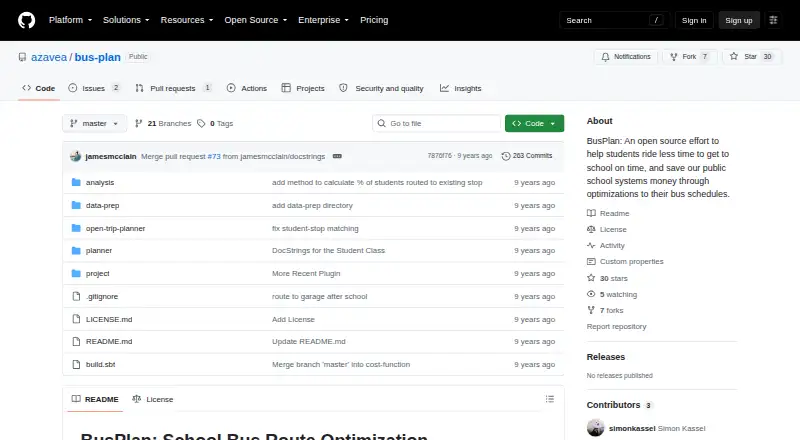
BusPlan is an open-source tool for generating school bus routes from student, stop, and school location data. It is intended for school districts and grew from Azavea’s work with the School District of Philadelphia on algorithmically optimized routing. Its goal is to reduce bus drive time, with an option to constrain maximum student ride time. The workflow uses CSV inputs for locations, students, candidate stops, stop eligibility, and garage bus limits. Its preparation instructions generate candidate stops within a one-mile radius of each student and calculate walk-distance eligibility. OpenStreetMap extracts and OpenTripPlanner provide route costs, while OptaPlanner handles optimization constraints. The tool outputs CSV files listing ordered route stops and assigning students to routes and stops. The repository also includes a script for calculating ride times and a Jupyter notebook for route analysis. BusPlan is distributed as source code on GitHub under the Apache License, Version 2.0, with setup and usage instructions. Getting started requires generating OpenTripPlanner routing graphs from OpenStreetMap extracts. The project describes several additional constraints as planned solver improvements, including fleet size, capacity, student age, special needs, and buses serving multiple schools.
Good
- Optimizes routes for drive time and ride-time limits.
- Exports ordered stops and student assignments as CSV.
- Includes ride-time calculations and route analysis tools.
- Apache License, Version 2.0.
Watch out
- Requires generating routing graphs from OpenStreetMap extracts.
- Distributed as source code, with no desktop or mobile download listed.
- Several additional solver constraints are described as planned improvements.
Who it suits
BusPlan suits school districts that want to generate routes from CSV student, stop, and school data. Users need to be able to prepare routing graphs from OpenStreetMap extracts and work with the repository’s source code.
Verdict
BusPlan provides a reproducible route-planning workflow with CSV inputs and outputs, plus tools for ride-time analysis. Districts should account for the graph-generation setup and distinguish current constraints from planned improvements.
Plans and prices
From BusPlan's own pricing page, checked 9 Oct 2001.
| Plan | Price | What it gives you |
|---|---|---|
| BusPlan | Free | Open source; no hosted plan or usage limits stated |
The facts
Each one read from BusPlan's own pages, with the date it was checked.
What it does
- Analysis
- The repository includes instructions and a Jupyter notebook for analyzing student ride times and routes.checked 9 Oct 2001
- Distribution
- The repository provides source code and setup instructions, with no packaged desktop or mobile download listed.checked 9 Oct 2001
- Input data
- The setup instructions use CSV files for network nodes, students, eligible stops, and garage bus limits.checked 9 Oct 2001
- Integrations
- The documented workflow uses OpenStreetMap extracts with OpenTripPlanner for routing and OptaPlanner for optimization.checked 8 Oct 2001
- Intended users
- The project describes its goal as reducing public school budgets and helping students spend less time riding to school.checked 9 Oct 2001
- License
- The repository provides the software under the Apache License, Version 2.0.checked 9 Oct 2001
- Open source license
- The repository provides the software under the Apache License, Version 2.0.checked 8 Oct 2001
- Optimization
- Routes are optimized to minimize bus drive time and can be constrained by maximum student ride time.checked 8 Oct 2001
- Optimization engine
- BusPlan uses OptaPlanner as its constraint solver.checked 9 Oct 2001
- Outputs
- The solver produces CSV files containing ordered route stops and student assignments, which can then be converted into mappable routes.checked 9 Oct 2001
- Potential constraints
- The project page describes planned solver improvements for bus fleet size, capacity, student age, special needs and buses serving multiple schools.checked 8 Oct 2001
- Project context
- Azavea says it worked with the School District of Philadelphia to investigate algorithmically optimized school bus routing.checked 8 Oct 2001
- Purpose
- BusPlan generates school bus routes for existing students, stops, and school locations, optimizing for minimum bus drive time.checked 9 Oct 2001
- Ride time constraint
- Routes can be constrained to limit maximum student ride time.checked 9 Oct 2001
- Routing and solver
- The project uses OpenTripPlanner to generate route costs and OptaPlanner as a constraint solver.checked 8 Oct 2001
- Routing engine
- BusPlan uses OpenTripPlanner to generate route costs.checked 9 Oct 2001
- Security
- The repository page does not state any product-specific security certifications or compliance claims.checked 9 Oct 2001
- Setup requirement
- The getting-started instructions require generating OpenTripPlanner routing graphs from OpenStreetMap extracts.checked 9 Oct 2001
- Stop eligibility
- The data-preparation instructions generate candidate stops within a one-mile radius of each student and calculate walk-distance eligibility.checked 9 Oct 2001
- Support
- The repository provides setup and usage instructions in its README; it does not state a support service.checked 8 Oct 2001
The company
- Headquarters
- Philadelphia, Pennsylvania, USAchecked 28 Sep 2001
The full review of BusPlan
BusPlan is an open-source tool for planning school bus routes from student, stop and school data. It suits school districts with the capacity to prepare CSV files and run routing software themselves.
Overview
BusPlan generates routes for existing students, candidate stops and school locations. It uses OpenTripPlanner to calculate route costs and OptaPlanner to optimize routes for shorter bus drive times. Districts can also impose a maximum student ride time, giving planners a way to weigh efficient driving against the length of students’ trips.
Azavea developed the project after working with the School District of Philadelphia on algorithmically optimized school bus routing. The Apache License, Version 2.0, permits use of the source code, while the self-hosted format places setup and operation with the district. The workflow requires routing graphs generated from OpenStreetMap extracts, so teams should be prepared to configure the routing stack before planning routes.
Key features
Route optimization and constraints
The solver targets reduced drive time and can enforce a maximum ride time for students. These are meaningful controls for districts balancing vehicle efficiency with student experience. The project describes fleet size, vehicle capacity, student age, special needs and buses serving multiple schools as planned solver improvements; districts that need those constraints in their routing decisions should look for a tool that supports them today.
CSV inputs, outputs and analysis
Districts prepare CSV files for locations, students, candidate stops, stop eligibility and garage bus limits. Candidate stops are generated within one mile of each student, with walk-distance eligibility calculated during data preparation. The planner returns CSV files with ordered route stops and student assignments to routes and stops. A ride-time script and Jupyter notebook support further analysis, making the output useful to teams that want to inspect and work with route results in their own data workflow.
This reproducible file-based approach can suit districts that want control over their planning process. It also shifts data preparation and analysis work to the district, and the README’s setup and usage instructions are the stated support path; no support service is described.
Pricing
BusPlan is free: its open-source plan costs nothing. There is no hosted plan or usage limit stated. That makes it a practical option for districts able to supply their own technical setup and operating effort. The free price does not remove the work of preparing inputs, generating routing graphs and running the software.
Platforms
BusPlan is self-hosted source code with setup instructions, rather than a packaged desktop or mobile download. Districts need to generate OpenTripPlanner routing graphs from OpenStreetMap extracts and use the documented CSV workflow. That favors teams able to manage their own environment; readers looking for a ready-to-deploy app should consider a hosted alternative.
Who it's for
BusPlan is best suited to school districts that can prepare structured student and stop data, configure the routing workflow and analyze CSV results. It is especially relevant when minimizing drive time and limiting maximum student ride time are the primary routing concerns. Districts that need broader fleet, vehicle or student-specific constraints already built into the solver should assess other options.
Pros and cons
Pros
- Free, open-source software under Apache License 2.0 gives districts a self-hosted route-planning option without a software charge.
- Drive-time optimization and a maximum student ride-time constraint address two central planning priorities.
- CSV route assignments, ordered stops and included ride-time analysis support repeatable workflows and further review of results.
Cons
- Generating routing graphs from OpenStreetMap extracts and preparing several CSV inputs require technical and data work from the district.
- Fleet size, capacity, student age, special needs and multi-school bus service are described as planned solver improvements, limiting its fit where those constraints are essential.
- The project provides setup and usage instructions but no stated support service, leaving operation with the district.
Alternatives
Compare school bus routing software if you want to consider a broader set of options. RouteCabin is worth considering for teams that need Android, iOS, web or API access and a freemium service: its free plan is free, billed Rs. 0 /mo, and caps use at 15 passengers, one vehicle and two drivers, with live tracking, attendance, basic fee records and email support.
RollCall may suit families seeking a free iOS or Android parent app, while schools and bus operators subscribe to the service. AlphaRoute is another paid option, with pricing available by requesting a demo. BusPlanner has custom pricing upon request and supports self-hosted use as well as Android, API, iOS, web and Windows platforms.
GoLoop is a paid alternative with a free plan and Android, iOS and web platforms. HNH HTSTM is a paid alternative available on Android, iOS and web. RouteBot is a paid alternative with a free plan and Android, iOS and web platforms. School Bus Manager may fit districts looking for a paid service with a free trial and Android, iOS, macOS, web and Windows support; its Lite plan is $990 a year, billed annually, with a $199 one-time first-year startup fee and a limit of 500 riders.
Verdict
Choose BusPlan if your district can manage a self-hosted workflow and wants a free, reproducible way to optimize bus drive time while constraining student ride time. Its strongest reason to choose it is the combination of open-source access, route outputs and analysis tools. Look elsewhere if you need packaged deployment, a stated support service or the planned fleet and student constraints already built into the solver.
Getting started
- Clone or download the BusPlan source from GitHub
- Prepare CSV files for locations, students, candidate stops, eligibility and garage limits
- Obtain OpenStreetMap extracts
- Generate OpenTripPlanner routing graphs
- Run the documented BusPlan workflow and inspect CSV route outputs
Questions
Is BusPlan free?
Yes. The BusPlan plan is free, and the project is open source.
What license does it use?
The repository provides BusPlan under the Apache License, Version 2.0.
What data does it accept?
The workflow uses CSV data for locations, students, candidate stops, stop eligibility and garage bus limits.
How are routes optimized?
OpenTripPlanner generates route costs, while OptaPlanner applies constraints to optimize routes and limit maximum student ride time.
What does it produce?
It produces CSV files with ordered route stops and student assignments to route and stop combinations.
What is required to get started?
The setup instructions require generating OpenTripPlanner routing graphs from OpenStreetMap extracts and using the repository's source and instructions.
Alternatives to BusPlan
- 1
RouteCabin
Free planAndroidiOSWebAPI7.9From 3,000 PKR a month - 2
RollCall
Free planAndroidiOSWebAPI7.3Free plan - 3

School Bus Manager
AndroidiOSWebmacOS7.0From $82.50 a month - 4
BusWhere
AndroidiOSWeb6.9 - 5

BusPlanner
AndroidiOSWebAPI6.7 - 6

AlphaRoute
AndroidiOSWebAPI6.4