
Bridgit
Bridgit is workforce planning software designed for construction contractors, including general and specialty contractors.
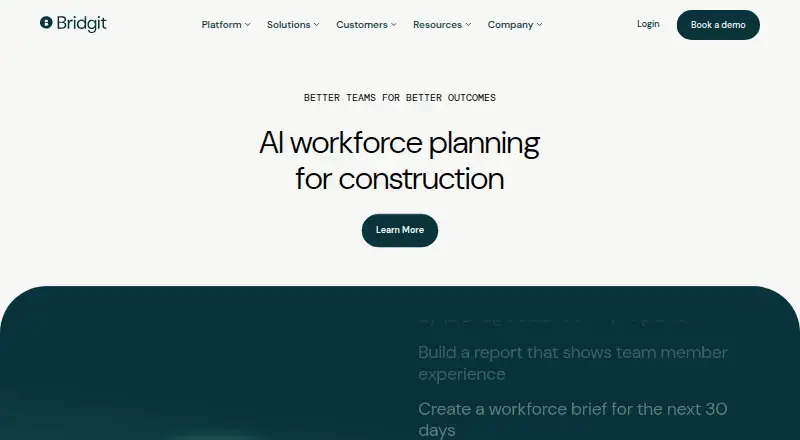
What Bridgit is
Bridgit is workforce planning software designed for construction contractors, including general and specialty contractors. It brings projects, roles, and people into one planning view so teams can consider staffing across their work. Internal profiles can record job history, skills, certifications, location, and availability. Planners can compare workforce requirements with the project pipeline to find staffing gaps and hiring needs, using scenario modeling, headcount forecasting, org chart planning, and a multi-year planning horizon. Communication tools support assignment alerts by SMS or email, project announcements, and notes on people’s profiles. Bridgit lists connectors for construction, CRM, HRIS, and data systems such as Autodesk Build, Procore, Salesforce, Workday, and Snowflake. These integrations pull information into Bridgit and do not send changes back to source systems. An open API provides access to projects, people, assignments, and forecast data. Bridgit Bench has iOS and Android apps, while the service also lists web and API access. Bridgit says it has SOC 2 Type 2 certification and supports Microsoft OAuth, Google OAuth, and SAML single sign-on. Pricing is provided on request.
Good
- Project, role, and people views support staffing planning
- Profiles capture skills, certifications, location, and availability
- Scenario modeling and multi-year workforce forecasting
- SMS and email assignment alerts
- Connectors include Autodesk Build, Procore, Salesforce, Workday, and Snowflake
- Open API covers projects, people, assignments, and forecasts
Watch out
- Pricing requires a request
- Integrations pull data in without pushing changes back
- Only SOC 2 Type 2 certification is stated
- Built specifically for construction contractors
Who it suits
Bridgit suits general and specialty construction contractors planning workforce needs across active and future projects. It is aimed at teams that need staffing forecasts, internal personnel details, construction-system integrations, and mobile access.
Verdict
Choose Bridgit if your construction business needs structured workforce planning tied to project pipelines. Its forecasting, personnel profiles, alerts, connectors, and API cover detailed staffing operations. Look elsewhere if you need publicly posted pricing, broader industry positioning, or integrations that write changes back to source systems.
Plans and prices
From Bridgit's own pricing page, checked 15 Oct 2026.
| Plan | Price | What it gives you |
|---|---|---|
| Bridgit Bench | Priced on request | subscription · no public starting price · free trial unavailable · free version unavailable · custom quote |
The facts
Each one read from Bridgit's own pages, with the date it was checked.
What it does
- AI assistant
- Bridgit AI lets users query workforce data in natural language for staffing and utilization decisions.checked 15 Oct 2026
- API
- Bridgit describes an open API for building connections to its projects, people, assignments, and forecasts data.checked 7 Oct 2026
- API authentication
- REST API access requires an access key and uses TLS; customers can regenerate keys.checked 15 Oct 2026
- API documentation
- The API guide documents versioned paths, authentication, pagination and JSON responses.checked 15 Oct 2026
- API versions
- The public API documentation says v1 and v2 are active and maintained.checked 15 Oct 2026
- Communication
- Assignment alerts, broadcasts and logged communications keep project teams informed.checked 15 Oct 2026
- Data storage
- Bench customer data is hosted on AWS in the United States with multi-zone replication and disaster-recovery infrastructure.checked 15 Oct 2026
- Documentation and support
- Customer resources include a help desk, status page, trust center, monthly training and live webinars.checked 15 Oct 2026
- Encryption
- The security page states that data is encrypted in transit and at rest with RSA 256-bit encryption and TLS 1.2/1.3 protections.checked 15 Oct 2026
- Forecasting
- The product provides five-year lookahead reporting for utilization and project demand.checked 15 Oct 2026
- Google Play listing
- The Bridgit Bench listing shows 1K+ downloads and does not display a user rating in the opened page.checked 15 Oct 2026
- Hosting model
- Bridgit describes Bench as a cloud-based SaaS platform.checked 15 Oct 2026
- Integration cadence
- Most integration changes appear in Bridgit within about five minutes.checked 15 Oct 2026
- Integration data flow
- The support documentation says integrations pull from source systems into Bridgit and do not push changes back.checked 7 Oct 2026
- Integration direction
- Standard integrations pull source-system data into Bridgit while source systems remain authoritative.checked 15 Oct 2026
- Integrations
- Supported connectors include ADP Workforce Now, UKG, Workday, BambooHR, Salesforce, HubSpot, Microsoft Dynamics, Procore, Autodesk Construction Cloud, Snowflake and others.checked 15 Oct 2026
- Internal resumes
- People profiles can contain project history, skills, certifications and experience for staffing decisions.checked 15 Oct 2026
- Legal name and funding
- Crunchbase identifies the legal name as Bridgit Inc. and reports more than $35 million in equity financing.checked 15 Oct 2026
- License
- Bridgit's terms describe proprietary software and prohibit reverse engineering, sublicensing and derivative works, so the product is not open source.checked 15 Oct 2026
- Limit: HRIS automation
- Reviewers say some deployments do not fully automate new-hire and termination updates from HR systems.checked 15 Oct 2026
Where it runs
- Browser requirements
- Supported minimum browsers listed are Chrome 135, Firefox 139, Safari 18.5 and Edge 132.checked 15 Oct 2026
The company
- Company facts
- LinkedIn lists Bridgit as a privately held construction company founded in 2012 with 51–200 employees and headquarters in Kitchener, Ontario.checked 15 Oct 2026
- Founded
- 2012checked 28 Sep 2026
- Headquarters
- Toronto, Ontario, Canadachecked 28 Sep 2026
The full review of Bridgit
Bridgit is workforce planning software made for construction contractors coordinating people across active and prospective projects. It is most compelling for general and specialty contractors whose staffing decisions depend on a changing project pipeline. The trade-off is a quote-based product with integrations that bring source data into Bridgit without writing updates back.
Overview
Founded in 2012 and headquartered in Toronto, Bridgit centers workforce planning on construction operations. Its workspace connects projects, roles, and people, so staffing discussions can be tied to actual delivery demands rather than a standalone employee list. The approach fits contractors managing many assignments and looking several years ahead; organizations wanting a broad, industry-neutral HR suite may find the scope narrower than they need.
Key features
Project, role, and people views provide a common planning context. Internal profiles record job history, skills, certifications, location, and availability. That information gives planners a practical basis for matching qualified staff to work and identifying where hiring or reassignment is realistic.
Scenario modeling, headcount forecasting, and org chart planning support a multi-year horizon. Users can compare workforce requirements with the project pipeline and expose staffing gaps before they become urgent. This is a meaningful strength for contractors with uncertain starts, overlapping jobs, or long-range hiring decisions; it is less relevant if planning is limited to short-term schedules.
Assignment alerts can be sent by SMS or email, while project announcements and profile notes keep staffing changes visible to the people involved. These communication tools improve coordination around assignments, but they serve the planning workflow rather than functioning as a full collaboration or messaging system.
Prebuilt connectors cover construction, CRM, HRIS, and data systems, including Autodesk Build, Procore, Salesforce, Workday, and Snowflake. The documented flow is inbound: records are pulled from source systems into Bridgit, and changes are not pushed back. That reduces duplicate entry inside Bridgit, but teams must maintain the source applications separately. An open API exposes projects, people, assignments, and forecasts data for custom connections.
Bridgit says it is SOC 2 Type 2 certified and supports single sign-on through Microsoft OAuth, Google OAuth, and SAML. It also states that it has no other security compliance or certifications at this time. Its team guides customers through integration setup and configuration, with the Customer Success Manager or Account Executive helping select integrations.
Pricing
Bridgit Bench: custom pricing, provided on request. Bridgit asks prospective customers to speak with an expert for a price. The plan is the product’s named offering and includes the planning capabilities described above, but no public seat allowances, usage quotas, trial period, renewal terms, or free tier are provided. Contractors should request a quote that spells out user access, implementation, integration work, and ongoing support before committing.
Quote-based pricing is a reasonable fit for larger construction organizations whose deployment needs vary, but it makes budget comparison difficult for smaller firms. There is no lower-cost published plan for testing the workflow independently.
Platforms
Bridgit is available on the web, with Bridgit Bench mobile apps for iOS and Android. An API supports programmatic access and custom integrations, making the platform suitable for teams that need to connect planning data to other systems.
Who it's for
Choose Bridgit for general or specialty contractors that need structured workforce planning tied to project pipelines, multi-year forecasts, and detailed personnel profiles. It is particularly suited to organizations already using construction, CRM, HRIS, or data platforms covered by its connectors. Look elsewhere if your operating model depends on two-way synchronization or if you need transparent self-serve pricing.
Pros and cons
- Pro: Construction-specific project and role planning links staffing decisions directly to pipeline demand.
- Pro: Profiles combine skills, certifications, location, availability, and work history for more informed assignments.
- Pro: Scenario modeling, headcount forecasting, and org chart planning extend across multiple years.
- Pro: SMS and email assignment alerts help communicate changes to field and office personnel.
- Con: Integrations import data but do not push changes back, leaving source systems as a separate maintenance point.
- Con: Pricing is available only on request, with no public free plan or published trial terms.
- Con: Security credentials are limited to SOC 2 Type 2 and the stated SSO options; Bridgit reports no other certifications.
Alternatives
For a broader category comparison, see Workforce Planning Software.
- Arrange is the better starting point for teams wanting a freemium, web-based planner with a free workspace, two scenarios, and benchmark rates in seven currencies.
- Pave Market Data suits organizations focused on compensation benchmarks, offering a free U.S. and one additional market option for startups with 1–200 employees.
- Workday Adaptive Planning is a wider planning choice when broad platform coverage, including desktop and mobile clients, matters more than construction specialization.
- HRForecast smartPlan is an alternative for enterprise scenario planning with unlimited planning units.
- PeopleCoral OrgStudio is an option for dedicated single-tenant deployment whose pricing depends on countries and headcount.
- Nakisa Capital Projects Suite is worth considering when capital-project management is the primary requirement.
- TalentNeuron is another paid, API- and web-based workforce option.
- beqom PaySuite is an alternative paid platform available through an API and web interface.
Verdict
Bridgit is a strong fit for construction contractors that need workforce forecasts, scenario planning, and personnel context aligned to a multi-year project pipeline. Its main reason to choose is that construction staffing decisions stay connected to project demand; its main reason to look elsewhere is the combination of custom pricing and one-way integrations that cannot return changes to source systems.
Getting started
- Visit https://gobridgit.com/
- Talk to an expert to request pricing
- Work with Bridgit’s team on integration setup and configuration
- Choose relevant connectors with your Customer Success Manager or Account Executive
- Use the web service or Bridgit Bench on iOS and Android
- Connect through Microsoft OAuth, Google OAuth, or SAML single sign-on
Limits worth knowing
Pricing is provided on request. Bridgit states that it has no other security compliance or certifications beyond SOC 2 Type 2.
Questions
What does Bridgit do?
It provides workforce planning for construction contractors, showing projects, roles, and people while modeling staffing needs against the project pipeline.
Which platforms are available?
Bridgit lists Android, API, iOS, and web access. Bridgit Bench is available for iOS and Android.
Does Bridgit offer integrations?
Yes. Listed connectors include Autodesk Build, Procore, Salesforce, Workday, and Snowflake, and an open API covers projects, people, assignments, and forecasts.
How do integrations handle data?
The documented integrations pull data from source systems into Bridgit and do not push changes back.
How much does Bridgit cost?
Pricing is on request; the Bridgit Bench plan has no listed price.
What security options are listed?
Bridgit says it is SOC 2 Type 2 certified and supports Microsoft OAuth, Google OAuth, and SAML single sign-on.
Alternatives to Bridgit
- 1

IBM Planning Analytics
iOSWebAPIExtension7.9 - 2
Workday Adaptive Planning
AndroidiOSWebAPI7.5 - 3

Arrange
Free planWeb7.2From $29 a month - 4

ChartHop
Web6.7From $3 a month - 5

Vena
WebAPIExtensionmacOS6.7 - 6
Anaplan
AndroidiOSWebAPI6.5