Bogus
Bogus is a synthetic data generator for C#, F#, and VB.NET, adapted from faker.js.
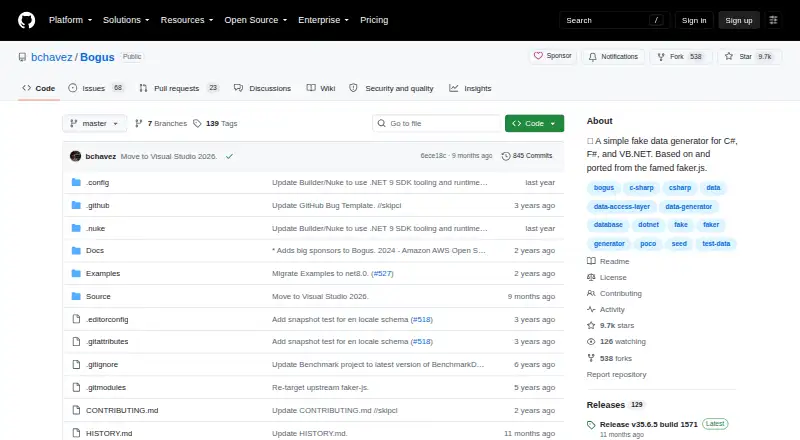
What Bogus is
Bogus is a synthetic data generator for C#, F#, and VB.NET, adapted from faker.js. It creates sample data for loading databases, user interfaces, and apps during testing. Its documented generators cover addresses, commerce, companies, databases, dates, finance, names, and internet data, with JSON listed as a supported format. It supports multiple locales and uses English when data for a requested locale is unavailable. A randomizer seed can make generated data repeatable. Developers can set object-generation rules with `Faker<T>`, including strict mode, custom instantiation, and completion callbacks. The project documents three usage styles: a Faker facade, direct use of DataSets, or inheritance from `Faker<T>`. Bogus is distributed as a NuGet package, installed with `Install-Package Bogus`. Listed minimum requirements are .NET Standard 1.3, .NET Standard 2.0, or .NET Framework 4.0. The free plan is free. It is self-hosted and lists Linux, macOS, and Windows platforms.
Good
- Generates data across many documented categories.
- Supports multiple locales.
- Randomizer seeds enable repeatable data sets.
- Offers several usage styles and configuration options.
Watch out
- Requires .NET Standard 1.3, .NET Standard 2.0, or .NET Framework 4.0.
- Deployment is self-hosted.
Who it suits
Bogus suits .NET developers who need synthetic data for testing databases, interfaces, or applications. Its locale support and repeatable-data option may help teams preparing varied or reproducible test inputs.
Verdict
Bogus provides configurable synthetic data generation for .NET projects, including locale selection and seeded repeatability. Its NuGet distribution and listed framework requirements are key considerations before adopting it.
Plans and prices
From Bogus's own pricing page, checked 7 Oct 2026.
| Plan | Price | What it gives you |
|---|---|---|
| Bogus | Free | Free open-source .NET package; minimum requirements: .NET Standard 1.3 or .NET Standard 2.0 or .NET Framework 4.0 |
The facts
Each one read from Bogus's own pages, with the date it was checked.
What it does
- Configuration
- The README demonstrates defining object-generation rules with `Faker<T>`, strict mode, custom instantiation, and completion callbacks.checked 7 Oct 2026
- Data categories
- Its documented generators cover areas including addresses, commerce, companies, databases, dates, finance, names, and internet data.checked 7 Oct 2026
- Ecosystem
- The project lists Bitwarden Passwordless Server, Elasticsearch .NET Client, FluentValidation, and Microsoft sample projects among projects using Bogus.checked 7 Oct 2026
- Installation
- The project provides a NuGet package installable with `Install-Package Bogus`.checked 7 Oct 2026
- License
- The repository includes a license file for the project.checked 7 Oct 2026
- Locales
- Bogus supports multiple locales and defaults to English when a locale-specific data set is missing.checked 7 Oct 2026
- Minimum requirements
- The package lists .NET Standard 1.3, .NET Standard 2.0, or .NET Framework 4.0 as minimum requirements.checked 7 Oct 2026
- Premium support
- The README says users can support the project by purchasing a Bogus Premium license, but it does not state a price on the page.checked 7 Oct 2026
- Purpose
- Bogus is a fake data generator for C#, F#, and VB.NET, ported from faker.js.checked 7 Oct 2026
- Repeatable data
- The README shows setting a randomizer seed to generate repeatable data sets.checked 7 Oct 2026
- Usage styles
- The README describes using Bogus through a Faker facade, DataSets directly, or `Faker<T>` inheritance.checked 7 Oct 2026
- Use cases
- It generates fake data to load databases, user interfaces, and apps for testing.checked 7 Oct 2026
The company
- Founded
- 2015checked 28 Sep 2026
The full review of Bogus
Bogus is a synthetic-data generator for C#, F#, and VB.NET projects. It suits developers who need realistic records for test databases, interfaces, or applications and want generation rules inside their own codebase. Its broad data sets and seeded repeatability are compelling, while the .NET target requirements and self-hosted, package-based workflow narrow its audience.
Overview
Ported from faker.js, Bogus creates fake records for loading databases, user interfaces, and applications during testing. Coverage includes addresses, commerce, companies, databases, dates, finance, names, and internet data, so it can populate varied test scenarios rather than only one type of fixture.
Founded in 2015, the project is used by Bitwarden Passwordless Server, Elasticsearch .NET Client, FluentValidation, and Microsoft sample projects. Those users place it within a recognizable .NET ecosystem, but Bogus is a library to configure and embed, not a hosted test-data service with a separate visual workflow.
Key features
Model-focused configuration
Developers can use the Faker facade, access DataSets directly, or inherit from Faker<T>. Rules can be defined for their own objects, with strict mode, custom instantiation, and completion callbacks available in the documented configuration approach. This is useful when generated records must follow application-specific models and lifecycle steps. The trade-off is that teams must design and maintain those rules in .NET code.
Locale and repeatability
Bogus supports multiple locales and falls back to English when a locale-specific data set is unavailable. That makes localized-looking fixtures practical without making every locale a hard dependency. A randomizer seed can produce repeatable data sets, which is valuable for deterministic tests, reproducible bug reports, and stable development fixtures. Seeded output is a control for test data, not a substitute for validating behavior against genuinely varied inputs.
Package delivery
The NuGet package installs with Install-Package Bogus, fitting established .NET dependency workflows. Generation is synthetic and JSON is a supported format. Deployment is self-hosted, so teams retain control of where the generator runs but must provide and operate the surrounding development or test environment.
Pricing
The Bogus plan costs nothing. It is a free open-source .NET package with minimum requirements of .NET Standard 1.3, .NET Standard 2.0, or .NET Framework 4.0. There are no stated seat, request, row, or usage quotas, making it suitable for teams that need a library without a metered service bill.
A Bogus Premium license is offered for users who want to support the project, with custom pricing. The package remains the practical choice for developers who only need generation; premium support is relevant when funding the project matters, but the published terms do not establish additional capabilities or service commitments.
Platforms
Bogus supports Linux, macOS, Windows, and self-hosted deployment through its .NET package. Compatibility depends on the project targeting one of the listed minimum frameworks. Teams on other runtimes or looking for a browser-hosted generator should consider a different tool.
Who it's for
Bogus is a strong fit for .NET developers building repeatable fixtures, seeding test databases, or filling UI and application scenarios with varied synthetic records. It is especially appropriate when generation rules belong alongside domain models and when locale selection or deterministic seeds are important.
It is less suitable for teams wanting a turnkey hosted data workspace, a no-code interface, or a service with explicit online quotas and managed deployment. Its value depends on being comfortable with NuGet and maintaining generation code.
Pros and cons
- Pros: broad generators cover common business and internet data categories, reducing the need to assemble separate fixture libraries.
- Pros: locale support with English fallback helps create region-aware test records without breaking when a locale-specific set is missing.
- Pros: seeded randomization enables repeatable data for deterministic tests and reproducible defects.
- Pros: Faker, DataSets, and Faker<T> usage styles accommodate different .NET codebases and model designs.
- Cons: self-hosted, code-first delivery requires developers to integrate and maintain the generator rather than configure a hosted workflow.
- Cons: framework compatibility is bounded by the listed .NET Standard and .NET Framework minimums.
- Cons: premium support has custom pricing and no stated service terms, so support costs cannot be planned from a published rate.
Alternatives
Choose Benerator when an open-source tool with API, desktop, and self-hosted platform coverage is preferable; its Community Edition is free but single-threaded and does not provide a full graph.
dbForge Studio for PostgreSQL is the better direction for a PostgreSQL workspace with a visual data editor, import/export, query history, and basic formatting; its Express plan has no listed price.
Pick JSON Schema Faker for a free MIT-licensed generator installed through npm or Bun when JSON Schema is the organizing model rather than .NET classes.
YData SDK suits teams seeking connectors and a managed-style SDK path: its free plan includes monthly credit and 20+ connectors, while pay-as-you-go starts at $1, paid once.
MOSTLY AI is an alternative for API, web, or self-hosted synthetic-data work with a free tier and no further stated limits.
Choose Chance.js for an open-source, MIT-licensed JavaScript option rather than a .NET package.
Mockaroo fits hosted or API workflows needing explicit allowances: its free plan permits 1,000 rows per file, unlimited browser downloads, and 200 API requests per day.
Snowfakery is a free open-source choice for API, Linux, or self-hosted use without stated paid plans or usage limits.
Verdict
Choose Bogus if you develop in .NET and need configurable, locale-aware synthetic records with repeatable seeds inside your test code. Look elsewhere if you need a hosted, visual service or runtime coverage beyond its listed .NET targets.
Alternatives to Bogus
- 1

Benerator
Free planOpen sourceWebAPILinuxmacOS7.6Free plan - 2
RandomUser
Free planOpen sourceWebAPIExtensionSelf-hosted7.1Free plan - 3

Tonic Fabricate
Free planWebAPISelf-hosted6.8$29 usage-based - 4

Mockaroo
Free planWebAPISelf-hosted6.7From $60 a year - 5

Synthetic Data Vault
Free planAPISelf-hosted6.6From $250 a month - 6
Chance.js
Free planWebAPI6.4Free plan