Bark
Bark is Suno’s open-source, transformer-based text-to-audio model.
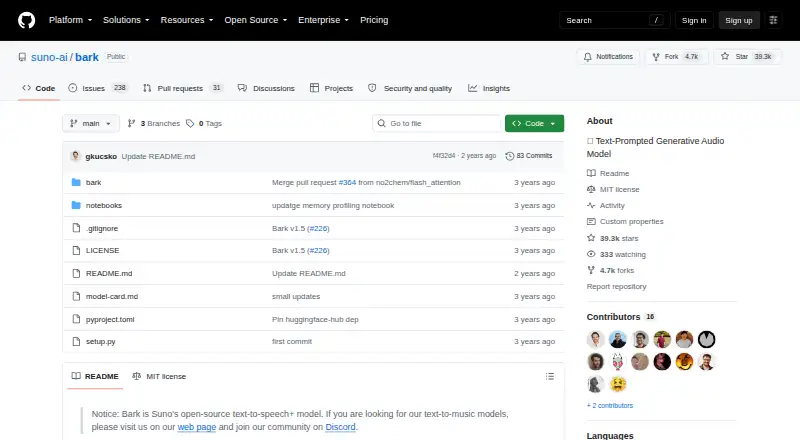
What Bark is
Bark is Suno’s open-source, transformer-based text-to-audio model. It can generate multilingual speech, music, background noise, sound effects, and nonverbal sounds such as laughter, sighs, and crying. It offers more than 100 speaker presets and can generate random voices, but does not support custom voice cloning. Bark supports 13 languages and exports WAV audio. The README says it works well with about 13 seconds of spoken text and describes typical outputs of roughly 13–14 seconds. The project documents Python and command-line installation and use, including through the Hugging Face Transformers library. It can run on CPU or GPU; the full version needs around 12 GB of GPU VRAM, while smaller models are described as fitting 8 GB. Bark is licensed under MIT, and its pretrained checkpoints are available for commercial use. Suno describes it as intended for research and demo purposes and warns that generated audio may depart unexpectedly from prompts. The project points users to Discord for discussion and shared prompts.
Good
- Generates speech, music, effects, and nonverbal sounds.
- Offers 100+ speaker presets and random voices.
- Supports 13 languages and WAV export.
- MIT-licensed, with pretrained checkpoints available for commercial use.
- Can run on CPU or GPU.
Watch out
- Custom voice cloning is not supported.
- Typical output is roughly 13–14 seconds.
- Full version needs around 12 GB of GPU VRAM.
- Generated audio may depart unexpectedly from prompts.
Who it suits
Bark suits developers and researchers who want an open-source model for generating speech, music, or other audio from text. Its short typical output length and lack of custom voice cloning are important constraints to consider.
Verdict
Bark covers several kinds of text-to-audio generation and offers an open-source route with commercial use permitted for its pretrained checkpoints. Its short typical output and prompt variability make the stated research and demo purpose worth keeping in mind.
The facts
Each one read from Bark's own pages, with the date it was checked.
What it does
- API access
- Yeschecked 20 Sep 2026
- Audio generation
- It can generate multilingual speech, music, background noise, sound effects, and nonverbal sounds such as laughter, sighs, and crying.checked 10 Oct 2026
- Commercial use
- Yeschecked 20 Sep 2026
- Export formats
- WAVchecked 20 Sep 2026
- Hardware
- Bark has been tested on CPU and GPU; the full version needs around 12 GB of GPU VRAM, while smaller models can fit in 8 GB.checked 10 Oct 2026
- Installation
- The README provides Python installation instructions using pip and GitHub, plus usage through the Hugging Face Transformers library.checked 9 Oct 2026
- Installation and use
- The project documents Python and command-line usage and installation from its GitHub repository.checked 10 Oct 2026
- Integration
- Bark is available through the Hugging Face Transformers library from version 4.31.0 onward.checked 10 Oct 2026
- Integrations
- The README documents use with Hugging Face Transformers and says Bark uses Hugging Face to download and store models.checked 9 Oct 2026
- Languages
- The README lists 13 supported languages and says English quality is best for the time being.checked 10 Oct 2026
- License
- The repository licenses Bark under MIT and says the pretrained checkpoints are available for commercial use.checked 10 Oct 2026
- Model downloads
- The FAQ says Bark uses Hugging Face to download and store models.checked 10 Oct 2026
- Product
- Bark is a transformer-based, fully generative text-to-audio model created by Suno.checked 9 Oct 2026
- Research status
- Suno says Bark was developed for research purposes and warns that generated audio can deviate unexpectedly from prompts.checked 9 Oct 2026
- Research use
- Suno says Bark was developed for research and demo purposes and may deviate unexpectedly from prompts.checked 10 Oct 2026
- Safety research
- The model card notes potential dual use and says the release includes a classifier intended to detect Bark-generated audio.checked 10 Oct 2026
- Support
- The project directs users to its Discord community for discussion and shared prompts.checked 9 Oct 2026
- Support and community
- The README points users to Discord for community support and shared prompts and presets.checked 10 Oct 2026
- Typical generation length
- The README says generation works well with about 13 seconds of spoken text and describes typical output as roughly 13–14 seconds.checked 10 Oct 2026
- Typical output length
- The README says generation works well with around 13 seconds of spoken text and describes outputs of roughly 13–14 seconds as an architectural limit.checked 9 Oct 2026
- Voice cloning
- Nochecked 20 Sep 2026
The company
- Founded
- 2022checked 28 Sep 2026
- Maker
- The model card identifies Suno.ai as the source of the official codebase.checked 10 Oct 2026
Where it runs
- Platforms
- api,self_hostedchecked 20 Sep 2026