
Bandcamp
Bandcamp is an online record store and music community that helps fans find artists, follow their work and support them directly.
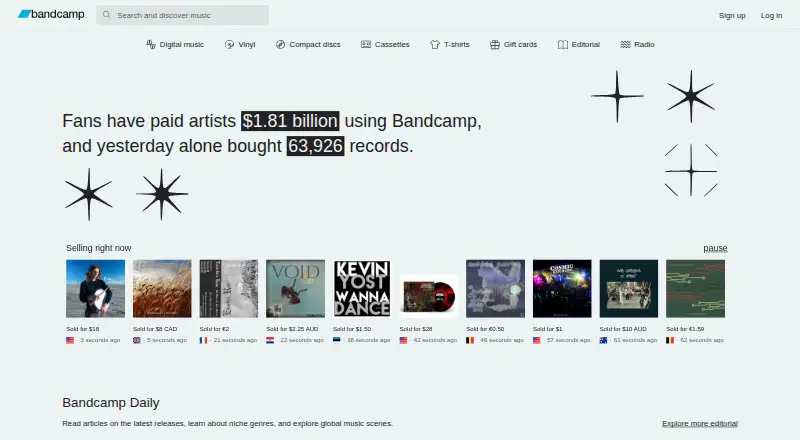
What Bandcamp is
Bandcamp is an online record store and music community that helps fans find artists, follow their work and support them directly. Artists can run customizable stores selling digital music and physical merchandise. Free fan accounts include playlists, a wishlist, artist follows, a music feed, a customizable collection page and high-quality downloads of purchases. The free iOS and Android apps let fans stream their purchases, create queues and playlists, and listen offline. Artists can also offer monthly or annual subscriptions, with options such as new releases, catalog items, subscriber-only music or merchandise, and community access. Bandcamp charges 15% on digital items and 10% on physical goods; the digital fee falls to 10% after $5,000 in sales if the artist also maintains at least $5,000 in sales over the prior 12 months. Bandcamp Pro adds features including Shopify inventory sync and Google Analytics integration. Playlists are in beta and have limits on sampling unowned tracks.
Good
- Free fan accounts include collections and high-quality downloads.
- Free mobile apps support offline listening.
- Artists can sell digital music and physical merchandise.
- Subscriptions can include music, merchandise and community access.
Watch out
- Bandcamp Playlists are still in beta.
- Unowned tracks have artist-set sampling limits.
- Pro for Artists costs $10 a month.
Who it suits
Bandcamp suits artists and labels looking for direct-to-fan sales, and fans who want to collect, follow and listen to artists’ music. Artists seeking subscriptions or Shopify inventory sync may also find its paid options relevant.
Verdict
Bandcamp combines artist storefronts and fan listening tools, with free accounts for fans and paid options for artists. Check the sales fees and playlist limits if those features matter to you.
Plans and prices
From Bandcamp's own pricing page, checked 29 Sep 2026.
| Plan | Price | What it gives you |
|---|---|---|
| Bandcamp Artist account | Free | Customizable direct-to-fan store · messaging and automatic fan notifications · listening parties and live streaming · Free |
| Pro for Artists | $10 a month | Batch uploads · ad-free video hosting · private streams via links · Shopify inventory integration · uploads up to 2 GB per track · $10 per month |
| Label Accounts | $20 a month | Includes Free and Pro features for the label account · free Bandcamp Pro account for each artist on the label · chart reporting · territory licensing · From $20 per month |
The facts
Each one read from Bandcamp's own pages, with the date it was checked.
What it does
- Artist sales
- Artists can run a customizable direct-to-fan store and sell digital music and physical merchandise.checked 29 Sep 2026
- Fan accounts
- Free fan accounts include playlists, a wishlist, artist following, a music feed, a customizable collection page, and access to high-quality downloads of purchases.checked 29 Sep 2026
- Google Analytics
- Bandcamp Pro lists Google Analytics integration as a feature.checked 29 Sep 2026
- Mobile listening
- The free Bandcamp apps for iOS and Android let fans stream their purchases, build queues and playlists, and listen offline.checked 29 Sep 2026
- Playlist limits
- Bandcamp Playlists are in beta, require listeners to be logged into a fan account, and limit sampling of unowned tracks to an artist-set number that is three plays by default.checked 29 Sep 2026
- Privacy
- Bandcamp publishes a privacy policy describing how it handles personal information and user data.checked 29 Sep 2026
- Revenue share
- Bandcamp takes 15% on digital items and 10% on physical goods, with the digital fee dropping to 10% after $5,000 in sales if the artist maintains at least $5,000 in sales over the past 12 months.checked 29 Sep 2026
- Service
- Bandcamp describes itself as an online record store and music community where fans discover, connect with, and directly support artists.checked 29 Sep 2026
- Shopify integration
- Bandcamp Pro offers Shopify inventory sync that automatically updates inventory levels across the two platforms.checked 29 Sep 2026
- Subscriptions
- Artists can set monthly or annual subscription prices and offer new releases, catalog items, subscriber-only music or merchandise, and access to a subscriber community.checked 29 Sep 2026
- Support
- Bandcamp directs artists, labels, and fans with site questions to its Help Center and says general support messages to the press email will not receive a response.checked 29 Sep 2026
- Third-party music clients
- Bandcamp’s Subsonic API beta supports streaming and downloading a fan’s collection through clients including Amperfy, Feishin, and Submariner.checked 29 Sep 2026
The company
- Founded
- Bandcamp says its business was founded in 2008.checked 29 Sep 2026
The full review of Bandcamp
Bandcamp is a music marketplace that pairs artist-run stores with tools for fans to collect and listen to music. It is best suited to artists and labels selling directly to an audience, and to listeners who want purchases and discovery tied to the artists they follow. Its strength is that joined-up artist-and-fan experience; its main trade-off is the sales share artists give up.
Overview
Artists can customize a store for digital music and physical merchandise, while fans can follow artists, keep a wishlist and collection, and get a music feed. Purchases are also available as high-quality downloads, and the mobile apps let fans stream their purchases. This makes Bandcamp a natural fit when an artist wants sales and fan engagement in one place, rather than a general-purpose storefront.
Bandcamp takes 15% on digital items and 10% on physical goods. The digital fee falls to 10% after $5,000 in sales only if the artist maintains at least $5,000 in sales over the past 12 months. That lower rate can help established sellers, but new or lower-volume artists should account for the 15% digital cut when pricing releases.
Key features
Artist stores and subscriptions
Artists can sell digital releases and physical merchandise through a customizable direct-to-fan store. Monthly or annual subscriptions can offer new releases, catalog items, subscriber-only music or merchandise, and access to a subscriber community. That range supports both one-off sales and recurring fan support, though artists still pay Bandcamp's applicable sales fee.
Fan listening and playlists
Free fan accounts include playlists, wishlists, artist following, a music feed and a customizable collection page. The free iOS and Android apps add queues, playlists, offline listening and streaming for purchases. Playlist sampling has a significant caveat: the beta requires a logged-in fan account and limits plays of unowned tracks to an artist-set number, three by default. Fans exploring unfamiliar music may hit that limit quickly.
Artist tools and integrations
Pro adds batch uploads, ad-free video hosting, private streams by link, Shopify inventory sync and uploads up to 2 GB per track. The inventory integration is useful to sellers managing stock across Bandcamp and Shopify; Google Analytics integration is also listed as a Pro feature. A beta Subsonic API lets fans stream and download their collection through clients including Amperfy, Feishin and Submariner.
Pricing
Bandcamp is freemium. The Artist account is free and includes a customizable store, messaging, automatic fan notifications, listening parties and live streaming. It is the sensible starting point for an artist who wants a direct sales presence without a monthly plan; the 15% digital and 10% physical sales fees still apply.
Pro for Artists costs $10 a month, billed $10 per month. It adds batch uploads, ad-free video hosting, private streams via links, Shopify inventory integration and uploads up to 2 GB per track. This is the better fit for artists who need those workflow or promotion tools; artists who do not need them can stay on the free Artist account.
Label Accounts start at $20 a month, billed From $20 per month. The plan includes Free and Pro features for the label account, a free Bandcamp Pro account for each artist on the label, chart reporting and territory licensing. It suits labels coordinating several artists and licensing territories, rather than a single artist who can use the free account or Pro.
Platforms
Bandcamp supports Android, iOS and web, with API access also available. Mobile apps focus on listening to purchases, including offline playback; the Subsonic API beta provides another route to a fan's collection through compatible third-party clients.
Who it's for
Bandcamp is a strong choice for independent artists and labels that want a customizable direct-to-fan shop alongside fan messaging, subscriptions and listening tools. Fans who buy music from artists they follow also get a collection, playlists and mobile access in one service. Sellers focused primarily on minimizing transaction fees or needing a broader commerce setup should compare alternatives before committing.
Pros and cons
- Pros: Artists can sell digital music and physical merchandise from a customizable store, with subscriptions for recurring offers.
- Pros: Free fan accounts combine purchases, artist follows, wishlists and a personal collection, while mobile apps support offline listening to purchases.
- Pros: Shopify inventory sync can keep stock aligned across two storefronts, and Pro includes batch uploads and larger track uploads.
- Cons: The 15% digital sales fee is substantial for lower-volume sellers, and the reduced 10% rate requires sustained sales of at least $5,000 over 12 months.
- Cons: Playlist sampling of unowned tracks is limited, with three plays by default, so it is less suited to unrestricted music discovery.
- Cons: Shopify sync and other Pro features require a paid monthly plan.
Alternatives
For a broader set of digital-product selling options, browse Digital Product Selling Platforms.
- Sellwire suits sellers who want a small web-based digital download shop: its free plan allows one file, while Solo at $9 a month supports up to 10 files with unlimited file versions and orders.
- SellApp is worth considering for API or web sales of varied products and resources; its free Standard plan includes unlimited resources and products, a custom domain and a store builder, with fees calculated per sale.
- Sellix is an option for sellers who want a free API- and web-based shop with no subscription, take-rate or expiry, and support for digital, physical, subscription and license products.
- Gumroad may fit creators selling through a profile or direct link, with direct sales priced at 10% + $0.50 per transaction; marketplace sales cost 30% per transaction.
- Payhip offers a free plan with unlimited products and revenue, making it a straightforward alternative for creators whose priority is a free storefront.
- Lemon Squeezy may suit web sellers who prefer no monthly ecommerce charge, with fees of 5% + $0.50 per transaction.
- Shoprocket is a paid alternative for sellers seeking unlimited products and staff/team members, starting with its Starter plan at $29 a month.
- 3DIMLI is another freemium option available on web, desktop and mobile platforms.
Verdict
Choose Bandcamp if you are an artist or label looking for a direct-to-fan music store that also gives buyers lasting listening and collection tools. The combination of sales, subscriptions and fan features is its clearest advantage; the sales share and playlist sampling cap are the reasons to look elsewhere if keeping more revenue or unrestricted discovery matters more.
Getting started
- Visit the Bandcamp website.
- Create a free Artist account to set up a customizable direct-to-fan store.
- Choose Pro for Artists for batch uploads, ad-free video hosting, private streams, Shopify inventory integration, or larger track uploads.
- Fans can create free accounts to build playlists, follow artists, and manage a collection.
- Use the free iOS or Android app to stream purchased music and listen offline.
Limits worth knowing
The free Artist account provides the customizable store, messaging and automatic fan notifications, listening parties, and live streaming. Pro costs $10 a month, and uploads are limited to 2 GB per track. Bandcamp's transaction fees are 15% on digital items and 10% on physical goods.
Questions
Is Bandcamp free?
Yes. The Artist account is free, and fan accounts are also free.
How much does Bandcamp Pro cost?
Pro for Artists costs $10 a month.
What does Bandcamp charge on sales?
Bandcamp takes 15% on digital items and 10% on physical goods. The digital fee falls to 10% after $5,000 in sales if the artist maintains at least $5,000 in sales over the past 12 months.
Can artists sell subscriptions?
Yes. Artists can set monthly or annual subscription prices and offer releases, catalog items, subscriber-only music or merchandise, and subscriber community access.
Which mobile platforms have Bandcamp apps?
Free Bandcamp apps are available for iOS and Android. They let fans stream purchases, build queues and playlists, and listen offline.
Does Bandcamp Pro integrate with Shopify?
Yes. Bandcamp Pro offers Shopify inventory sync that automatically updates inventory levels across the two platforms.
Alternatives to Bandcamp
- 1

Payhip
Free planAndroidiOSWebAPI8.1From $29 a month - 2

3DIMLI
Free planAndroidiOSWebAPI8.0From $250 a year - 3

Gumroad
Open sourceAndroidiOSWebAPI7.7$30 one-time - 4
FastSpring
Free planAndroidiOSWebAPI7.6Free plan - 5

Lemon Squeezy
WebAPI7.6$550 one-time - 6

Blink
WebAPI7.2$50.50 one-time