
Autonnel
Autonnel is an open-source, AI-native funnel builder for e-commerce that generates landing, checkout, and upsell pages from prompts.
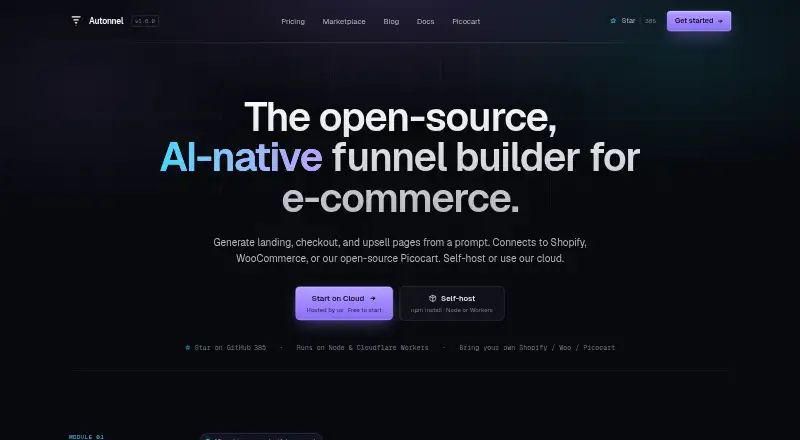
What Autonnel is
Autonnel is an open-source, AI-native funnel builder for e-commerce that generates landing, checkout, and upsell pages from prompts. Its canvas editor composes real components, with changes represented as diffable JSON. Funnel analytics show conversion and drop-off by step and include 17 built-in payment and form events that can be queried with DuckDB. A scheduled analysis agent sends funnel data through an LLM and can notify a team when performance changes. Commerce adapters include Shopify, WooCommerce, and the open-source Picocart; documentation also lists Stripe and PayPal payments and conversion postbacks for Facebook, TikTok, Bing, and Google. One-click post-purchase offers can charge a saved card without another checkout. Autonnel includes an MCP server, Claude skills, and an API using scoped Bearer keys. It can be self-hosted with Docker or Node.js, or deployed to Cloudflare Workers. Self-hosted is free; Managed costs $29 a month. Enterprise pricing is not listed.
Good
- Generates landing, checkout, and upsell pages from prompts.
- Includes funnel conversion and drop-off analytics.
- Supports self-hosting or Cloudflare Workers deployment.
- Self-hosted plan is free.
Watch out
- Self-hosting requires session and credential-encryption secrets.
- There is no open registration.
- Managed costs $29 a month.
- Enterprise pricing is not listed.
Who it suits
It suits e-commerce teams building and analyzing sales funnels, particularly those using the listed commerce adapters. The self-hosted plan is described for infrastructure-owning teams, hackers, and open-source maintainers.
Verdict
Autonnel offers a free self-hosted option alongside a managed plan and includes commerce adapters, analytics, and post-purchase offers. Choose it if its deployment options and integration list fit your funnel setup.
Plans and prices
From Autonnel's own pricing page, checked 30 Sep 2026.
| Plan | Price | What it gives you |
|---|---|---|
| Self-hosted | Free | Self-host on Node or Cloudflare Workers · bring your own LLM key · all adapters included · $0 forever |
| Managed | $29 a month | 0% of revenue · free to build and test; custom domain starts paid plan · marketplace templates and plugins included · $29 / mo flat |
| Enterprise | Priced on request | Dedicated resources · SSO/SAML · on-prem option · priority SLA · Contact us |
The facts
Each one read from Autonnel's own pages, with the date it was checked.
What it does
- AI/API
- The product includes an MCP server, Claude skills, and an API using scoped Bearer keys.checked 30 Sep 2026
- Analysis
- A scheduled analysis agent sends funnel data through an LLM and can notify a team when performance changes.checked 30 Sep 2026
- Analytics
- Funnel analytics include step-by-step conversion, drop-off, and 17 built-in payment and form events queried with DuckDB.checked 30 Sep 2026
- Commerce integrations
- The product lists Shopify, WooCommerce, and its open-source Picocart as commerce adapters.checked 30 Sep 2026
- Deployment
- Autonnel can be self-hosted with Docker or Node.js, or deployed to Cloudflare Workers.checked 30 Sep 2026
- Editing
- Its page builder composes real components on a canvas, with edits represented as diffable JSON.checked 30 Sep 2026
- Intended users
- The self-hosted plan is described for hackers, open-source maintainers, and teams that run their own infrastructure.checked 30 Sep 2026
- License
- Autonnel is licensed under Apache-2.0, which its About page says permits commercial, modified, and private use.checked 30 Sep 2026
- Payments and ads
- Documentation lists Stripe and PayPal payments and conversion postbacks for Facebook, TikTok, Bing, and Google.checked 30 Sep 2026
- Purpose
- Autonnel is an open-source, AI-native funnel builder for e-commerce that generates landing, checkout, and upsell pages from prompts.checked 30 Sep 2026
- Security and access
- Self-hosting documentation requires session and credential-encryption secrets outside development and says there is no open registration.checked 30 Sep 2026
- Support
- The Cloud plan includes email and Slack support; the self-hosted plan lists GitHub Issues and Discussions.checked 30 Sep 2026
- Upsells
- Autonnel supports one-click post-purchase offers charged to the saved card without a second checkout.checked 30 Sep 2026
The company
- Company
- The About page describes Autonnel as built by a small team but does not state a company name, headquarters, or founding date.checked 30 Sep 2026
The full review of Autonnel
Overview
Autonnel is an open-source funnel builder for e-commerce that uses AI to create landing, checkout, and upsell pages from prompts. Its visual builder works with real page components on a canvas, while edits are stored as diffable JSON. That combination gives the product both a visual editing surface and a structured representation of changes.
The platform brings page creation together with commerce adapters, payment options, conversion tracking, and funnel analytics. It can run as a managed service or on infrastructure you operate. Autonnel uses the Apache-2.0 license; its About page says that license permits commercial, modified, and private use. The About page describes a small team behind the product, but does not name a company or give a headquarters or founding date.
Autonnel belongs to the Sales Funnel Builders category. Its notable choices are an open-source codebase, self-hosting options, and a hosted plan for teams that prefer not to manage deployment.
Key features
- Prompt-based page generation: Prompts can generate landing, checkout, and upsell pages. The builder composes real components on a canvas, and edits are represented as diffable JSON.
- Commerce connections: Listed adapters include Shopify, WooCommerce, and the open-source Picocart.
- Payments and conversion tracking: Documentation lists Stripe and PayPal payments, along with conversion postbacks for Facebook, TikTok, Bing, and Google.
- Post-purchase offers: One-click upsells can charge a saved card without sending the customer through a second checkout. The product also lists order bumps.
- Funnel analytics: Analytics cover conversion and drop-off at each step. Seventeen built-in payment and form events can be queried with DuckDB.
- Performance analysis: A scheduled analysis agent sends funnel data through an LLM and can notify a team when performance changes.
- AI and developer interfaces: Autonnel includes an MCP server, Claude skills, and an API that uses scoped Bearer keys.
- Testing and automation: A/B testing and email automation are listed capabilities.
Pricing
Autonnel has a free self-hosted plan, a managed plan at $29/mo, and an enterprise option with no listed price. The free plan is billed $0 forever; the managed plan is billed $29 / mo flat, with 0% of revenue. Building and testing are free on the managed plan, while a custom domain starts with the paid plan.
| Plan | Price | What is listed |
|---|---|---|
| Self-hosted | free | Self-host on Node or Cloudflare Workers, bring your own LLM key, and use all adapters. |
| Managed | $29 a month | Flat monthly billing, 0% of revenue, free building and testing, and a custom domain starting with the paid plan. Marketplace templates and plugins are included. |
| Enterprise | Price not listed | Dedicated resources, SSO/SAML, an on-prem option, and priority SLA. Billing is listed as Contact us. |
The self-hosted plan is aimed at people willing to operate the software and provide their own LLM key. Managed pricing has a clear flat monthly fee, while enterprise cost requires contacting Autonnel.
Platforms
Autonnel is listed for API, Linux, self-hosted, and web use. Self-host deployment is available with Docker or Node.js, as well as on Cloudflare Workers. The documentation requires session and credential-encryption secrets outside development and says open registration is not available, so self-hosting entails attention to configuration and access control.
Who it's for
Autonnel may suit e-commerce teams that want to create and manage funnel pages alongside checkout, upsells, and conversion analysis. Its self-hosted plan is specifically described for hackers, open-source maintainers, and teams that run their own infrastructure. The managed plan is the alternative for users who want a hosted option; it includes email and Slack support. Self-hosted support is listed through GitHub Issues and Discussions.
The product's API, MCP server, Claude skills, and diffable JSON may also be relevant to teams building workflows around their funnel setup. However, the self-hosting route expects users to manage deployment and required secrets rather than offering open registration.
Pros and cons
Pros
- Open-source under Apache-2.0, with self-hosting on Node.js or Cloudflare Workers.
- Page generation, commerce adapters, payments, post-purchase upsells, and funnel analytics are brought together.
- The managed plan has flat monthly pricing and 0% of revenue.
- The product lists an API, MCP server, Claude skills, and scoped Bearer keys.
Cons
- Self-hosting requires infrastructure management and configuration of session and credential-encryption secrets.
- The free self-hosted plan requires users to bring their own LLM key.
- Enterprise pricing is not listed.
- There is no open registration, according to the self-hosting documentation.
Alternatives
Other options in this category include ConvertFlow, Systeme.io, FunnelKit, Fynlix, ClickFunnels, Launchtic, North Commerce, and OpenFunnels. Autonnel's defining distinction in this review is its open-source licensing and choice between self-hosted and managed deployment; compare the alternatives based on the workflow and hosting model you need.
Verdict
Autonnel combines prompt-led e-commerce page creation with checkout, integrations, post-purchase offers, and step-level funnel analytics. Its Apache-2.0 license and self-hosting options make it a relevant candidate for technically capable teams that want to operate their own funnel software, while the managed plan offers a $29 / mo hosted starting point. The main decision is whether the available features justify taking on self-hosting requirements or paying for managed hosting; teams that need enterprise services will need to ask for pricing.
Getting started
- Visit autonnel.com.
- Choose the free Self-hosted plan or the Managed plan at $29 a month.
- For Self-hosted, deploy with Docker or Node.js, or use Cloudflare Workers.
- For Self-hosting, configure session and credential-encryption secrets outside development.
- Bring your own LLM key for the Self-hosted plan.
- Connect a listed commerce adapter such as Shopify, WooCommerce, or Picocart.
Limits worth knowing
The free Self-hosted plan requires your own LLM key and infrastructure. The Managed plan costs $29 a month; its custom domain starts with a paid plan.
Questions
Is Autonnel free?
Yes. The Self-hosted plan is free forever and includes all adapters; you provide your own LLM key.
How much does Managed cost?
Managed costs $29 a month as a flat fee, with 0% of revenue.
What does the Managed plan include?
It includes marketplace templates and plugins, and building and testing are free. A custom domain starts with a paid plan.
Can I self-host Autonnel?
Yes. It can be self-hosted with Docker or Node.js, or deployed to Cloudflare Workers.
Which commerce and payment services are listed?
Commerce adapters include Shopify, WooCommerce, and Picocart. Documentation lists Stripe and PayPal payments.
What license does Autonnel use?
It uses the Apache-2.0 license, which its About page says permits commercial, modified, and private use.
Alternatives to Autonnel
- 1

ClickFunnels
AndroidiOSWebAPI7.7From $97 a month - 2

ConvertFlow
Free planWebAPI7.6From $29 a month - 3

Systeme.io
Free planWebAPI7.5From $17 a month - 4
Influx OS
Free planWebSelf-hosted7.3From $79 a month - 5
CheckoutChamp
AndroidiOSWebAPI7.1From $300 a month - 6

PayKickstart
AndroidiOSWebAPI7.1From $99 a month