Audify
Audify is free, open-source software for turning PDF, DOC, and DOCX files into editable two-speaker podcast scripts and downloadable MP3 episodes.
What Audify is
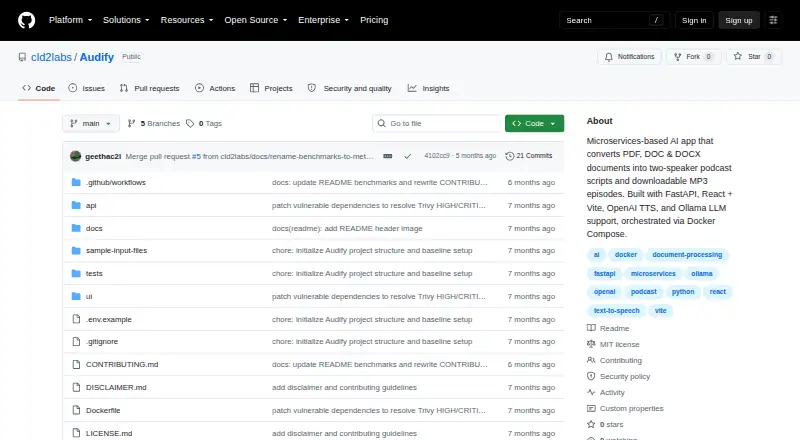
Audify is free, open-source software for turning PDF, DOC, and DOCX files into editable two-speaker podcast scripts and downloadable MP3 episodes. It extracts document text and can use OCR when a scanned PDF contains little detectable text. After script generation, you can revise speaker turns, wording, and flow, then choose host and guest voices from available text-to-speech options. Script generation uses Ollama as the primary path and OpenAI as a fallback, with conversational, educational, and professional tone choices. The TTS service creates speech for each dialogue turn, combines the segments into an MP3, and supports playback and download. Audify is a FastAPI microservices application with a React and Vite frontend, intended for local Docker Compose deployment. Its API covers uploads, script and audio generation, job status, and MP3 downloads. Docker Engine 24.x or later and Docker Compose Plugin v2 or later are required. Uploads are limited to 10 MB, and jobs reset after container restarts unless persistent storage is added. The project uses the MIT license and warns that scripts, OCR output, dialogue, and audio should be reviewed for accuracy and tone.
Good
- Imports PDF, DOC, and DOCX files
- OCR fallback for scanned PDFs
- Editable dialogue before audio generation
- Exports downloadable MP3 episodes
- Offers host and guest voice choices
Watch out
- Uploads are limited to 10 MB
- OpenAI API key required for TTS
- Jobs reset when containers restart
- Maker says production-grade security is absent
Who it suits
Audify suits people who want to turn office documents into editable, two-speaker audio episodes. It is aimed at web, API, or self-hosted deployments where Docker and the required AI services are available.
Verdict
Audify combines document extraction, editable dialogue, voice selection, and MP3 creation in one self-hosted workflow. Review requirements, upload limits, in-memory jobs, and security guidance before using it for important material.
The facts
Each one read from Audify's own pages, with the date it was checked.
What it does
- Accuracy guidance
- The project advises users to review scripts, validate OCR output for scanned documents, and check generated audio and dialogue for factual accuracy and tone.checked 4 Oct 2026
- API
- The gateway exposes endpoints for document upload, script and audio generation, job status, and MP3 download.checked 8 Oct 2026
- Audio features
- The TTS service creates speech for each dialogue turn, mixes the segments into MP3, and provides voice options, status tracking, and downloadable audio.checked 8 Oct 2026
- Audio generation
- The TTS service generates speech for dialogue turns, combines them into an MP3 podcast, and provides playback and download.checked 4 Oct 2026
- Data handling
- The README says gateway and TTS job metadata use in-memory stores and jobs reset when containers restart unless persistent storage is added.checked 8 Oct 2026
- Deployment
- The project is a FastAPI and React application orchestrated with Docker Compose, with setup instructions for running the stack locally.checked 8 Oct 2026
- Document extraction
- It extracts text from PDF, DOC, and DOCX files and can use OCR for scanned PDFs when little text is detected.checked 8 Oct 2026
- Document processing
- It extracts text from PDF, DOC, and DOCX files and uses OCR as a fallback for scanned PDFs with little detected text.checked 4 Oct 2026
- Generation limit
- The TTS service's documented MAX_SCRIPT_LENGTH default is 100 dialogue turns.checked 8 Oct 2026
- Integrations
- The documented external providers are Ollama for local model inference and OpenAI for TTS and optional LLM fallback.checked 8 Oct 2026
- Intended use
- The project is described as an AI-assisted document-to-audio generator, and its disclaimer advises reviewing scripts and audio and checking OCR output.checked 8 Oct 2026
- Job persistence
- Gateway and TTS job stores are in memory, so jobs reset when containers restart unless persistent storage is added.checked 4 Oct 2026
- License
- The repository is licensed under the MIT License.checked 8 Oct 2026
- Processing limit
- The TTS service configuration accepts up to 100 dialogue turns and allows up to five concurrent requests.checked 4 Oct 2026
- Purpose
- Audify converts PDF, DOC, and DOCX documents into editable two-speaker podcast scripts and downloadable MP3 audio.checked 8 Oct 2026
- Requirements
- The setup instructions require Docker Engine 24.x or later and Docker Compose Plugin v2 or later; an OpenAI API key is required for TTS, while Ollama is optional.checked 4 Oct 2026
- Script editing
- Users can review the generated dialogue and edit speaker turns, wording, and flow before audio generation.checked 4 Oct 2026
- Script generation
- Audify uses Ollama as the primary script-generation path and OpenAI as a fallback, with conversational, educational, and professional tone options.checked 8 Oct 2026
- Security
- The maker says Audify lacks production-grade security controls and requires a security review before production use.checked 8 Oct 2026
- Upload limit
- The README sets MAX_FILE_SIZE to 10,485,760 bytes and recommends keeping uploads under 10 MB.checked 8 Oct 2026
- Voice selection
- The interface lets users choose host and guest voices from available text-to-speech options.checked 4 Oct 2026
- Workflow
- Users upload a document, review and edit the generated dialogue, choose voices, then play or download the finished episode.checked 8 Oct 2026