
Assembly
Assembly combines an AI app builder, CRM, and branded client experience for creating client-facing apps and internal tools.
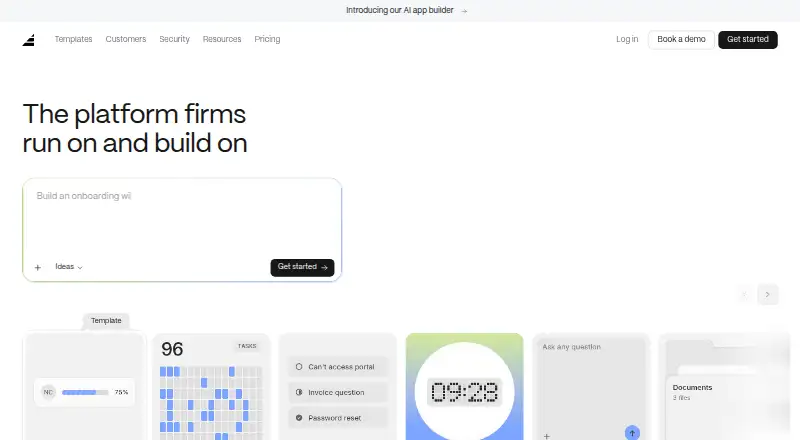
What Assembly is
Assembly combines an AI app builder, CRM, and branded client experience for creating client-facing apps and internal tools. To build an app, users describe it in plain language, review a proposed plan, publish the result, and refine it through conversation. More than 30 templates cover workflows such as document collection, project tracking, proposals, and client support. Apps can connect to third-party services by authenticating a tool or entering an API key during setup. Assembly’s MCP connector can link the workspace to AI tools including ChatGPT and Claude for analysis and workspace actions. Each workspace includes a branded client experience, with published apps grouped in its sidebar. Assembly handles client authentication, roles, permissions, and client data scoping through its platform rather than generating those controls with AI. The company says its platform is SOC 2 Type II certified and offers HIPAA support with a BAA on Advanced; its AI features are not covered by that support. It says data is stored in the United States, encrypted in transit with TLS and at rest with AES-256, and not used to train AI models. Assembly is designed for authenticated experiences, not public-facing websites, directories, or consumer apps. It offers web access and desktop apps for macOS and Windows.
Good
- Build apps by describing them in plain language and refining through conversation.
- More than 30 templates cover common client workflows.
- Apps can connect to third-party services using authentication or API keys.
- The platform handles client authentication, roles, permissions, and data scoping.
- The company says customer data is not used to train AI models.
Watch out
- The free plan allows five active contacts and one internal user.
- Starter's listed annual price is $29 per month; monthly billing is $49.
- HIPAA support with a BAA is only on Advanced, and excludes AI features.
- The product is not suited to public-facing websites or consumer apps.
Who it suits
Assembly suits teams building authenticated client-facing apps or internal tools, particularly those that want templates, connected services, and an integrated client experience. It is not suited to teams building public websites, public directories, or consumer apps.
Verdict
Choose Assembly if you need to build authenticated apps for clients or internal teams and want client experience and access controls handled by the platform. Look elsewhere for public-facing websites, directories, or consumer apps; teams requiring HIPAA support with a BAA need Advanced, and AI features are excluded from that support.
Plans and prices
From Assembly's own pricing page, checked 15 Oct 2026.
| Plan | Price | What it gives you |
|---|---|---|
| Free | Free | 5 active contacts · 1 internal user · 50 build credits/month · CRM · client experience · app builder · 30+ pre-made apps · messaging · billing/payments · community support · Free forever |
| Starter | $29 a month | 50 active contacts · 1 internal user · 200 build credits/month · API & MCP connector · add-on credits · email support · Billed annually; $49/month billed monthly |
| Professional | $99 a month | 500 active contacts · 3 internal users · 200 build credits/month · custom domains · remove Assembly badge · app visibility · automation builder · AI model selection · priority email support · Billed annually |
| Advanced | $499 a month | Unlimited active contacts · 5 internal users · 200 build credits/month · audit log · client access permissions · enforced MFA · HIPAA compliance with BAA · priority email and phone support · personalized onboarding · Billed annually |
| Enterprise | Priced on request | Unlimited users, contacts and apps · custom SSO · volume-based build credits · dedicated architect and success manager · Contact sales |
The facts
Each one read from Assembly's own pages, with the date it was checked.
What it does
- Accounting integration
- The QuickBooks integration syncs Assembly invoices, customers, changes and payments one way into QuickBooks Online.checked 15 Oct 2026
- AI data use
- Assembly says it does not use workspace or client data to train AI models.checked 7 Oct 2026
- AI integrations
- Assembly’s MCP connector can connect the workspace to AI tools including ChatGPT and Claude for analysis and workspace actions.checked 7 Oct 2026
- Builder limits
- The builder does not create public websites, native mobile or desktop apps, streaming experiences or heavy-compute workloads.checked 15 Oct 2026
- Builder scope
- Generated apps can be client-facing or internal, use Assembly CRM/auth/notifications/branding, keep their own database and call external APIs.checked 15 Oct 2026
- Built-in client experience
- Workspaces include a branded client experience, and published apps appear together in its sidebar.checked 7 Oct 2026
- Client portal
- The portal centralizes client messaging, file sharing, e-signature contracts, invoices, forms and tasks under the firm's branding.checked 15 Oct 2026
- Compliance
- Assembly says its platform is SOC 2 Type II certified and offers HIPAA support with a BAA on the Advanced plan; AI features are not covered by HIPAA support.checked 7 Oct 2026
- Connected services
- Apps can connect to third-party services by authenticating the tool or providing an API key during setup.checked 7 Oct 2026
- Contracts
- The platform includes professional agreements with built-in electronic signatures.checked 15 Oct 2026
- CRM
- Contacts and companies are maintained in one CRM with client context available across apps.checked 15 Oct 2026
- Data protection
- Assembly says customer data is encrypted in transit with TLS and at rest with AES-256, and workspace data is not used to train AI models.checked 15 Oct 2026
- Developer extensibility
- Custom apps can be embedded for internal users or clients and can use Assembly's REST API plus webhook URLs.checked 15 Oct 2026
- Developer requirements
- The public custom-app starter expects modern web development with Node.js 22 or newer, React, Next.js and Yarn or another package manager.checked 15 Oct 2026
- Documentation
- The documentation includes getting-started guides, built-in app references, custom-app building, API reference, MCP and support sections.checked 15 Oct 2026
- Funding
- Assembly announced a $10 million Series A in January 2023 led by YC Continuity and Lachy Groom; TechCrunch reported $13 million raised to date.checked 15 Oct 2026
- How it builds
- Users describe an app in plain language, review a proposed plan, publish it, and refine it through conversation.checked 7 Oct 2026
- Integrations
- Assembly supports embedded third-party tools and connects to more than 1,000 apps through Zapier, Make and similar no-code services.checked 15 Oct 2026
Where it runs
- AI app builder
- Users describe an app in plain English, answer a short question flow, approve a plan and receive a deployed app in their workspace.checked 15 Oct 2026
- App templates
- Assembly offers 30+ app templates covering workflows such as document collection, project tracking, proposals, and client support.checked 7 Oct 2026
- Desktop app
- Assembly offers a desktop app for macOS on Apple silicon and Intel, and Windows 10 or later 64-bit; the site also links to its web app.checked 7 Oct 2026
Money
- Billing
- Payments support invoices, subscriptions, payment links, stores and credit-card or ACH collection.checked 15 Oct 2026
The company
- Company size
- LinkedIn lists Assembly as a privately held software-development company with 11–50 employees.checked 15 Oct 2026
- Founded and headquarters
- LinkedIn lists Assembly as founded in 2020 and headquartered in New York, New York.checked 15 Oct 2026
The full review of Assembly
Assembly is an AI app builder for organizations that need authenticated client workflows or internal tools, with a branded workspace around the apps they publish. It is most compelling when client access and permissions matter as much as building the workflow; it is the wrong fit for public websites or consumer products.
Overview
Users describe an app in plain language, review a proposed plan, publish it, and refine it through conversation. More than 30 templates cover tasks such as collecting documents, tracking projects, preparing proposals, and supporting clients, offering useful starting points for common business workflows.
Published apps sit together in a branded client experience. Connections to third-party services can be made by authenticating the service or providing an API key during setup. Assembly’s MCP connector can also connect the workspace to AI tools such as ChatGPT and Claude for analysis and workspace actions.
A meaningful distinction is that Assembly handles client authentication, roles, permissions, and client data scoping at the platform level rather than leaving those controls to generated apps. Assembly says its platform is SOC 2 Type II certified, stores customer data in the United States, encrypts it in transit with TLS and at rest with AES-256, and does not use workspace or client data to train AI models. HIPAA support with a BAA is reserved for Advanced, and AI features are excluded from that support.
Assembly is designed for authenticated experiences, not public-facing websites, directories, or consumer apps. Teams building a public product should choose a different kind of builder.
Key features
- Prompt-based app creation: Describe a workflow, review Assembly’s proposed plan, and refine the published app through conversation. This makes iteration part of the product, though the stated build-credit allowances still constrain how much teams can build each month.
- Templates and integrations: More than 30 templates address common client and operational workflows. Third-party connections use authentication or an API key, while the MCP connector extends workspace analysis and actions to ChatGPT and Claude.
- Branded client workspace: Published apps appear together in a branded experience, which suits organizations that want clients to enter through one consistent place rather than separate standalone tools.
- Platform-managed access: Assembly manages authentication, roles, permissions, and client data scoping. That is a practical advantage for teams serving multiple clients, because access control is not left to AI-generated app logic.
- Security and compliance: Assembly says the platform is SOC 2 Type II certified and uses TLS in transit and AES-256 at rest. Advanced includes HIPAA support with a BAA, but that support does not extend to AI features.
Pricing
Assembly is freemium. Free is free, forever, and includes 5 active contacts, 1 internal user, 50 build credits per month, 3 apps, and community support. It is a sensible way for one person to explore a small workflow, but the five-contact and three-app ceilings make it difficult to serve a growing client base.
Starter costs $29 a month billed annually, or $49 billed monthly. It raises the allowance to 50 active contacts and 5 apps, with 1 internal user, 200 build credits per month, and email support. This is the entry paid tier for a small practice that needs more contacts and support; it still provides no additional internal-user capacity over Free.
Professional costs $99 a month billed annually. It supports 500 active contacts and 3 internal users, with 200 build credits per month, 5 apps, custom domains, and priority email support. The higher contact limit and domain option suit client-facing teams that need a more established presentation, though the build-credit and app caps remain the same as Starter.
Advanced costs $499 a month billed annually. It includes unlimited active contacts, 5 internal users, 200 build credits per month, 5 apps, an audit log, enforced MFA, HIPAA compliance with a BAA, and priority call support. This is the relevant tier for teams that need the stated HIPAA support or stronger administrative controls; it is a substantial jump in price without an increase in build credits or app count.
Enterprise has custom pricing and is arranged through a demo. It includes unlimited users, contacts, and apps, custom SSO, volume-based build credits, and a dedicated architect and success manager, making it the tier for organizations that need capacity and deployment support beyond Advanced. Paid plans are billed annually at the stated monthly rates unless choosing Starter’s $49 billed monthly option.
Platforms
Assembly is available on the web and as a desktop app for macOS on Apple silicon or Intel and Windows 10 or later (64-bit). The desktop options cover the major desktop systems, while the web app provides browser access.
Who it's for
Assembly suits service businesses and internal teams building authenticated client portals, intake flows, document collection, project tracking, or support tools. Request intake, work tracking, file sharing, custom domains, and single sign-on are among its supported capabilities. The plan limits matter for teams: the Free plan has one internal user and five active contacts, while even Professional is capped at three internal users and five apps. Larger organizations may need Enterprise for unlimited users and apps.
It is not the right choice for public-facing sites, public directories, or consumer apps. Teams with HIPAA requirements should also distinguish between Advanced’s BAA support and AI features, which are not covered.
Pros and cons
- Pro: Assembly handles authentication, roles, permissions, and client data scoping at the platform level, reducing the need to rely on generated app logic for these core client controls.
- Pro: A branded workspace, 30+ templates, third-party connections, and an MCP connector bring app building and client access into one workflow.
- Pro: The free plan provides 3 apps and 50 monthly build credits, enough to start with a limited workflow without paying.
- Con: Lower tiers cap contacts and internal users tightly: Free allows 5 active contacts and 1 internal user, and Starter still permits only 1 internal user.
- Con: Paid plans through Advanced remain limited to 5 apps and 200 build credits per month, even as contact allowances and support increase.
- Con: Advanced’s HIPAA support excludes AI features, so teams cannot treat the BAA as covering the entire product experience.
- Con: Its authenticated-app focus rules out public websites, directories, and consumer apps.
Alternatives
For legal practices weighing a client portal against dedicated legal software, the right alternative depends on the workflow. 8am MyCase is a better fit for case and contact management, time entry, invoicing, and trust accounting; its MyCase Basic plan is $50 a month billed annually, and it has iOS and macOS apps.
LawConnect is the more suitable choice for consumers seeking free AI legal information, with lawyer fees potentially applying if they hire. For broader matter management, document management, billing, and payments, Filevine offers custom-built packages with optional intake, deposition, signature, and AI packages.
Jursu is another freemium option. SimpleLaw Document Automation is worth considering for document automation, with a free Law Firm plan for connecting with potential leads and a $59 a month annual-pricing tier for up to 39 users.
If the priority is launching a website rather than an authenticated client workspace, B12 is the more relevant alternative: its Website plan is $24 a month and includes 100 AI credits per month, up to 10 launched projects, and a free custom domain for the first year. Lawcus and Visn Enterprise are additional alternatives to consider.
Readers comparing portal products can also browse Legal Client Portal Software and Customer Portal Software.
Verdict
Choose Assembly for authenticated client apps and internal tools when a branded client experience and platform-managed access controls are central to the job. Its template-led, conversational building approach is paired with meaningful security controls, but low-tier user and contact caps, fixed app and credit allowances, and its exclusion of public products narrow the fit. Teams needing HIPAA support must choose Advanced and keep in mind that its BAA does not cover AI features.
Getting started
- Visit https://assembly.com/ and choose a plan.
- Start on Free or select a paid plan; Starter is $29 per month billed annually or $49 billed monthly.
- Open Assembly on the web or install the desktop app for macOS or Windows.
- Describe the app in plain language, review the proposed plan, and publish it.
- Authenticate a connected service or provide its API key during setup, if needed.
- Connect the workspace to ChatGPT or Claude through Assembly’s MCP connector, if desired.
Limits worth knowing
Free includes five active contacts, one internal user, 50 build credits per month, and three apps. Starter includes 50 active contacts, one internal user, 200 build credits per month, and five apps; HIPAA support with a BAA is on Advanced, and does not cover AI features.
Questions
Is Assembly free?
Yes. Free is billed free forever and includes five active contacts, one internal user, 50 build credits per month, and three apps.
What do paid plans cost?
Starter is $29 per month billed annually, or $49 billed monthly. Professional is $99 per month and Advanced is $499 per month, both billed annually.
Which platforms does Assembly support?
Assembly links to its web app and offers desktop apps for macOS on Apple silicon and Intel, and Windows 10 or later 64-bit.
Can Assembly build public websites or consumer apps?
No. Assembly says it is not suited to public-facing websites, public directories, or consumer apps because it builds authenticated experiences.
Does Assembly offer HIPAA support?
Advanced includes HIPAA compliance with a BAA. AI features are not covered by HIPAA support.
What AI tools can connect to Assembly?
Its MCP connector can connect the workspace to tools including ChatGPT and Claude for analysis and workspace actions.
Alternatives to Assembly
- 1
SimpleLaw Document Automation
Free planAndroidiOSWeb8.0From $39 a year - 2

8am MyCase
Free planiOSmacOS7.8From $39 a month - 3

CosmoLex
AndroidiOSWeb7.8From $49 a month - 4

CARET Legal
AndroidiOSWebAPI7.7From $79 a month - 5
Clio Manage
AndroidiOSWebAPI7.7 - 6
Rocket Matter
AndroidiOSWebAPI7.7From $39 a month