Aria
Aria is a native SIP softphone for connecting to standards-compliant SIP servers.
What Aria is
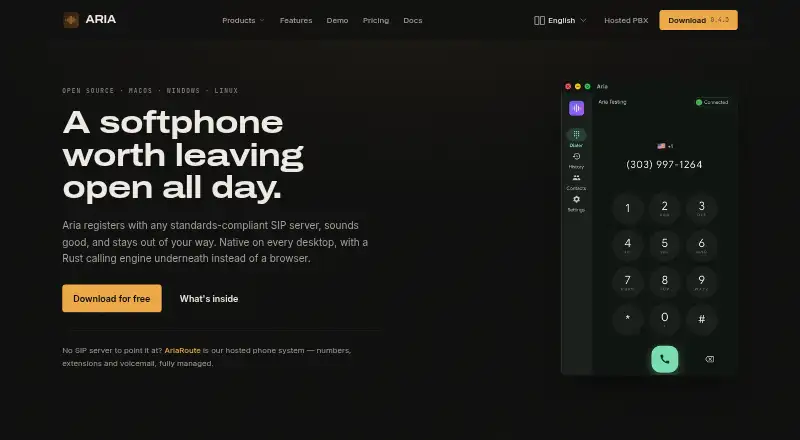
Aria is a native SIP softphone for connecting to standards-compliant SIP servers. It handles inbound and outbound calls, mute, hold, transfers, DTMF, presence, contacts, and call history. Audio support includes Opus up to 48 kHz, G.711, an adaptive jitter buffer, and local WAV recording. The maker names Asterisk, FreeSWITCH, and 3CX as compatible server examples; Aria also works with its AriaRoute hosted PBX. Desktop downloads are available for macOS, Windows, and Linux, with signed installers and in-app updates. The maker says its iOS and Android apps are still in testing and have no releases yet. The mobile apps require a self-hosted push gateway to receive incoming calls in the background. An opt-in build feature can transcribe and summarise calls locally, but is not part of the default download. The privacy policy says the app has no telemetry or analytics and stores credentials, call history, contacts, and recordings locally. The free tier is for personal and other non-commercial use; business use requires a separate commercial licence.
Good
- Supports inbound and outbound SIP calls.
- Works with Asterisk, FreeSWITCH, and 3CX examples.
- Desktop downloads for macOS, Windows, and Linux.
- Supports local WAV call recording.
- Privacy policy says there is no telemetry or analytics.
Watch out
- Business use requires a separate commercial licence.
- iOS and Android apps have no releases yet.
- Background mobile incoming calls require a self-hosted push gateway.
- Local transcription is not included in the default download.
Who it suits
Aria suits people who need a desktop softphone with a compatible SIP server and whose use is personal or non-commercial. Businesses need a separate commercial licence, and mobile users should note the apps have not been released.
Verdict
Aria provides a broad set of softphone functions and desktop builds, with a free licence limited to non-commercial use. Its unreleased mobile apps and separate business licensing are important constraints to weigh first.
Plans and prices
From Aria's own pricing page, checked 7 Oct 2026.
| Plan | Price | What it gives you |
|---|---|---|
| Free | Free | Personal and non-commercial use · Unlimited calls · Multi-account · Core softphone features · $0 forever |
| Commercial | Priced on request | Business use licence · Priority email support · Custom branding and white-label options · Custom development · Dedicated account manager · SLA guarantees · Contact Us custom pricing |
The facts
Each one read from Aria's own pages, with the date it was checked.
What it does
- Audio
- Aria supports Opus audio up to 48 kHz, G.711, an adaptive jitter buffer and local WAV recording.checked 7 Oct 2026
- Calling
- It supports inbound and outbound calls, mute, hold, transfers, DTMF, presence, contacts and call history.checked 7 Oct 2026
- Hosted option
- Aria works with the maker's AriaRoute hosted PBX, which offers numbers, extensions, auto-attendant, ring groups, voicemail and call recording.checked 7 Oct 2026
- Licensing
- The maker says Aria is free for personal and other non-commercial purposes and that business use requires a separate commercial licence.checked 7 Oct 2026
- Local transcription
- An opt-in build feature can transcribe and summarise calls locally, and is not included in the default download.checked 7 Oct 2026
- Mobile availability
- The maker says the iOS and Android apps are in testing and have no releases yet.checked 7 Oct 2026
- Mobile integrations
- The mobile apps are described as integrating with iOS CallKit and PushKit and Android ConnectionService and FCM.checked 7 Oct 2026
- Mobile limitation
- The push gateway is required for mobile apps to receive incoming calls while in the background.checked 7 Oct 2026
- Privacy
- The privacy policy says the app has no telemetry or analytics, does not phone home, and stores account credentials, call history, contacts and recordings locally.checked 7 Oct 2026
- Product
- Aria is a native SIP softphone that registers with standards-compliant SIP servers.checked 7 Oct 2026
- Push gateway
- The self-hosted push gateway uses APNs and FCM, stores data in SQLite and provides a REST API for device registration and call signalling.checked 7 Oct 2026
- Security
- SIP signalling can use TLS and media can use SRTP with AES-128-CM and HMAC-SHA1-80; the maker says this is transport encryption, not end-to-end encryption.checked 7 Oct 2026
- SIP compatibility
- The maker names Asterisk, FreeSWITCH and 3CX as examples of compatible SIP servers.checked 7 Oct 2026
- Support
- The free tier includes community support; the commercial tier lists priority email support.checked 7 Oct 2026
Where it runs
- Desktop platforms
- Desktop downloads are available for macOS, Windows and Linux, with signed installers and in-app updates.checked 7 Oct 2026
The full review of Aria
Aria is a native SIP softphone for people who already use a standards-compliant SIP service or server. It is strongest as a private, multi-account desktop client for personal and other non-commercial calling, while organisations and mobile-first users face important qualifications. The free licence is unusually broad for individual use, but the absence of released mobile apps and the separate business licence materially shape the buying decision.
Overview
Aria connects directly to SIP infrastructure rather than providing browser calling or requiring a bundled telephone service. It names Asterisk, FreeSWITCH and 3CX among compatible servers, so it is a sensible front end for an existing self-hosted or hosted deployment. It also works with the maker's AriaRoute hosted PBX, which adds numbers, extensions, an auto-attendant, ring groups, voicemail and call recording.
There is no browser calling, and the iOS and Android applications remain in testing without released builds. That makes Aria a desktop-led choice today, not a complete cross-device replacement for a mature mobile softphone.
Key features
The calling set covers inbound and outbound calls, mute, hold, transfer, DTMF, presence, contacts and call history. Multiple accounts are supported, and the free plan allows unlimited calls, which is useful for someone maintaining several personal SIP identities without monitoring a usage quota.
Voice options include Opus at up to 48 kHz, G.711 and an adaptive jitter buffer. Those standards give Aria room to work across different SIP environments, while local WAV recording keeps recordings on the device. Recording still carries consent and regulatory responsibilities for the caller. An opt-in build feature can transcribe and summarise calls locally, but it is not part of the default download, so it should not be treated as a standard installation feature.
SIP signalling can use TLS and media can use SRTP with AES-128-CM and HMAC-SHA1-80. This protects transport rather than providing end-to-end encryption, a meaningful limitation for conversations requiring confidentiality beyond the normal SIP path. The privacy policy says Aria has no telemetry or analytics and does not phone home; credentials, contacts, call history and recordings are stored locally. That is a strong fit for users who want to minimise cloud processing, provided they can secure the device and its local files.
Desktop installers for macOS, Windows and Linux are signed and support in-app updates. The planned mobile integrations target iOS CallKit and PushKit, plus Android ConnectionService and FCM. Until those apps ship, the self-hosted push gateway is relevant only to a future mobile deployment: it uses APNs and FCM, stores data in SQLite and exposes a REST API for device registration and call signalling, and is required for background incoming calls on mobile.
Pricing
Free
The Free plan costs nothing, billed at $0 forever. It includes personal and non-commercial use, unlimited calls, multi-account support and the core softphone features, with community support. This is a generous fit for individual SIP users and hobbyist self-hosters. It cannot be used for business activity, and there is no free trial because the plan itself is permanently free.
Commercial
The Commercial plan uses custom pricing: billed as “Contact Us”. It grants a business-use licence, priority email support, custom branding and white-label options, custom development, a dedicated account manager and SLA guarantees. Companies that need contractual support or a branded client should consider it; organisations seeking a published, predictable per-seat cost cannot budget from the stated terms alone.
Platforms
Aria has desktop applications for Windows, macOS and Linux, plus self-hosted and API components. Android and iOS are described as testing builds rather than released apps. There is no web client, so desktop installation or an existing SIP integration is required.
Who it's for
Choose Aria if you run Asterisk, FreeSWITCH, 3CX, AriaRoute or another standards-compliant SIP service and want unlimited, multi-account desktop calling without a subscription for non-commercial use. Its local storage and no-telemetry policy also suit privacy-conscious individuals. Look elsewhere if your work is commercial and you need a licence immediately, if browser access is essential, or if staff require a released mobile app with background calling today.
Pros and cons
- Pros: The free plan permits unlimited calls and multiple accounts, removing common personal-use caps.
- Pros: TLS, SRTP options, local recordings and local account data support a privacy-conscious desktop setup.
- Pros: Signed installers and in-app updates cover all three major desktop operating systems.
- Cons: Business use requires a separate commercial licence, and commercial pricing is custom rather than published.
- Cons: iOS and Android releases are not yet available, while background mobile calling would require the push gateway.
- Cons: Transport encryption is not end-to-end encryption, and local transcription requires a special build.
Alternatives
Browse Softphone Software for the wider category. Pick Blink instead if you need released Android, iOS or web availability alongside desktop downloads; its free desktop build requires a SIP account. Linphone is the better choice when open-source licensing under GNU GPLv3 or web support matters. Siperb Mobile Softphone suits users wanting a personal tier with mobile and web platforms, accepting limited storage and seven-day logs. Choose SipPulse Softphone for a free app offering iOS, Android, Windows and Linux with unlimited users and installations. Zoiper is an alternative for a non-commercial free desktop client limited to one account and two lines. Bria Solo fits users who want a free trial and a paid cross-platform plan, though its free tier limits devices, accounts and weekly calls. AGEphone is another personal-use option with separate cloud or business requirements for commercial use. MicroSIP is preferable when you specifically want a GPL v2 Windows desktop client or a one-time custom-branded build.
Verdict
Aria is a strong recommendation for personal SIP users who value unlimited calls, multiple accounts and local data on a signed Windows, macOS or Linux client. Its main reason to choose it is the capable free desktop licence; its main reason to look elsewhere is that commercial users need custom licensing and mobile users must wait for unreleased apps.
Alternatives to Aria
- 1
Siperb Mobile Softphone
Free planAndroidiOSWebAPI7.9From £2 a month - 2

Zoiper
Free planAndroidiOSLinuxmacOS7.3From €29.88 a year - 3

Bria Solo
Free planAndroidiOSmacOSWindows7.1From $35.40 a year - 4

SessionTalk Softphone
AndroidiOSWebmacOS7.0From $20 a month - 5
Phoner
AndroidiOSWeb6.9From $9.99 a month - 6

Blink
Free planAndroidiOSWebLinux6.8Free plan