AppPorter
AppPorter distributes entitled applications to desktop and mobile endpoints and hosts private Python and npm packages.
What AppPorter is
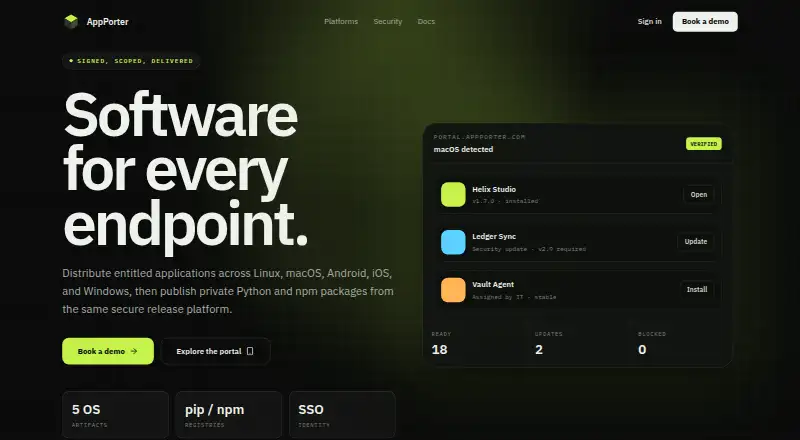
AppPorter distributes entitled applications to desktop and mobile endpoints and hosts private Python and npm packages. It supports Linux, macOS, Android, iOS, and Windows, with packages or installers including deb, rpm, dmg, pkg, APK, IPA, exe, and msi. A portal and local agent let teams install, update, repair, and remove apps, including required and optional updates. Admins can assign apps to users, groups, devices, or organizations according to subscription, role, license, or release channel. Internal, beta, and stable channels make rollout intent explicit. Users can browse approved apps, read release notes, and install through a branded self-service portal. Its Python registry supports wheels and source distributions through a pip-compatible Simple API; the npm registry supports scoped and unscoped packages. AppPorter also lists SHA-256 artifact integrity fields and checksums, server-side OIDC, role limits, audit-log review and export, and secure downloads scoped through sessions or API tokens. It is paid, with pricing on request, and is described for platform, release-operations, IT-entitlement, and internal-distribution teams.
Good
- Supports five named operating systems
- Manages installation, updates, repair, and removal
- Supports Python and npm registries
- Includes internal, beta, and stable channels
- Admins can assign apps by role or license
Watch out
- Pricing is available on request
- Deployment uses an agent
Who it suits
AppPorter suits platform and IT teams managing internal app distribution across desktop and mobile systems. It also fits teams that need private Python or npm packages, entitlement controls, and staged release channels.
Verdict
AppPorter combines application delivery, entitlement management, and private package hosting for organizations distributing internal software. Its fit depends on whether teams need its agent-based deployment and its supported release and access controls.
The facts
Each one read from AppPorter's own pages, with the date it was checked.
What it does
- Artifact integrity
- The security page lists SHA-256 artifact fields, checksums, and metadata as integrity controls.checked 4 Oct 2026
- Audit
- Release operation audit logs can be reviewed and exported.checked 8 Oct 2026
- Audit and delivery
- The product page says release operations can be reviewed and exported in audit logs, and describes secure downloads scoped through sessions or API tokens.checked 4 Oct 2026
- Developer registries
- Its Python registry supports wheels and source distributions through a pip-compatible Simple API; its npm registry supports scoped and unscoped packages.checked 4 Oct 2026
- Entitlements
- Apps can be assigned to users, groups, devices, or organizations by subscription, role, license, or release channel.checked 8 Oct 2026
- Identity and access
- Admins can use server-side OIDC, and roles limit upload, release, audit, and tenant actions.checked 4 Oct 2026
- Install management
- Its portal and local agent support one-click install, repair, clean uninstall, and required or optional updates.checked 8 Oct 2026
- Integrations
- The maker describes a pip-compatible Python registry, an npm-compatible registry, and server-side OIDC for admin identity.checked 4 Oct 2026
- Integrations and identity
- The site describes private Python and npm registries and OIDC-based admin SSO.checked 8 Oct 2026
- Intended users
- The maker describes the product as built for platform teams, release operations, IT entitlement, and internal distribution.checked 4 Oct 2026
- Operating systems
- It supports Linux, macOS, Android, iOS, and Windows, with packages or installers including deb, rpm, dmg, pkg, APK, IPA, exe, and msi.checked 4 Oct 2026
- Package registries
- The Python registry supports wheels, source distributions, private tokens, hashes, and yanked releases; the npm registry supports scoped packages, dist-tags, SHA-512 integrity, and authenticated tarballs.checked 8 Oct 2026
- Product
- AppPorter distributes entitled applications across desktop and mobile endpoints and hosts private Python and npm package registries.checked 8 Oct 2026
- Release controls
- Internal, beta, and stable release channels let teams make rollout intent explicit.checked 4 Oct 2026
- Rollouts
- Release channels include internal, beta, and stable, and rollouts can be staged with policy windows.checked 8 Oct 2026
- Security
- AppPorter describes package signing, checksum verification, scoped access, role and tenant controls, audit logs, and HTTPS delivery.checked 8 Oct 2026
- Self-service
- The branded portal lets employees and customers browse approved apps, read release notes, and install apps without manual provisioning.checked 8 Oct 2026
- Target users
- The homepage describes the product as built for platform teams, release operations, IT entitlement, and internal distribution.checked 8 Oct 2026
Where it runs
- Platforms
- The platform page lists Linux deb and rpm, macOS dmg and pkg, Android APK, iOS IPA, and Windows exe and msi delivery.checked 8 Oct 2026
Alternatives to AppPorter
- 1
Fleet
Free planOpen sourceAndroidiOSWebAPI8.6From $7 a month - 2

OPSI
Free planOpen sourceWebAPILinuxmacOS8.4From €4.99 a year - 3

FileWave
Free planAndroidiOSWebAPI8.3Free plan - 4

ManageEngine Patch Manager Plus
Free planAndroidiOSWebAPI8.2From $245 a year - 5

Patch My PC
Free planWebmacOSSelf-hostedWindows7.7From $3.50 a year - 6

Uyuni
Free planOpen sourceWebAPILinuxSelf-hosted7.4Free plan