
APIVerve Website Readability API
APIVerve Website Readability API analyzes a webpage and returns its readability score information, including eight scores and grade-level analysis.
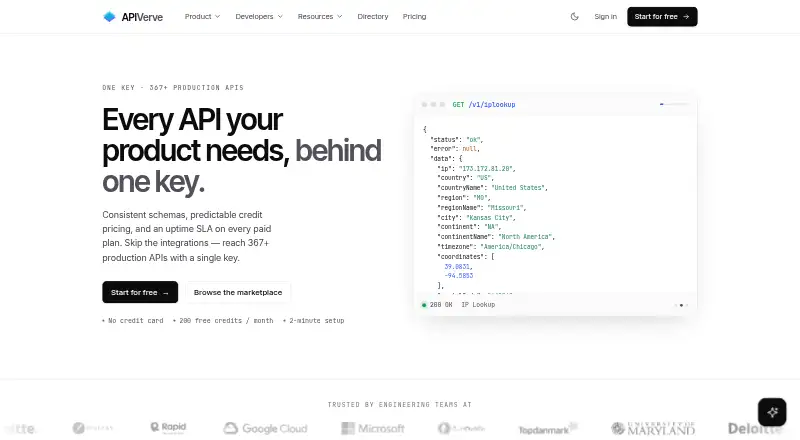
What APIVerve Website Readability API is
APIVerve Website Readability API analyzes a webpage and returns its readability score information, including eight scores and grade-level analysis. It is accessed with an HTTPS POST request to /v1/websitereadability. Requests use an API key in the x-api-key header, and the same key works across APIVerve’s 300+ APIs. Each call uses 10 credits from a shared account pool. The API can return JSON, XML, YAML, CSV, GraphQL, or MCP access. A live request tool on the product page can be tried without an API key, and an embeddable interactive form is available through a snippet that does not put keys in the markup. The listed integrations include VerveKit for MCP agents and VerveSheets for Google Sheets or Excel formulas, along with automation tools and SDKs. APIVerve lists the API as online with a 99.9% uptime SLA and typical p50 latency of 1798 ms. It says traffic uses TLS 1.2+ and stored data uses AES-256; request and response content is not retained beyond real-time processing, while usage logs are kept for 90 days. The Free plan includes 200 credits per month, 5 requests per minute, non-commercial use, required attribution, and community support.
Good
- Returns eight readability scores and grade-level analysis.
- Supports JSON, XML, YAML, CSV, GraphQL, and MCP access.
- Live request tool can be tried without an API key.
- Free plan includes 200 credits per month.
- Request and response content is not retained beyond real-time processing.
Watch out
- Each API call uses 10 shared credits.
- Free plan is non-commercial and requires attribution.
- Free plan is limited to 5 requests per minute.
- Usage logs are kept for 90 days.
Who it suits
This API suits developers or teams that need webpage readability results in an application, spreadsheet, or automation workflow. Its live request tool and embeddable form may also suit people exploring the service without placing an API key in page markup.
Verdict
APIVerve Website Readability API offers webpage scoring through an API, with several response formats and integrations. Check the credit cost, free-plan terms, and data-log retention against your intended use.
Plans and prices
From APIVerve Website Readability API's own pricing page, checked 7 Oct 2026.
| Plan | Price | What it gives you |
|---|---|---|
| Free | Free | 200 credits / mo · 5 req/min · non-commercial use · attribution required · community support |
| Starter | $29.99 a month | 200,000 credits / mo · 60 req/min · commercial license · Zapier, Make & MCP access · email support · Billed monthly |
| Pro | $99.99 a month | 1,000,000 credits / mo · 180 req/min · 3 team members · 5 scoped sub-keys · 10 embedded forms · Billed monthly |
| Mega | $299.99 a month | 4,000,000 credits / mo · 10 team members · 25 scoped sub-keys · dedicated servers · 90-day audit history · priority support · Billed monthly |
The facts
Each one read from APIVerve Website Readability API's own pages, with the date it was checked.
What it does
- Authentication
- Requests use an API key in the x-api-key header, and one key works across APIVerve’s 300+ APIs.checked 7 Oct 2026
- Automation and developer tools
- APIVerve lists Zapier, Make, Power Automate, Pipedream, n8n, ViaSocket, Postman, and SDKs for Node.js, Python, and .NET.checked 7 Oct 2026
- Availability
- The product page lists the API as online with a 99.9% uptime SLA and a typical p50 latency of 1798 ms.checked 7 Oct 2026
- Data handling
- APIVerve says it does not store API request or response content beyond real-time processing and keeps usage logs for 90 days.checked 7 Oct 2026
- Endpoint and method
- It uses POST at /v1/websitereadability over HTTPS.checked 7 Oct 2026
- Integrations
- The product page names VerveKit for MCP agent access and VerveSheets for Google Sheets or Excel formulas.checked 7 Oct 2026
- Playground
- The product page offers a live request tool that can be tried without an API key.checked 7 Oct 2026
- Response formats
- The API supports JSON, XML, YAML, CSV, GraphQL, and MCP access.checked 7 Oct 2026
- Security
- APIVerve states that API traffic uses TLS 1.2+ and stored data uses AES-256, and that API keys are hashed rather than stored in plain text.checked 7 Oct 2026
- Support
- Support varies by plan: Free includes community support, Starter email support, and Mega priority support.checked 7 Oct 2026
- Usage limit
- Each call costs 10 credits from the account’s shared credit pool.checked 7 Oct 2026
- What it does
- The API analyzes a website and returns its readability score.checked 7 Oct 2026
- Zero-code embed
- APIVerve says users can embed an interactive form on a site with a snippet, without placing keys in the markup.checked 7 Oct 2026
The company
- Company
- EvlarSoft LLC identifies itself as the company behind APIVerve; its About page describes EvlarSoft as owner-operated but gives no founding year or headquarters.checked 7 Oct 2026
- Founded
- 2020checked 28 Sep 2026
- Headquarters
- Lee's Summit, Missouri, United Stateschecked 28 Sep 2026
The full review of APIVerve Website Readability API
APIVerve Website Readability API scores webpages for developers and teams that want readability checks inside software or automated workflows. Its flexible access options are useful, but each call draws 10 credits from a shared pool, and commercial use starts at $29.99 a month.
Overview
The service accepts webpage input through an HTTPS POST request to /v1/websitereadability. Requests use an API key in the x-api-key header; one key works across APIVerve’s 300+ APIs. Each readability call costs 10 credits, so the monthly allowance is shared with other APIs on the account. That arrangement suits teams already using APIVerve, while making the effective readability quota depend on their overall API use.
Responses support JSON, XML, YAML, CSV, GraphQL, and MCP access. A live request tool on the product page can be tried without an API key, and an interactive form can be embedded on a website without placing keys in its markup. These options give the service several ways into a workflow, though the analysis itself takes webpages as input.
Key features
The API provides eight readability scores and grade-level analysis. It also supports multiple export options and bulk search up to 200. Teams can connect through VerveKit for MCP agent access or VerveSheets formulas for Google Sheets and Excel. Zapier, Make, Power Automate, Pipedream, n8n, ViaSocket, and Postman are also named, alongside SDKs for Node.js, Python, and .NET. This is a broad set of routes for a focused endpoint; projects that need domain variations will need another approach, since none are supported.
APIVerve lists the API as online with a 99.9% uptime SLA and typical p50 latency of 1798 ms. It states that traffic uses TLS 1.2 or higher, stored data uses AES-256, and API keys are hashed. Request and response content is processed in real time rather than retained, while usage logs are kept for 90 days. The stated latency is worth weighing for workflows where response time matters.
Pricing
The free plan costs free and includes 200 credits per month, a 5-request-per-minute limit, community support, and required attribution. Its non-commercial-use restriction makes it suitable for evaluation or personal projects, not commercial deployment. At 10 credits per call, the allowance covers up to 20 readability requests per month if used only for this API.
Starter costs $29.99 a month, billed monthly. It includes 200,000 credits per month, 60 requests per minute, a commercial license, Zapier, Make and MCP access, and email support. It is the entry point for commercial use and should cover regular use of this endpoint, provided other APIs do not consume the shared credits.
Pro costs $99.99 a month, billed monthly. Its 1,000,000 monthly credits and 180 requests per minute support heavier usage, while three team members, five scoped sub-keys, and ten embedded forms add room for a small team to manage separate access and site integrations. Mega costs $299.99 a month, billed monthly. It raises the allowance to 4,000,000 credits and includes ten team members, 25 scoped sub-keys, dedicated servers, 90-day audit history, and priority support. Mega fits larger deployments that need those operational provisions; its price is difficult to justify for occasional scoring.
Platforms
The API is available on web and through API access. Its integrations and SDKs make it accessible from several developer and automation environments, while the zero-code form offers a route for site owners who do not want to build a direct API connection.
Who it's for
This is a strong fit for developers and teams that need repeatable webpage scoring, grade-level analysis, and a choice of API, spreadsheet, agent, or automation integrations. It is less suitable for commercial users with light or occasional needs, since the free tier prohibits commercial use and the paid plans begin at $29.99 a month. It also does not fit workflows that require arbitrary text input or domain variations.
Pros and cons
- Pros: Six response options, eight readability scores, and grade-level analysis give developers useful flexibility for structured workflows.
- Pros: The live request tool and embeddable form provide ways to try or use the service without first building a direct API integration.
- Pros: A shared key across 300+ APIs and a wide range of named integrations can simplify use within an existing APIVerve setup.
- Cons: Each call costs 10 shared credits, so activity on other APIVerve APIs reduces the balance available for readability checks.
- Cons: The free plan is limited to 200 monthly credits, 5 requests per minute, non-commercial use, and required attribution.
- Cons: Webpage-only input and no domain variations limit its usefulness for text-first or domain-comparison workflows.
Alternatives
ToolsVale Readability Checker is a free option across Android, iOS, Linux, macOS, web, and Windows for readers who prefer broad device coverage over an API plan. Readability offers a free, MIT-licensed GitHub Action, CLI, and Docker image for Linux, macOS, and Windows, making it a better fit for teams that want those tools without a paid plan. Eclipse Readability Studio is free and open source for Linux, macOS, and Windows. Readability Formulas offers free online readability tools and a Readability Scoring System, with extension, macOS, web, and Windows availability.
textstat is a free MIT-licensed Python package for Linux and self-hosted use, suited to developers who want a package rather than a hosted API. A2Z Tools Plain Language Analyzer is a free English-only web tool. PageRefine is a free web tool with no signup. ProfText offers a free API and web plan with unlimited analyses, a 5,000-character limit per analysis, 30 clarity rules, and AI-generated text detection; it may suit users who need those checks alongside readability.
Browse AI Readability Checkers for more options.
Verdict
Choose APIVerve Website Readability API if you need webpage scoring in an API-driven workflow and value its response formats, integrations, and shared access to APIVerve’s broader catalog. Its main drawback is the combination of a small, non-commercial free tier and paid plans starting at $29.99 a month. For occasional checks, a free alternative is the more practical choice; for commercial automation at scale, Starter is the clearest entry point.
Getting started
- Open the APIVerve Website Readability API product page.
- Try a request in the live playground without an API key, or choose a plan.
- For API requests, use HTTPS POST at `/v1/websitereadability` and provide an API key in the `x-api-key` header.
- Submit webpage input and select a supported response format.
- Connect an integration, automation tool, SDK, or embedded form if it fits your workflow.
Limits worth knowing
The free plan includes 200 credits per month and 5 requests per minute; each API call costs 10 credits. It is for non-commercial use, requires attribution, and includes community support.
Questions
Is there a free plan?
Yes. The Free plan costs nothing and includes 200 credits per month, 5 requests per minute, non-commercial use, required attribution, and community support.
What do paid plans cost?
Starter is $29.99 a month, Pro is $99.99 a month, and Mega is $299.99 a month. Each is billed monthly.
Which platforms and input does it support?
The listed platforms are API and web, and the input format is webpage.
What integrations are available?
The product names VerveKit for MCP agent access and VerveSheets for Google Sheets or Excel formulas. It also lists Zapier, Make, Power Automate, Pipedream, n8n, ViaSocket, Postman, and SDKs for Node.js, Python, and .NET.
How does API authentication and usage work?
Requests use an API key in the `x-api-key` header, and one key works across APIVerve’s 300+ APIs. Each call costs 10 credits from the shared account pool.
Who makes APIVerve?
EvlarSoft LLC identifies itself as the company behind APIVerve.
Alternatives to APIVerve Website Readability API
- 1
Text Inspector
Free planWebAPI7.4From £9.96 a month - 2
Avidemux
Free planOpen sourceWebLinuxmacOSWindows7.3Free plan - 3
Health Literacy Advisor
AndroidiOSWebmacOS7.0From $499 a year - 4

Readable
WebAPI7.0From $12 a month - 5

Hemingway Editor
WebmacOSWindows6.8 - 6

ToolsVale Readability Checker
Free planAndroidiOSWebLinux6.7Free plan