Amimica
Amimica is a free, offline repository scanner for repeated code.
What Amimica is
Amimica is a free, offline repository scanner for repeated code. It detects exact copies, renamed fragments, near-duplicates and recurring patterns, using a deterministic hybrid approach. You can run it as a standalone command-line tool or as an MCP server for Claude Code, VS Code and other compatible editors over stdio. The CLI prints text or JSON, can write results to a file, and provides thresholds for clone score and size, normalization, test exclusion, caching and deeper analysis. Project or global YAML files hold configuration, with environment variables able to override settings. MCP tools scan repositories, list findings, explain matches and compare source regions. Scan results remain in memory during the MCP session and disappear when the server stops. Supported languages listed in the README are Go, JavaScript, TypeScript, Ruby, Objective-C and C#. The MIT-licensed project requires Go 1.25 or later when building from source. Its findings are intended as evidence for human refactoring decisions.
Good
- Free MIT-licensed project
- Deterministic offline scanning
- Detects several clone types
- Text and JSON output options
- MCP tools for explanations and comparisons
Watch out
- Building requires Go 1.25 or later
- No listed CI integration
- No listed IDE integration
- MCP results disappear when the server stops
Who it suits
It suits developers reviewing repositories for duplicate or structurally similar code. It is useful for users comfortable with command-line tools, MCP clients and building from source.
Verdict
Amimica provides configurable, local clone detection through a CLI and MCP server. Its source-build workflow and session-only MCP results are important considerations for adoption.
The facts
Each one read from Amimica's own pages, with the date it was checked.
What it does
- Analysis controls
- Users can set clone score and size thresholds, normalization level, test-file handling, caching, and thorough-analysis options.checked 7 Oct 2026
- Analysis options
- The CLI supports text or JSON output, score and size thresholds, test exclusion, deeper analysis, caching controls, and configuration files.checked 7 Oct 2026
- Build requirement
- Building from source requires Go 1.25 or later.checked 7 Oct 2026
- Clone types
- It detects exact, renamed, near-duplicate, and recurring-pattern clones.checked 7 Oct 2026
- Configuration
- Amimica supports project or global YAML configuration, with environment variables able to override configuration.checked 7 Oct 2026
- Detection
- It detects exact, renamed, near-duplicate, and recurring-pattern clones.checked 7 Oct 2026
- Distribution
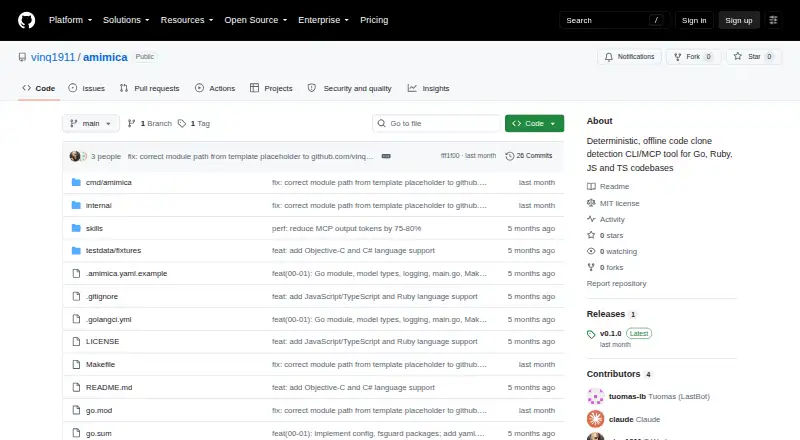
- The README documents building from a Git clone and installing to GOPATH/bin; no release assets are listed on the repository page.checked 7 Oct 2026
- Editor integration
- The MCP server can integrate with Claude Code, VS Code, and other MCP-compatible clients using stdio transport.checked 7 Oct 2026
- Intended users
- The README describes using findings as evidence for a human to decide whether and how to refactor code.checked 7 Oct 2026
- Interfaces
- It works as a standalone CLI and as an MCP server for Claude Code and other MCP-compatible editors.checked 7 Oct 2026
- Languages
- The README lists Go, JavaScript, TypeScript, Ruby, Objective-C, and C# support.checked 7 Oct 2026
- License
- The project is distributed under the MIT license.checked 7 Oct 2026
- Local results
- MCP scan results are held in memory for the server session and are discarded when the server stops.checked 7 Oct 2026
- MCP integration
- The MCP server uses stdio transport and exposes scan, finding-list, explanation, and source-region comparison tools.checked 7 Oct 2026
- MCP session data
- MCP scan results are stored in memory for the session and disappear when the server stops.checked 7 Oct 2026
- Operation
- It is described as a deterministic, offline code clone detection tool.checked 7 Oct 2026
- Output
- The CLI can print text or JSON results, including an option to write results to a file.checked 7 Oct 2026
- Privacy posture
- The project describes Amimica as offline; its README does not state a security certification or compliance standard.checked 7 Oct 2026
- Purpose
- Amimica scans repositories for repeated code, from exact copy-paste clones to structurally similar renamed fragments.checked 7 Oct 2026
The company
- Maker profile
- The GitHub profile for vinq1911 displays the name T-Work and the location Europe.checked 7 Oct 2026