
Amazon Aurora
Amazon Aurora is a fully managed relational database service offering PostgreSQL, MySQL, and DSQL engines.
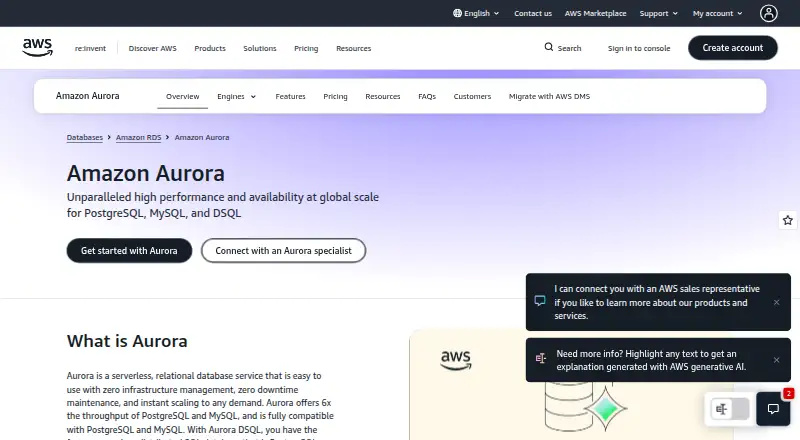
What Amazon Aurora is
Amazon Aurora is a fully managed relational database service offering PostgreSQL, MySQL, and DSQL engines. Aurora PostgreSQL and Aurora MySQL provide open-source compatibility intended to let existing applications and tools run without modification. AWS says Aurora offers up to 6x the throughput of PostgreSQL and MySQL and is designed for up to 99.99% single-Region and 99.999% multi-Region availability. Provisioning, patching, backup, and recovery are handled through the Amazon RDS console, CLI commands, and API operations. Aurora Serverless starts, stops, and adjusts capacity according to application needs, with charges for capacity consumed. Standard tools can migrate MySQL and PostgreSQL databases to and from Aurora; Babelfish supports legacy SQL Server applications on Aurora PostgreSQL with minimal code change. Security features include encryption at rest with AWS KMS keys and SSL (AES-256) for data in transit. The free plan provides Aurora PostgreSQL Serverless instances with up to 4 ACUs and 1 GiB of storage per cluster. Paid options use usage-based pricing, with instance and storage charges and optional features billed separately.
Good
- Offers PostgreSQL, MySQL, and DSQL engines
- Serverless capacity adjusts to application needs
- Free plan includes up to 4 ACUs
- Supports encryption at rest and in transit
Watch out
- Free plan limited to 1 GiB storage per cluster
- Paid pricing varies by engine, region, and configuration
- Optional features are billed separately
Who it suits
Aurora may suit teams building enterprise applications, multi-tenant SaaS, or globally distributed applications. Its free plan is limited to Aurora PostgreSQL Serverless with up to 4 ACUs and 1 GiB of storage per cluster.
Verdict
Aurora combines managed relational database operations with PostgreSQL, MySQL, and DSQL engine options. Check the free plan limits and usage-based charges when assessing a configuration.
Plans and prices
From Amazon Aurora's own pricing page, checked 22 Sep 2026.
| Plan | Price | What it gives you |
|---|---|---|
| Free plan | Free | 4 ACUs · 1 GiB storage per cluster |
| Paid plan | — | Usage-based pricing · Charges for database instances and storage · Optional features are billed separately · Provisioned and serverless configurations |
| Aurora PostgreSQL Serverless Free plan | Free | Up to 4 ACUs · 1 GiB storage per cluster · No cost for new AWS customers; AWS credits are available for up to 12 months. |
| Aurora PostgreSQL and Aurora MySQL On-Demand | — | Price varies by engine, AWS Region, instance or capacity, storage, I/O, and selected configuration · Usage-based; provisioned instances are billed per instance-hour, with storage and optional features billed separately. |
The facts
Each one read from Amazon Aurora's own pages, with the date it was checked.
What it does
- Availability
- AWS says Aurora is designed for up to 99.99% single-Region and 99.999% multi-Region availability.checked 11 Oct 2026
- Compatibility
- Aurora PostgreSQL and Aurora MySQL offer open source compatibility so existing applications and tools can run without modification.checked 11 Oct 2026
- Compliance
- AWS lists Aurora in compliance programs that include SOC, PCI, FedRAMP, and HIPAA.checked 11 Oct 2026
- Integrations
- Aurora MySQL can invoke AWS Lambda functions and load data from or save data to Amazon S3.checked 11 Oct 2026
- Intended workloads
- AWS identifies enterprise applications, multi-tenant SaaS, and globally distributed applications as Aurora use cases.checked 11 Oct 2026
- Migration
- AWS says MySQL and PostgreSQL databases can be migrated to and from Aurora using standard tools; Babelfish supports legacy SQL Server applications on Aurora PostgreSQL with minimal code change.checked 11 Oct 2026
- Notable limit
- The free plan provides Aurora PostgreSQL Serverless instances with up to 4 ACUs and 1 GiB of storage per cluster.checked 11 Oct 2026
- Operations
- Aurora uses the Amazon RDS console, CLI commands, and API operations for tasks such as provisioning, patching, backup, and recovery.checked 11 Oct 2026
- Performance
- AWS says Aurora offers up to 6x the throughput of PostgreSQL and MySQL.checked 11 Oct 2026
- Product
- Amazon Aurora is a fully managed relational database service with PostgreSQL, MySQL, and DSQL engines.checked 11 Oct 2026
- Scaling
- Aurora Serverless automatically starts, stops, and scales capacity based on application needs, and charges for capacity consumed.checked 11 Oct 2026
- Security
- Aurora supports encryption at rest using AWS KMS keys and uses SSL (AES-256) to secure data in transit.checked 11 Oct 2026
- Support
- Customers with an active AWS Premium Support plan can contact AWS for Aurora-specific troubleshooting and guidance.checked 11 Oct 2026
- Threat detection
- Amazon GuardDuty RDS Protection profiles and monitors Aurora database login activity for suspicious behavior.checked 11 Oct 2026
The company
- Founded
- 2006checked 23 Sep 2026
- Headquarters
- Seattle, Washington, United Stateschecked 23 Sep 2026
Money
- Free plan
- Nochecked 22 Sep 2026
Alternatives to Amazon Aurora
- 1

LocalStack
Free planOpen sourceWebAPIExtensionLinux8.2Free plan - 2

Beeceptor
Free planWebAPILinuxmacOS7.9From $10 a month - 3

ReadyAPI
WebAPILinuxmacOS7.6 - 4

Microcks
Free planWebAPIExtensionLinux7.2Free plan - 5

Hoverfly
WebAPILinuxmacOS6.7From $10 a month - 6

MockServer
Free planWebAPILinuxmacOS6.6Free plan