
Alertus Unified Mass Notification
Alertus Unified Mass Notification brings facility, network, outdoor, and personal notification together for organizations that need to reach people across di…
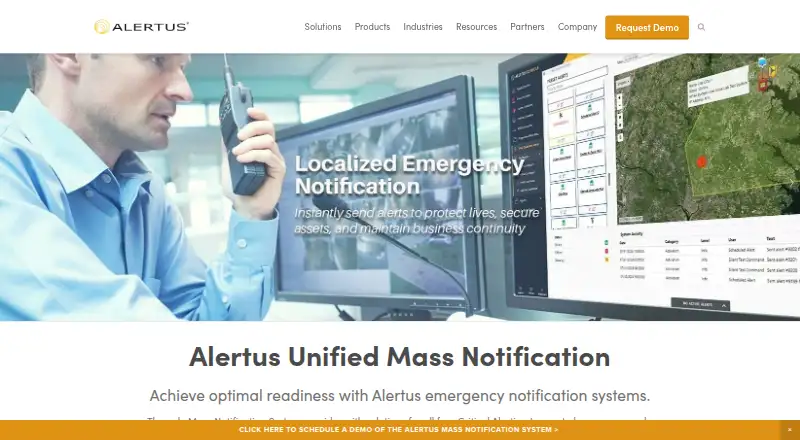
What Alertus Unified Mass Notification is
Alertus Unified Mass Notification brings facility, network, outdoor, and personal notification together for organizations that need to reach people across different settings. Alerts can be sent to endpoints including speakers, beacons, strobes, desktop systems, VoIP phones, digital signage, and mobile apps, as well as through text and email integrations. Recipients can be targeted by map location, buildings, functional areas, preset groups, directory membership, or subscribed mobile lists. Staff can activate alerts through panic buttons, desktop activators, VoIP phones, or mobile applications. The system includes alert histories, recipient acknowledgements, device status, membership reports, system health digests, and event dashboards. Alertus lists integrations with Microsoft Teams, Slack, and Google Chat, supports SOAP and REST APIs, and accepts CAP and FEMA IPAWS alerts. Organizations can choose on-premise or cloud hosting. Pricing is on request. Alertus does not provide its own text or email service, instead using third-party providers or a customer's SMTP server for those distributions.
Good
- Targets alerts by location, group, or directory
- Supports on-premise and cloud-hosted options
- Offers SOAP and REST APIs
- Includes alert histories and recipient acknowledgements
- Mobile app can launch and cancel preset alerts
Watch out
- Pricing is available on request
- Does not provide its own text or email service
- Desktop client is not available for Linux
Who it suits
Alertus may suit organizations in education, industry, healthcare, corporate, government, or military settings that need facility-wide or personal notifications. It is relevant to teams seeking multiple activation methods and recipient targeting options.
Verdict
Alertus offers multiple notification channels, targeting methods, and deployment options for organizations coordinating mass alerts. Buyers should account for third-party text or email delivery and request pricing directly.
Plans and prices
From Alertus Unified Mass Notification's own pricing page, checked 30 Sep 2026.
| Plan | Price | What it gives you |
|---|---|---|
| Alertus Unified Mass Notification | Priced on request | Custom solutions and product assortment; annual fee for Enhanced Services and Support; scalable pricing for third-party hardware and software integrations |
The facts
Each one read from Alertus Unified Mass Notification's own pages, with the date it was checked.
What it does
- Activation
- Activation methods include panic buttons, desktop activators, VoIP phones, and mobile applications.checked 30 Sep 2026
- Alerting methods
- Alerts can reach endpoints including IP speakers, Alert Beacons, strobes, desktops, VoIP phones, digital signage, mobile apps, text, and email integrations.checked 30 Sep 2026
- API and alert standards
- Alertus provides SOAP and REST APIs and supports inbound CAP and FEMA IPAWS alerts.checked 30 Sep 2026
- Hosting and security
- Alertus offers on-premise and cloud-hosted options; its FAQ says Alert Beacon traffic uses AES, Alertus Desktop uses PKI certificates, and the software runs behind the customer's firewall.checked 30 Sep 2026
- Integrations
- Alertus lists integrations with Microsoft Teams, Slack, and Google Chat, and supports integration with existing facility and notification systems.checked 30 Sep 2026
- Intended customers
- Alertus describes serving higher education, K-12, industrial, corporate, healthcare, government, and military sectors.checked 30 Sep 2026
- Limits
- Alertus says it does not provide its own text or email service, but integrates with third-party providers or a customer's SMTP server for email distribution lists.checked 30 Sep 2026
- Mobile activation
- The Alertus Dispatcher app for Android and iPhone can view, launch, and cancel preset alerts.checked 30 Sep 2026
- Purpose
- Alertus unifies facility, network, outdoor, and personal or mobile notification under one mass notification platform.checked 30 Sep 2026
- Reporting
- The system provides daily system health digests, alert histories, recipient acknowledgements, device status, membership reports, and event dashboards.checked 30 Sep 2026
- Support
- Customers can contact technical support by phone or email and access the Alertus Customer Portal; Alertus also offers tailored training by video conference or in person.checked 30 Sep 2026
- Targeting
- Users can target alerts by map location, preset groups, Active Directory or LDAP, subscribed mobile lists, buildings, or functional areas.checked 30 Sep 2026
Where it runs
- Client platforms
- Alertus Desktop is available for Windows and Mac, and the company says its desktop client is not currently available for Linux.checked 30 Sep 2026
The company
- Company history
- Alertus says it was founded in 2002 after a 2001 tornado at the University of Maryland inspired the idea for a mass notification solution.checked 30 Sep 2026
- Founded
- 2002checked 23 Sep 2026
- Headquarters
- Baltimore, Maryland, United Stateschecked 23 Sep 2026
The full review of Alertus Unified Mass Notification
Alertus Unified Mass Notification brings facility, network, outdoor, and mobile alerts together for organizations that need to coordinate communications across sites and devices. It is strongest for institutions with varied alerting infrastructure and established response procedures; buyers should weigh its breadth against custom pricing and reliance on outside providers for text and email delivery.
Overview
Alertus is designed to distribute alerts across many endpoints, from IP speakers and strobes to desktop clients, VoIP phones, digital signage, and mobile apps. Teams can target messages by map location, building, functional area, preset group, directory membership, or subscribed mobile list. That range can help organizations reach the people and places relevant to an incident, but it also makes Alertus a better fit for coordinated institutional operations than for a small team seeking a simple notification tool.
Alerts can be activated through panic buttons, desktop activators, VoIP phones, or mobile applications. Alertus also accepts inbound CAP and FEMA IPAWS alerts, and offers SOAP and REST APIs. Its integrations with Microsoft Teams, Slack, Google Chat, and existing facility and notification systems can connect alerting to established workflows.
Key features
Alertus provides system-health digests, alert histories, recipient acknowledgements, device-status and membership reports, and event dashboards. These records give response teams a way to review delivery and recipient activity alongside operational status, rather than relying on a single message log.
Alertus offers on-premise and cloud-hosted deployments. Its security measures include AES for Alert Beacon traffic and PKI certificates for Alertus Desktop; the software runs behind the customer's firewall. The Dispatcher app for Android and iPhone can view, launch, and cancel preset alerts, supporting mobile activation as well as alert review.
The platform supports SMS, voice-call, email, desktop, and mobile-app alerts, plus two-way messaging. One important operational boundary is that Alertus does not supply its own text or email service: organizations must integrate a third-party provider for those channels, or use their SMTP server for email distribution lists. That means delivery arrangements and associated provider costs need to be considered separately.
Pricing
Alertus Unified Mass Notification: custom pricing. The offering uses a custom assortment of solutions, with an annual fee for Enhanced Services and Support. Pricing for third-party hardware and software integrations scales with the selected integrations. Organizations should request a quote based on their deployment and integration needs.
There is no free plan. Alertus is a paid, organization-oriented platform rather than a low-commitment option for individuals or small groups. Its custom pricing can accommodate different deployments, but makes direct budget comparison harder before an organization defines its requirements.
Platforms
Alertus supports Android, iOS, macOS, Windows, web, API, and self-hosted deployments. Alertus Desktop runs on Windows and Mac, but not Linux. The Dispatcher app is available for Android and iPhone, while hosting choices let organizations choose between on-premise and cloud deployment.
Who it's for
Alertus serves higher education, K–12 schools, industrial and corporate organizations, healthcare, government, and military customers. It is most appropriate where a response team needs to reach different facilities and audiences through multiple channels, and where integrations, targeting, reporting, and deployment choices matter. Organizations that depend on Linux desktop clients or want built-in text and email delivery should account for those constraints before choosing it.
Pros and cons
- Pros: Multiple alert endpoints and targeting methods let organizations direct messages across facilities, devices, and defined groups.
- Pros: On-premise and cloud-hosted options, APIs, and integrations with chat and facility systems support varied operational environments.
- Pros: Acknowledgements, device status, alert histories, and event dashboards provide useful visibility for response coordination.
- Cons: Custom pricing and integration-dependent costs make budgeting less straightforward than a published plan price.
- Cons: Text and email depend on third-party providers or the customer's SMTP server, adding delivery arrangements outside Alertus.
- Cons: Alertus Desktop is unavailable for Linux, which rules it out for organizations requiring that client platform.
Alternatives
Compare mass notification software to consider other options for an organization's alerting needs.
- EMMA Notify is another paid option, with Android, iOS, Linux, macOS, web, and Windows support.
- CrisisGo is worth considering for schools seeking a freemium option; it offers a free plan and a school plan priced at $2,520 a year, billed annually per school, for up to 500 students, with an additional-student charge.
- Regroup Mass Notification is a paid alternative for web, iOS, and Android.
- SA-Announce is a paid alternative with a free trial and support for Android, API, iOS, macOS, self-hosted, and Windows deployments.
- Hyper-Reach is a paid option for web, iOS, and Android.
- CivicPlus Mass Notification is a paid option for web and Android.
- Omnilert is a paid option for web, iOS, and Android.
- AlertFind is a paid option for web, iOS, and Android.
Verdict
Choose Alertus if your organization needs coordinated alerts across facilities, device types, and defined groups, with flexible hosting and operational reporting. Its broad reach and integration options are compelling for complex environments; look elsewhere if you need transparent pricing, Linux desktop support, or text and email service supplied directly by the platform.
Alternatives to Alertus Unified Mass Notification
- 1
Text-Em-All (formerly Call-Em-All)
Free planAndroidiOSWebAPI8.1From $19 a month - 2
NetSupport Notify
AndroidiOSWebExtension7.6$2 one-time - 3
Open Paging Server
Free planOpen sourceWebLinuxSelf-hosted7.1Free plan - 4

OnPage
AndroidiOSWebAPI7.0From $13.99 a month - 5
PushPulse
AndroidiOSWebmacOS6.9From $540 a year - 6
SA-Announce
AndroidiOSAPImacOS6.8