
Aleph Archives
Aleph Archives captures websites and preserves them as searchable records that users can replay as they appeared on a chosen capture date.
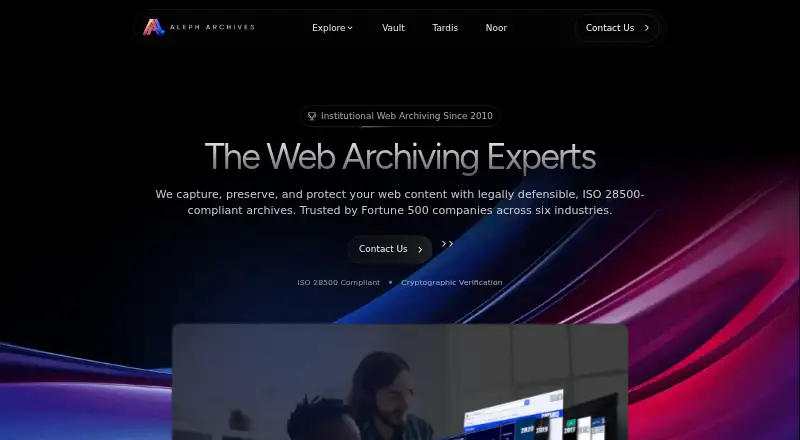
What Aleph Archives is
Aleph Archives captures websites and preserves them as searchable records that users can replay as they appeared on a chosen capture date. Its Aleph Vault uses a browser engine to render JavaScript and other dynamic content, then stores captures in WARC with PDF and PNG renderings. Captures can be scheduled daily, weekly, or monthly, run on demand, or triggered by detected site changes. Full-text search covers archived captures, and export formats include WARC, searchable PDF, MHTML, PNG, and Relativity-compatible DAT load files. Captured pages receive SHA-512 and RIPEMD-160 hashes, and archives are stored on WORM infrastructure. Customers control retention schedules and can use legal holds and exceptions. The platform is offered as cloud-hosted SaaS or an enterprise on-premise instance; dedicated hosting is available in Switzerland and the EEA, with data kept in the chosen jurisdiction absent explicit consent. LDAP and SAML support enterprise sign-on and user management. Pricing is on request, and the company offers a 15-minute demo.
Good
- Renders JavaScript and dynamic page content.
- Captures can run on schedules or detected site changes.
- Supports full-text search and replay by capture date.
- Includes legal holds and configurable retention.
- Offers cloud-hosted and on-premise deployment.
Watch out
- Pricing is available only on request.
- Dedicated hosting is specified for Switzerland and the EEA.
Who it suits
It suits regulated organizations and legal teams that need searchable, replayable website records and configurable retention. Banks, insurers, asset managers, pharmaceutical firms, government agencies, and law firms are among the intended users.
Verdict
Aleph Archives focuses on durable website records, with capture, search, replay, export, and retention controls. Organizations considering it can choose hosted or on-premise deployment and request a demo.
Plans and prices
From Aleph Archives's own pricing page, checked 4 Oct 2026.
| Plan | Price | What it gives you |
|---|---|---|
| Basic | $19 a month | Flexible subscription plans · Customizable feature bundles · Free trial period |
| Standard | $39 a month | Flexible subscription plans · Customizable feature bundles · Free trial period |
| Pro | $49 a month | Flexible subscription plans · Customizable feature bundles · Free trial period · More facilities |
The facts
Each one read from Aleph Archives's own pages, with the date it was checked.
What it does
- Availability
- The infrastructure is designed for 99.9% availability with automated failover across geographically distributed data centres.checked 4 Oct 2026
- Capture
- Aleph Vault uses a full browser engine to render JavaScript and dynamic content, then stores captures in WARC alongside PDF and PNG renderings.checked 4 Oct 2026
- Deployment
- Aleph Archives is available as cloud-hosted SaaS or as an on-premise instance for enterprise customers.checked 4 Oct 2026
- Exports
- Archives can be exported as WARC, searchable PDF, MHTML, and Relativity-compatible .DAT load files.checked 4 Oct 2026
- Hosting
- The company offers dedicated hosting in Switzerland and the EEA, and says data stays in the chosen jurisdiction absent explicit consent.checked 4 Oct 2026
- Integrations
- The platform provides LDAP and SAML integration for enterprise single sign-on and centralised user management.checked 4 Oct 2026
- Intended users
- The company identifies regulated organisations, including banks, insurers, asset managers, pharmaceutical firms, government agencies, and law firms, as customers or intended users.checked 4 Oct 2026
- Product
- Aleph Archives captures, preserves, and replays entire websites in native format as legally defensible, ISO 28500-compliant archives.checked 4 Oct 2026
- Retention
- Customers control archive retention schedules, and the platform supports legal holds and retention exceptions.checked 4 Oct 2026
- Scheduling
- Captures can run daily, weekly, monthly, or on demand, and can also be triggered by detected website changes.checked 4 Oct 2026
- Search and replay
- Aleph Vault supports full-text search across captures and lets users replay archived pages as they appeared on the capture date.checked 4 Oct 2026
- Security
- Captured pages receive SHA-512 and RIPEMD-160 hashes, and archives are stored on WORM infrastructure.checked 4 Oct 2026
- Support and onboarding
- The site offers a 15-minute demo, and says admin and engineering users receive additional onboarding training.checked 4 Oct 2026
The company
- Founded
- 2010checked 28 Sep 2026
- Headquarters
- Lausanne, Switzerlandchecked 28 Sep 2026
The full review of Aleph Archives
Aleph Archives is a website preservation platform for organisations that need durable, searchable records of online content. It suits compliance, records and legal teams best. Its capture and retention controls are compelling for that work, but custom pricing and a specialised focus make it a poor fit for casual archiving.
Overview
Aleph Vault uses a full browser engine to capture dynamic pages, including JavaScript-rendered content, and stores records in WARC alongside PDF and PNG renderings. That makes it better suited to preserving complex pages than a basic screenshot workflow; replay also lets teams see a page as it appeared on its capture date.
Capture can run daily, weekly, monthly or on demand, and can be triggered by detected site changes. That flexibility supports both routine records programs and change-led monitoring, while allowing teams to match capture frequency to the importance and pace of the content.
Key features
Search, evidence and retention
Full-text search across captures and replay by date make accumulated archives practical to inspect. Exports include WARC, searchable PDF, MHTML, PNG and Relativity-compatible .DAT load files, giving legal and records teams options for working with material in other systems.
Captured pages receive SHA-512 and RIPEMD-160 hashes, and archives are stored on WORM infrastructure. Customers control retention schedules, with legal holds and retention exceptions available. These are meaningful safeguards for regulated records, though they do not make the platform a general-purpose document archive.
Administration and hosting
LDAP and SAML integration support enterprise single sign-on and centralised user management. Aleph offers dedicated hosting in Switzerland and the EEA and says data remains in the selected jurisdiction unless the customer consents otherwise. Cloud-hosted SaaS and on-premise deployment give organisations a choice over where the system runs.
The infrastructure is designed for 99.9% availability, with automated failover across geographically distributed data centres. Admin and engineering users receive additional onboarding training, and prospective customers can request a 15-minute demo.
Pricing
Aleph is a paid product with a free trial and pricing on request. Its published plans are Basic at $19 a month, Standard at $39 a month and Pro at $49 a month. Each describes flexible subscriptions, customizable feature bundles and a free trial; Pro also includes “More facilities.” The plan descriptions do not establish which capture quotas, seats or feature bundles come with each tier, so buyers should confirm those terms and the post-trial price before choosing.
The plan names and monthly figures provide a starting point, but the customizable bundles mean the lowest price may not cover every compliance need. Basic and Standard do not spell out a distinct capability difference, while Pro's additional facilities are not defined. Organizations evaluating it should compare a configured quote against their retention, deployment and export requirements.
Platforms
Aleph supports web access and self-hosted deployment. The on-premise option is aimed at enterprise customers, while hosted customers can choose dedicated hosting in Switzerland or the EEA. This range is useful for organizations with jurisdiction or infrastructure requirements, but the product is not positioned as a mobile-first archive.
Who it's for
The strongest fit is a regulated organization that must preserve websites as durable records and manage evidence, retention and access centrally. Aleph identifies banks, insurers, asset managers, pharmaceutical firms, government agencies and law firms among its intended users. Teams seeking simple personal page-saving or a low-cost social media archive should look for a more focused or transparent offer.
Pros and cons
- Pros: Browser-based capture handles dynamic content, while scheduled and change-triggered runs support ongoing preservation.
- Pros: Search, date-based replay, multiple export formats and Relativity-compatible load files serve legal and records workflows.
- Pros: Hashing, WORM storage, legal holds and configurable retention address evidence integrity and governance needs.
- Pros: SaaS and on-premise options plus Swiss and EEA hosting give organizations deployment and jurisdiction choices.
- Cons: Custom pricing and configurable bundles make it difficult to compare total costs or know which tier covers a specific workflow.
- Cons: The product's focus on organizational website preservation is narrower than a general-purpose archive for individuals.
Alternatives
Social Archiver is a better starting point for individuals who want a free cross-platform option: its free plan allows 10 successful archives per month, with duplicate saves excluded, plus local browsing and search. Aleph is the stronger fit when organizational retention and legal evidence controls matter.
Jatheon Cloud may suit teams comparing paid archiving services that emphasize unlimited storage and no egress fees at exit, with per-user annual billing. Archive Intel is another paid option, with a $99.00 USD monthly platform fee, per-user connector and text-archiving charges, and 1TB of included storage.
Proofpoint Email DLP and Encryption is a paid option for buyers considering email data-loss prevention and encryption. MirrorWeb Insight is another web-based paid alternative. Orlo is worth considering for social media management, community voice and customer service modules with sector-tailored pricing.
Page Vault Browser is an alternative for buyers seeking a browser extension or desktop-supported paid product with annual contracts. Smarsh Archive is another paid archiving option available on web and through an API. For a broader category comparison, see Social Media Archiving Software.
Verdict
Choose Aleph Archives if your organization needs replayable website records, controlled retention and legal-oriented exports, especially where jurisdiction and on-premise deployment matter. Its strongest reason to choose is the combination of dynamic capture and governance controls; its main drawback is that custom, configurable pricing obscures the cost and scope until a buyer engages with the vendor. Look elsewhere for personal archiving or a clearly bounded low-cost plan.
Alternatives to Aleph Archives
- 1
Social Archiver
Free planOpen sourceAndroidiOSWebExtension8.4From $39.99 a year - 2

Jatheon Cloud
AndroidiOSWebAPI7.5From $60 a month - 3
Tweet Archivist
WebWindows7.1From $290 a year - 4
Page Vault Browser
WebAPIExtensionmacOS7.0$149 one-time - 56.7From $5,000 a year
- 6

Archive Intel
AndroidiOSWeb6.6From $99 a month