Adalo
Adalo is a visual no-code builder for database-driven apps, letting users create native iOS and Android apps and responsive web apps from one project.
What Adalo is
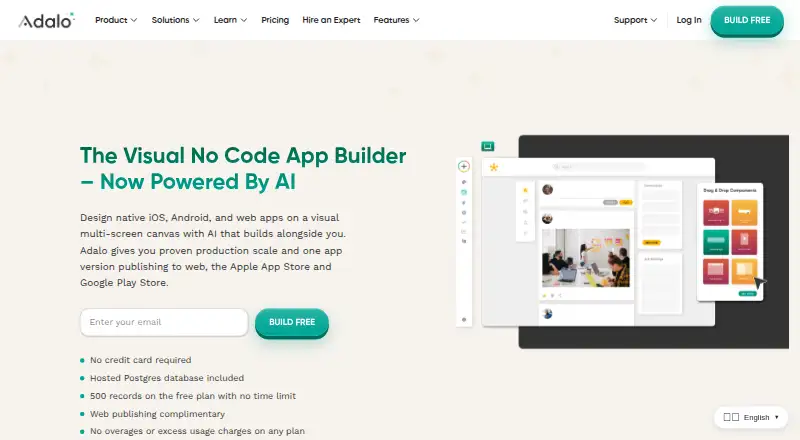
Adalo is a visual no-code builder for database-driven apps, letting users create native iOS and Android apps and responsive web apps from one project. Its Ada assistant can generate and edit apps through natural-language prompts; Adalo describes it as a beta assistant included in all plans. The platform includes a hosted or built-in Postgres database and supports external sources such as Airtable, Google Sheets, Xano and REST APIs. Integrations include Zapier, Make, Stripe, Google Maps and IAPHUB, and custom actions can connect to APIs or perform tasks such as sending email and retrieving weather data. Feature Templates provide screens, actions and database setup for features such as chat, purchasing and appointment booking. The free plan has no time limit and includes 500 records per app, unlimited screens and test apps, and one app editor; no credit card is required to start. Adalo states that it does not currently provide HIPAA compliance.
Good
- Build native iOS, Android and web apps from one project.
- Free plan has no time limit.
- Free plan includes 500 records per app.
- Supports external data sources and API connections.
Watch out
- Free plan has one app editor.
- Free plan is limited to 500 records per app.
- Adalo does not currently provide HIPAA compliance.
Who it suits
Adalo suits people building database-driven apps for web, iOS and Android from a shared project. The free tier may suit those starting to build and test, while paid plans add app publishing and team editors.
Verdict
Adalo combines app building, database features and publishing for web and native mobile projects. Its free plan supports building and testing; paid plans start at $36/mo (annual).
Plans and prices
From Adalo's own pricing page, checked 28 Sep 2026.
| Plan | Price | What it gives you |
|---|---|---|
| Free | Free | Free plan for building and testing · 500 records per app · 1 app editor · unlimited test apps · billed annually |
| Starter | $36 a month | For founders and entrepreneurs · 1 published app · unlimited app actions · 1 app editor · custom domain · web publishing · automated app-store publishing · no Adalo branding · billed annually |
| Professional | $52 a month | For small and medium businesses · 2 published apps · unlimited app actions · 5 app editors · custom integrations · design versions · geolocation · custom app actions · analytics · formulas · push notifications · billed annually |
| Team | $160 a month | For freelancers and agencies · 5 published apps · unlimited app actions · 10 app editors · priority support · Xano integration · App & Collections API · version history · white labeling · billed annually |
| Free | Free | 500 records per app · unlimited app actions · 1 app editor · unlimited screens · unlimited test apps · hosted Postgres · Ada AI beta · billed annually |
The facts
Each one read from Adalo's own pages, with the date it was checked.
What it does
- AI assistant
- Ada provides prompt-based app building and editing using natural language.checked 28 Sep 2026
- AI builder
- Ada can generate and edit apps through natural-language prompts, and the pricing page says it is included in all plans as a beta assistant.checked 28 Sep 2026
- API capabilities
- Adalo offers REST API, Collections API, Notifications API, and custom actions.checked 28 Sep 2026
- API integrations
- Yeschecked 20 Sep 2026
- Available integrations
- Integrations include Zapier, Make, Stripe, Google Maps, Xano, and IAPHUB.checked 28 Sep 2026
- Built-in database
- Adalo includes a hosted Postgres database and can also use external data sources.checked 28 Sep 2026
- Compliance limit
- Adalo's glossary states that it currently does not provide HIPAA compliance because a Business Associate Agreement is required.checked 28 Sep 2026
- Credit card
- A credit card is not required to start building for free.checked 28 Sep 2026
- Custom actions
- Custom Actions can send email, write text, get weather data and connect to APIs.checked 28 Sep 2026
- Database
- The platform includes a hosted or built-in Postgres database, while also supporting external data sources.checked 28 Sep 2026
- Data limit
- 500checked 20 Sep 2026
- External data sources
- Supported data sources include Airtable, Google Sheets, Xano, REST APIs, and external collections.checked 28 Sep 2026
- Feature templates
- Feature Templates provide ready-made features such as chat, browsing, purchasing, social feeds and appointment booking with screens, actions and database setup.checked 28 Sep 2026
- Integrations
- Adalo documents integrations and connection methods for its API, Xano, Airtable, DreamFactory, Zapier, Make, IAPHUB and Mixpanel.checked 28 Sep 2026
- Mobile publishing
- Yeschecked 20 Sep 2026
- Native output
- Adalo produces true native iOS IPA and Android APK builds rather than web wrappers.checked 28 Sep 2026
- Paid from
- 36checked 20 Sep 2026
Where it runs
- App limit
- 1checked 20 Sep 2026
- App types
- bothchecked 20 Sep 2026
The company
- Company scale
- Adalo reports more than 1 million apps created and 1 million makers building with Adalo.checked 28 Sep 2026
- Headquarters
- 911 Washington Avenue, Suite 501, St. Louis, MO 63101, United Stateschecked 23 Sep 2026
Money
- Free plan
- Yeschecked 20 Sep 2026
- Free plan duration
- The free plan is free forever and has no time limit.checked 28 Sep 2026
- Free plan limits
- The free plan includes 500 records per app, unlimited screens, and unlimited test apps.checked 28 Sep 2026
The full review of Adalo
Overview
Adalo is a visual, no-code builder for database-driven apps, with AI assistance and web and native mobile publishing in one project. It suits founders and small teams that want to build an app without maintaining separate versions for each platform. Its breadth is appealing, but the free plan is for building and testing, and paid plans are billed annually.
Key features
Adalo combines a built-in Postgres database with external data connections, including Airtable, Google Sheets, Xano and REST APIs. That flexibility can make it a practical choice for apps that need to use existing data rather than start from scratch. Integrations such as Stripe, Google Maps, Zapier and Make extend those connections; custom integrations are reserved for Professional.
One project can produce responsive web apps and native iOS and Android builds. Adalo says its native output is IPA and APK builds, rather than web wrappers, which matters to teams targeting app-store distribution. Web apps can use custom domains. Ada, the natural-language builder and editor, is included across plans as a beta assistant, so it is an additional way to shape an app, not a reason to assume every build will be production-ready without review.
Feature Templates supply prepared screens, actions and database structures for common app patterns such as chat, purchasing and appointment booking. Custom Actions and REST, Collections and Notifications APIs provide ways to extend an app or connect services. These are useful building blocks, though the plan determines which publishing, collaboration and advanced tools are available.
Adalo reports more than one million apps created and one million makers, along with 99% average uptime, over two million unique end users and more than 20 million average daily data requests. Those company-reported figures describe platform scale, not a guarantee of uptime or capacity for a particular app. Adalo also says its infrastructure is designed for five million users and beyond; that should not be read as a promise that every app will scale without additional work.
Pricing
The Free plan costs nothing and has no time limit or credit-card requirement. It allows one editor, 500 records per app, unlimited screens and unlimited test apps. That is a useful, low-friction way to explore the builder or validate an idea, but the plan is explicitly for building and testing rather than publishing a production app.
Starter costs $36 a month (billed annually). It includes one published app, unlimited app actions, one editor, a custom domain, web publishing, automated app-store publishing and removal of Adalo branding. It is the straightforward paid option for an individual founder ready to publish one app, but the single-editor seat makes it a poor fit for collaborative teams.
Professional costs $52 a month (billed annually) and raises the allowance to two published apps and five editors. It adds custom integrations, design versions, geolocation, custom app actions, analytics, formulas and push notifications. Small and medium businesses with several collaborators or a need for those tools have a clear reason to move up; a solo maker publishing one app may not.
Team costs $160 a month (billed annually), with five published apps and ten editors. It adds priority support, Xano integration, App and Collections APIs, version history and white labeling. That makes it more relevant to agencies and freelancers managing multiple client projects than to a single-app business. The annual billing term matters at every paid tier: the monthly figures do not mean month-to-month billing.
Platforms
Adalo supports web, iOS and Android. Its responsive web output adapts to the viewing device, while native builds target Apple and Android app distribution. Building from one project avoids maintaining a wholly separate app for each destination, although teams should still choose a plan with the publishing and app allowances their release requires.
Who it's for
Adalo is best suited to founders, small businesses and independent makers building data-driven apps who value a visual workflow and want web and native mobile options together. Agencies or teams with multiple editors and published projects should look at Professional or Team rather than expect the free tier to cover collaboration and launch needs.
It is not the right choice for healthcare apps that require HIPAA compliance: Adalo says it does not provide that compliance because a Business Associate Agreement is required. Its privacy policy describes reasonable safeguards and says data from apps built with Adalo is used for app functionality and product improvement, not tracking or advertising, and is not rented, sold or given to advertisers. It also cautions that absolute security cannot be guaranteed.
Pros and cons
- Pro: One project supports responsive web and native iOS and Android output, reducing the need to build separate platform versions.
- Pro: A permanent free tier with no card requirement, unlimited screens and test apps lets makers evaluate the builder without a deadline.
- Pro: Built-in Postgres, external data sources, integrations and APIs give database-driven projects multiple ways to connect data and services.
- Con: The free plan's 500-record cap and lack of published-app allowances limit it to testing and small prototypes.
- Con: Paid plans are billed annually, and Starter's one-editor limit excludes teams that need shared editing.
- Con: Adalo does not provide HIPAA compliance, ruling it out for projects that require it.
Alternatives
FlutterFlow is worth considering if its free allowance of up to two projects, 10 Lite credits, five lifetime AI requests and two API endpoints suits your early build; its listed Basic plan costs $39 a month, compared with Adalo's lower Starter price but annual billing. Bubble is another freemium option for web and mobile, with a free plan that includes one editor, 50K workload units per month and six hours of server logs; choose it if those stated limits better fit your starting point. Replit offers a free Starter plan with daily usage, one live project and one background task at a time, making it an alternative when that project-based free allowance is the better fit. For broader discovery, see No-Code AI App Builders, No-Code Development Platforms, AI App Builders and No-code app builders.
Verdict
Choose Adalo if you want a visual way to build a data-driven app once and publish it to web, iOS and Android, with a free tier for testing and paid plans that expand publishing and team capacity. Look elsewhere if HIPAA compliance is essential, or if annual billing and the editor and app limits do not fit your project.
Getting started
- Visit the Adalo website and start building on the free plan; no credit card is required.
- Build and test with the free plan, which includes unlimited screens and test apps.
- Choose a paid plan if you need publishing features or additional editors.
- Publish the project to web, Apple App Store or Google Play as supported by your plan.
Limits worth knowing
The free plan includes 500 records per app and one app editor, alongside unlimited screens and test apps. Starter is limited to one published app; Professional allows two, and Team allows five.
Questions
Is Adalo free?
Yes. Its free plan has no time limit and does not require a credit card to start building.
What does the free plan include?
It includes 500 records per app, one app editor, unlimited screens and unlimited test apps.
Which platforms can Adalo publish to?
Adalo supports native iOS and Android apps and responsive web apps. A project can publish to the web, Apple App Store and Google Play.
How much do paid plans cost?
Starter costs $36 a month and Professional costs $52 a month when billed annually. Team costs $160 a month when billed annually.
What integrations and data sources does it support?
Data sources include Airtable, Google Sheets, Xano, REST APIs and external collections. Integrations and connection methods include Zapier, Make, Stripe, Google Maps, IAPHUB, DreamFactory and Mixpanel.
Does Adalo provide HIPAA compliance?
No. Adalo states that it does not currently provide HIPAA compliance because a Business Associate Agreement is required.
Alternatives to Adalo
- 1

Base44
Free planAndroidiOSWebAPI8.2From $16 a month - 2
Thunkable
Free planAndroidiOSWebAPI8.2From $18 a month - 3

Bubble
Free planAndroidiOSWeb8.1From $32 a month - 4

FlutterFlow
Free planAndroidiOSWebLinux7.9From $39 a month - 5

Bolt.new
Free planAndroidiOSWeb7.6From $25 a month - 6

Draftbit
Free planAndroidiOSWebAPI7.6From $12 a month