
Accevo APS
Accevo APS schedules manufacturing orders around real limits on machines, personnel, tools, materials and other production resources.
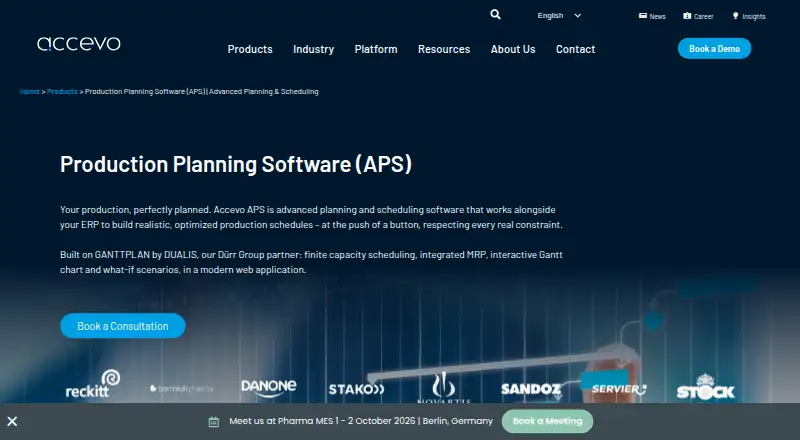
What Accevo APS is
Accevo APS schedules manufacturing orders around real limits on machines, personnel, tools, materials and other production resources. Its planning engine weighs up to seven criteria, including setup and production costs, throughput time, capacity use and delivery reliability, to create executable schedules alongside ERP systems. Integrated MRP provides lot-size optimization, pull-push strategies and Available-to-Promise checks. Planners can adjust schedules in an interactive Gantt chart; the system checks manual changes against restrictions in real time. Scenario mode allows production changes to be simulated and plans compared using KPIs before a decision is made. Accevo APS connects with SAP, Microsoft Dynamics, Oracle, Infor and Comarch through REST APIs and dedicated connectors, with bidirectional synchronization. When paired with Accevo MES, confirmations, machine states and order progress update schedules in real time. The product is a web application with no client installation. Pricing is available on request; license options include perpetual, subscription and fully managed SaaS. A typical implementation takes 3–6 months, with ERP data integration usually taking 4–6 weeks.
Good
- Plans machines, personnel, tools, materials and other resources together
- Balances up to seven weighted planning criteria
- Simulates scenarios and compares plans against KPIs
- Connects with several named ERP systems bidirectionally
Watch out
- Pricing is available only on request
- Typical implementation takes 3–6 months
- ERP data integration usually takes 4–6 weeks
Who it suits
Accevo APS may suit manufacturers coordinating constrained resources and production orders alongside an ERP system. Its listed industries include food and beverage, automotive and electronics, pharmaceuticals and life sciences, and discrete manufacturing.
Verdict
Accevo APS combines finite-resource scheduling, integrated MRP and scenario planning in a web application. Consider its implementation timeline and request pricing details to assess fit.
Plans and prices
From Accevo APS's own pricing page, checked 15 Oct 2026.
| Plan | Price | What it gives you |
|---|---|---|
| Fully Managed SaaS | Priced on request | managed infrastructure · updates · 24/7 managed support · price not published |
| Perpetual License | — | on-premise deployment · software ownership · one-time license purchase; optional annual maintenance |
| Subscription License | — | updates included · premium support · scale up/down · annual or multi-year subscription |
The facts
Each one read from Accevo APS's own pages, with the date it was checked.
Money
- AI-supported planning
- A self-learning layer analyzes historical production data, flags likely deviations and forecasts process durations.checked 15 Oct 2026
What it does
- API and connectors
- ERP connectivity is offered through REST APIs and dedicated connectors, with bidirectional synchronization of master data, work orders and bills of material.checked 15 Oct 2026
- ATP and CTP
- Available-to-promise and capable-to-promise checks are included in the material-planning workflow.checked 15 Oct 2026
- Automated optimization
- Its planning engine generates schedules automatically and can balance up to seven weighted objectives, including setup cost, production cost, labor cost, throughput, utilization, capital commitment and delivery reliability.checked 15 Oct 2026
- Bottleneck scheduling
- Multi-level bills of material are scheduled around constraints to reduce throughput time and work in progress.checked 15 Oct 2026
- Demo and quote
- The product page offers a free demo and describes a 60-minute online meeting, live production-process modeling and a budget quotation.checked 5 Oct 2026
- Deployment options
- Accevo states that its platform supports on-premise deployment, a customer cloud such as AWS, Azure or GCP, and Accevo-managed cloud SaaS.checked 15 Oct 2026
- Documentation and support
- The vendor publicly provides an FAQ and describes implementation, factory assessment and integration support, but no public APS developer SDK documentation is listed on the cited pages.checked 15 Oct 2026
- ERP integrations
- Named ERP integrations include SAP, Microsoft Dynamics, Oracle, Infor and Comarch.checked 15 Oct 2026
- Finite-capacity scheduling
- The scheduler uses finite capacity so planned work does not exceed available machines, shifts, tools or materials.checked 15 Oct 2026
- GDPR handling
- Accevo's privacy policy identifies Accevo Sp. z o.o. in Kraków as the data administrator and describes GDPR rights including access, correction, deletion, restriction, portability and objection.checked 15 Oct 2026
- Implementation
- A typical APS implementation takes 3–6 months, with ERP data integration usually taking 4–6 weeks.checked 5 Oct 2026
- Implementation timeline
- The vendor says a typical APS implementation takes three to six months, with ERP data integration commonly taking four to six weeks.checked 15 Oct 2026
- Industries
- Accevo identifies food and beverage, automotive and electronics, pharmaceuticals and life sciences, and discrete manufacturing as industries it serves with APS.checked 5 Oct 2026
- Integrated MRP
- The product includes material requirements planning with lot-size optimization and hybrid pull/push strategies.checked 15 Oct 2026
- Integration methods
- Beyond APIs, Accevo describes web services, database connections, flat files and dedicated connectors for enterprise integration.checked 15 Oct 2026
- Integrations
- Accevo APS connects to SAP, Microsoft Dynamics, Oracle, Infor and Comarch through REST APIs and dedicated connectors, with bidirectional synchronization.checked 5 Oct 2026
- Interactive Gantt
- Planners can drag and drop orders in an interactive Gantt chart, with edits checked against constraints in real time.checked 15 Oct 2026
- ISA-95 alignment
- The integration approach is described as aligned with the ISA-95 enterprise-to-control integration standard.checked 15 Oct 2026
The company
- Company founded and size
- LinkedIn lists Accevo as founded in 2006 with 51–200 employees and headquarters in Kraków, Poland.checked 15 Oct 2026
- Company legal name
- The contact page identifies the maker as Accevo sp. z o.o.checked 15 Oct 2026
- Company security
- Accevo says it holds ISO 9001, ISO/IEC 27001 and ISO 22301 certifications; these are company-level certifications listed on its compliance page.checked 5 Oct 2026
- Founded
- 2006checked 28 Sep 2026
- Headquarters
- Accevo lists its headquarters at Al. Pokoju 18B, 31-564 Kraków, Poland.checked 15 Oct 2026
The full review of Accevo APS
Accevo APS is a manufacturing planning application for plants that must schedule orders around real limits on machines, people, tools and materials. It is best suited to ERP-connected operations with several competing priorities and a need to test changes before releasing them. The trade-off is a substantial implementation and a quote-based buying process rather than an off-the-shelf, quick-start scheduler.
Overview
Accevo APS works alongside an ERP system to turn manufacturing orders into executable production schedules. Its planning engine can balance as many as seven weighted objectives, including setup cost, production cost, throughput time, capacity utilization and delivery reliability. That lets a planner formalize operational trade-offs instead of relying on a single optimization target, although the approach requires the business to agree on priorities during implementation.
The finite-capacity model schedules machines, qualified personnel, tools, other production resources and materials together. This is a meaningful advantage for plants where an apparently open machine still cannot run because the right operator, tool or component is unavailable. Integrated MRP adds lot-size optimization, pull-push strategies and Available-to-Promise checks, extending the product beyond sequencing jobs on a work centre.
Accevo identifies food and beverage, automotive and electronics, pharmaceuticals and life sciences, and discrete manufacturing among its target industries. A typical implementation takes three to six months, with ERP data integration usually requiring four to six weeks, so it is a considered transformation project rather than a lightweight departmental purchase.
Key features
- Constraint-aware scheduling: Machine and labor capacity planning, material constraints and simultaneous resource planning help produce schedules that reflect the shop floor’s actual limits.
- Multi-criteria optimization: Up to seven weighted criteria allow teams to choose whether cost, speed, utilization or delivery reliability should dominate a plan. The benefit is explicit prioritization; the cost is more planning discipline.
- Integrated MRP: Lot-size optimization, pull-push strategies and Available-to-Promise checks connect scheduling with material and customer-commitment decisions.
- Interactive Gantt chart: Drag-and-drop changes are checked against restrictions in real time. Planners can intervene manually without silently creating an infeasible sequence.
- Scenario planning: Scenario mode allows proposed production changes to be simulated and compared against KPIs before a plan is committed, reducing the risk of making disruptive changes directly in the live schedule.
- ERP connectivity: REST APIs and dedicated connectors provide bidirectional synchronization with SAP, Microsoft Dynamics, Oracle, Infor and Comarch. This is a strong fit for established ERP estates that need planning data to flow both ways.
- MES feedback: When connected to Accevo MES, confirmations, machine states and order progress update the schedule in real time, improving the relevance of plans as production conditions change.
Pricing
Accevo uses custom pricing, with a free demo that includes a 60-minute online meeting, live production-process modeling and a budget quotation.
- Perpetual License: A one-time license fee buys on-premise deployment and full software ownership. An annual maintenance fee is optional, so buyers should weigh ownership against the need for continuing support and updates.
- Subscription License: Annual or multi-year billing includes updates, support and maintenance, with the ability to scale up or down. It suits organizations that prefer operating expenditure and a less permanent commitment than a perpetual purchase.
- Fully Managed SaaS: All-inclusive pricing covers infrastructure, 24/7 managed support and automatic scaling. This is the most hands-off option, but it still requires a quotation and does not provide a published entry price.
Platforms
APS is delivered as a web application with no client installation and can be accessed from anywhere. The web delivery favors distributed planning teams and avoids maintaining desktop clients.
Who it's for
Choose Accevo APS when manufacturing schedules must respect finite machine, labor and material capacity, especially across ERP-connected plants with complex trade-offs. Its scenario comparison, integrated MRP and optional MES feedback are most valuable to organizations making consequential planning decisions across several resources or sites. Look elsewhere if you need a short deployment, transparent self-service pricing or a simple scheduler for a small operation.
Pros and cons
Pros
- Plans against real constraints: Machines, qualified staff, tools, materials and production resources are considered together.
- Broad planning scope: MRP functions and Available-to-Promise checks connect scheduling with material and customer commitments.
- Controlled what-if planning: KPI comparisons in scenario mode support safer decisions before committing changes.
- Enterprise integration: Bidirectional connections cover SAP, Microsoft Dynamics, Oracle, Infor and Comarch.
Cons
- Long implementation: A typical three-to-six-month project, plus ERP integration work, is unsuitable for urgent deployments.
- No published price: Every commercial edition requires a quotation, making initial budgeting harder.
- Configuration commitment: Multi-criteria optimization delivers most value only when priorities and production rules are clearly defined.
Alternatives
Browse Production Scheduling Software, Advanced Planning and Scheduling Software or Manufacturing Scheduling Software for category comparisons.
- frePPLe is the better starting point when a free, open-source edition or web, API, Linux and self-hosted deployment matters; its Cloud plan allows up to six scenarios.
- NETVIBES suits teams seeking a paid platform with free-plan and free-trial options across web, mobile and self-hosted environments.
- Phoenix APS is worth considering for a free beta evaluation, with a Windows/API footprint, when production use is not yet required.
- FitFactory Scheduler is an alternative for Android, iOS and Windows users; training is charged separately at £955+VAT per day.
- GE Vernova Proficy Plant Applications targets hosted or on-premises process, discrete and mixed manufacturing environments.
- DELMIA Demand Planning is a Windows option whose quote varies by package, business size, contract duration and requirements.
- SkyPlanner APS fits buyers wanting a paid product with a free trial and a five-workstation base plan.
- Statii offers a month-to-month shop-floor user plan at £8.50 a month, with cancellation at a month’s notice.
Verdict
Accevo APS is a strong choice for ERP-connected manufacturers that need finite-capacity schedules, integrated MRP and measurable scenario analysis across machines, labor and materials. Its main reason to choose it is the breadth of constraint-aware planning and integration; its main reason to look elsewhere is the three-to-six-month implementation and custom-priced commitment.
Alternatives to Accevo APS
- 1

GMDH Streamline
Free planAndroidiOSWebAPI7.6Free plan - 2
Microsoft Dynamics 365 Sales
AndroidiOSWebAPI7.6 - 3
Workday Adaptive Planning
AndroidiOSWebAPI7.5 - 4

frePPLe
Free planWebAPILinuxSelf-hosted7.2Free plan - 5

Inventory Planner
Free planWebAPI7.0Free plan - 6

Siemens Opcenter
WebAPISelf-hostedWindows7.0