ZEsarUX
ZEsarUX emulates Sinclair computers and a range of other systems, including ZX Spectrum, ZX80, ZX81, QL, Z88, Amstrad, MSX, ColecoVision, and Sega machines.
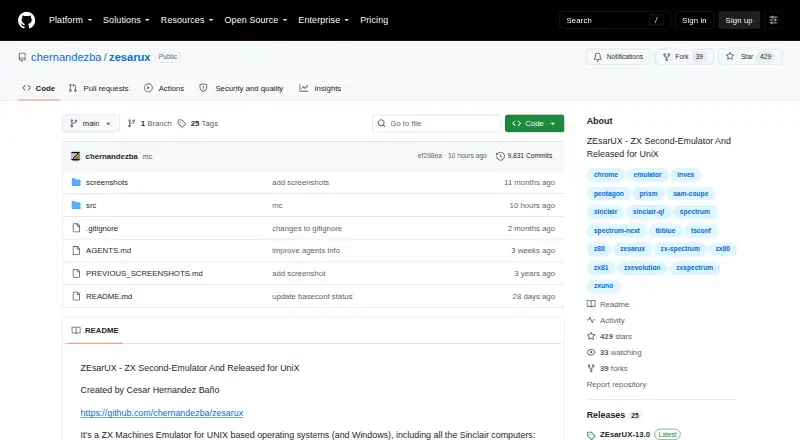
What ZEsarUX is
ZEsarUX emulates Sinclair computers and a range of other systems, including ZX Spectrum, ZX80, ZX81, QL, Z88, Amstrad, MSX, ColecoVision, and Sega machines. It is free software under GNU GPL v3, and its source code and binaries cost nothing to use. For Spectrum emulation, listed details include timing behavior, undocumented Z80 flags and registers, contended memory, and ULA timing. It supports tape, snapshot, floppy, microdrive, MMC/SD, IDE, and cartridge formats, and can save audio and video captures to files. Debugging tools include reverse debugging, CPU history, breakpoints, watches, assembler and disassembler views, and memory inspection. Network Gaming supports multiplayer with up to 16 emulator instances or a central online server. The remote command protocol works with a telnet client, and the project mentions enhanced debugging from Visual Studio Code through DeZog. Text-to-speech support can read the menu and captured game text. Releases are listed for GNU/Linux, FreeBSD, Haiku, macOS, Windows, and Raspberry Pi; a Docker image is also linked. Included third-party content is outside the GPL license.
Good
- Free software under GNU GPL v3
- Supports many tape and snapshot formats
- Includes reverse debugging and memory inspection
- Network multiplayer supports up to 16 instances
- Menu and game text can work with text-to-speech
Watch out
- Included third-party content is not covered by GPL
- Some supported systems are listed as tested, not released
Who it suits
ZEsarUX suits people who want to emulate Sinclair and other listed systems, with options for debugging, multiplayer, and text-to-speech access. Its range of supported media and host systems may also suit users working across different formats or operating systems.
Verdict
ZEsarUX combines broad machine and media support with detailed debugging and network multiplayer. Check the license status of included third-party content separately from the emulator's GPL license.
Plans and prices
From ZEsarUX's own pricing page, checked 30 Sep 2026.
| Plan | Price | What it gives you |
|---|---|---|
| ZEsarUX | Free | Free software · use costs nothing · optional donations |
The facts
Each one read from ZEsarUX's own pages, with the date it was checked.
What it does
- Accessibility
- Print-character traps can capture game text and send it to text-to-speech software, and the emulator menu can also be read by text-to-speech software.checked 30 Sep 2026
- Accuracy
- The feature list includes Spectrum timing emulation, undocumented Z80 flags and registers, contended memory, and ULA timing behavior.checked 30 Sep 2026
- Debugging
- Debug tools include reverse debugging, CPU history, breakpoints, watches, assembler and disassembler views, and memory inspection.checked 30 Sep 2026
- Developer integration
- The ZEsarUX remote command protocol can be used with a telnet client, and the project mentions enhanced debugging from Visual Studio Code via DeZog.checked 30 Sep 2026
- Latest release
- The GitHub releases page lists ZEsarUX 13.0, released on June 9, 2026.checked 30 Sep 2026
- License
- The source code and binaries are distributed under GNU GPL v3, and the project says it is free software that costs nothing to use.checked 30 Sep 2026
- Media support
- It supports tape, snapshot, floppy, microdrive, MMC/SD, IDE, and cartridge formats, with audio and video capture to files.checked 30 Sep 2026
- Multiplayer
- Its ZEsarUX Network Gaming protocol supports multiplayer through up to 16 emulator instances or a central online server.checked 30 Sep 2026
- Operating systems
- The maker lists binary releases for GNU/Linux, FreeBSD, Haiku, macOS, Windows, and Raspberry Pi, and also links a Docker image.checked 30 Sep 2026
- Other tested systems
- The project says it has also been tested on AROS, FiwixOS, Minix3, and Sortix.checked 30 Sep 2026
- Purpose
- ZEsarUX is an emulator for Sinclair computers and other machines, including ZX Spectrum, ZX80, ZX81, QL, Z88, Amstrad, MSX, ColecoVision, and Sega systems.checked 30 Sep 2026
- Support
- The repository asks users to read the included feature, installation, and history documents; it provides a YouTube channel and donation link.checked 30 Sep 2026
- Third-party content
- The project notes that included third-party ROMs, media, programs, and games are not covered by the GNU GPL license.checked 30 Sep 2026
The full review of ZEsarUX
Overview
ZEsarUX is a free emulator for Sinclair computers and a broad set of other classic machines, including Amstrad, MSX, ColecoVision and Sega systems. It is a particularly strong fit for people who need more than basic Spectrum playback, though its extensive options and technical tools are better suited to curious users than to anyone seeking a minimal, single-purpose emulator.
The project distributes its source code and binaries under GNU GPL v3. Version 13.0 was released on June 9, 2026. That license applies to the emulator, not included third-party ROMs, media, programs or games; check those separately before using or distributing them.
Key features
Emulation and media
Spectrum accuracy features include timing emulation, undocumented Z80 flags and registers, contended memory, and ULA timing behavior. These details matter to users interested in faithful machine behavior, rather than only loading a game. Support for tape and snapshot files spans formats including WAV, TZX, TAP, PZX, Z80, SNA, NEX and ZSF. The emulator also handles floppy, microdrive, MMC/SD, IDE and cartridge media, and can capture audio and video to files. The format range is a practical advantage for users with mixed software collections, though the sheer breadth of support comes with a more specialized feature set than a basic emulator needs.
Hardware, debugging and networking
Peripheral support covers joysticks, steering wheels, the ZX Printer, light guns, a light pen and Kempston mouse, alongside expansion and storage devices such as DivMMC, DivIDE, Dandanator, SamRam and HiLow DataDrive. A built-in debugger adds reverse debugging, CPU history, breakpoints, watches, assembler and disassembler views, and memory inspection. That makes ZEsarUX relevant to developers and users tracing program behavior, not just people starting old software.
ZEsarUX Network Gaming supports multiplayer across up to 16 emulator instances or through a central online server. Developers can send commands through a remote protocol using a telnet client; the project also describes enhanced debugging through Visual Studio Code with DeZog. For accessibility, print-character traps can pass game text to text-to-speech software, and the menu can also be read aloud. These are useful capabilities for specific workflows, though they are not substitutes for a simpler interface if those workflows are not needed.
Pricing
ZEsarUX: free. The free software plan includes the emulator at no charge, with optional donations. There is no free trial because the software itself is free; there are no paid tiers, seat counts or usage quotas described. Its GPL v3 license covers the project’s software, not third-party content bundled with it.
Platforms
Binary releases are offered for GNU/Linux, FreeBSD, Haiku, macOS, Windows, Raspberry Pi and Cygwin. The project also links a Docker image and says it has tested the emulator on AROS, FiwixOS, Minix3 and Sortix. The range makes it a flexible option across desktop and small-device environments, although the named platforms do not imply identical installation paths.
Who it's for
ZEsarUX suits retro-computing enthusiasts with software from multiple machine families, users who need broad media and peripheral support, and developers who value debugging, remote commands or multiplayer sessions. Its accuracy features and accessibility options widen that appeal. Someone who only wants a straightforward Spectrum emulator may find the additional machine, device and debugging support unnecessary.
Pros and cons
Pros
- Broad machine coverage: Emulates Sinclair systems alongside Amstrad, MSX, ColecoVision and Sega machines, making it useful beyond a single computer family.
- Deep Spectrum tools: Timing details, reverse debugging, memory inspection and CPU history serve users who need to examine how software behaves.
- Extensive media and hardware support: Multiple tape and snapshot formats plus storage interfaces and peripherals can accommodate varied collections and setups.
- Free and open source: The GPL v3 software costs nothing to use, with donations optional.
- Accessibility and multiplayer features: Text-to-speech support and network gaming address needs beyond solo emulation.
Cons
- Third-party licensing needs separate attention: The emulator’s GPL license does not cover included ROMs, media, programs or games.
- Technical breadth may be unnecessary for casual use: The many machine, media, peripheral and debugging options are most valuable to users who will use them.
Alternatives
For a broader comparison, browse ZX Spectrum Emulators.
- JNEXT is another free, open-source GPLv3 option for Linux, macOS and Windows; consider it if that platform set and a no-ads, nothing-for-sale model fit your needs.
- Spectral is free, open source and cross-platform on Linux, macOS and Windows, but its code is prone to change; choose it if an experimental emulator is acceptable.
- GZX is a free, open-source option for Linux and Windows with an MIT-style license, except for ZX Spectrum ROM files; it may suit users focused on those platforms.
- zx_go is a free, open-source alternative for Linux, macOS and Windows.
- EightyOne is a free, open-source Windows alternative.
- Unreal Speccy Portable is free and open source under GNU GPL v3 or later, with support for Android, Linux, macOS and Windows; consider it if Android support matters.
- Spectaculator is a paid alternative for Windows, iOS and Android.
- Klive IDE is a free, open-source option for Windows, macOS and Linux.
Verdict
Choose ZEsarUX if you want a free emulator that spans many classic systems and pairs detailed Spectrum emulation with serious debugging, media and multiplayer support. Look elsewhere if you want a narrower, simpler experience or need the emulator’s GPL license to cover bundled third-party content.
Alternatives to ZEsarUX
- 1
Unreal Speccy Portable
Free planOpen sourceAndroidiOSLinuxmacOS7.8Free plan - 2
Avidemux
Free planOpen sourceWebLinuxmacOSWindows7.3Free plan - 3
Klive IDE
Free planOpen sourceAPIExtensionLinuxmacOS7.2Free plan - 4

JNEXT
Free planLinuxmacOSWindows6.6Free plan - 5

Spectaculator
AndroidiOSWindows6.6$2.99 one-time - 6
SpeccyDate
Free planmacOSWindows6.3Free plan