Zero Density Reality
Zero Density Reality 5 is a real-time graphics platform for virtual studios, augmented and extended reality, on-air graphics, and videowall production.
What Zero Density Reality is
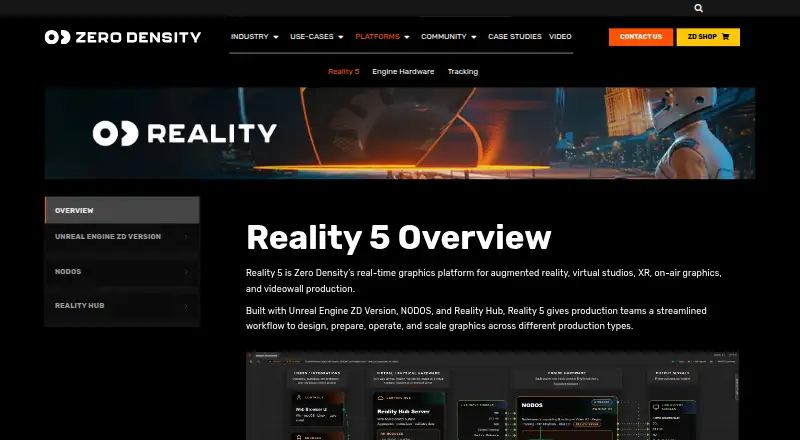
Zero Density Reality 5 is a real-time graphics platform for virtual studios, augmented and extended reality, on-air graphics, and videowall production. Its workflow combines Unreal Engine ZD Version, NODOS, and Reality Hub for content creation, compositing, and live playout. NODOS is a node-based compositor that handles real-time video input/output and logic processing separately from Unreal Engine. Reality Hub provides browser-based control, with shop bundles specifying Chrome or Edge on a modern computer without a client installation. The Lino workflow lets designers create reusable graphic templates for different shows and channels. Reality Hub can take data from web services, databases, XLSX files, and CSV files, and the platform supports newsroom, automation, and custom integrations. NODOS lists support for FreeD, Xync, Mo-Sys, Stype, and Telemetrics tracking protocols. An Open Studio License Program offers no-cost access for eligible applicants, subject to approval and conditions. Paid bundles include an On-Air Graphics option at $4,888 a year and an Augmented Reality option at $16,992 a year; bundle capabilities and limits vary.
Good
- Browser-based control through Reality Hub
- Reusable graphic templates across shows and channels
- Ingests data from databases and web services
- NODOS lists support for five tracking protocols
Watch out
- Open Studio access requires eligibility and approval
- Open Studio licenses exclude support unless purchased
- Bundles can limit channels, cameras, or render output
Who it suits
Reality 5 suits broadcast and production teams creating virtual studio, AR, XR, on-air graphics, or videowall workflows. Eligible SOHO, academic, and self-learning applicants can apply for the no-cost Open Studio License Program.
Verdict
Reality 5 combines graphics creation, compositing, and live playout with browser-based control and data integrations. Compare bundle limits and support terms with the intended production workflow.
Plans and prices
From Zero Density Reality's own pricing page, checked 30 Sep 2026.
| Plan | Price | What it gives you |
|---|---|---|
| Open Studio License Program | Free | eligibility and approval required · SOHO under $1,000,000 annual gross revenue, academic, or self-learning use · self-learning is non-commercial |
| Reality 5 On-Air Graphics Bundle | $4,888 a year | single-channel graphics engine · one render output channel · Reality Hub LE runs on same system as Reality 5 · 1 Year; 3 Year option |
| Reality 5 Designer Bundle | $8,067 a year | design workstation bundle · Reality Hub LE · resolutions depend on available hardware · 1 Year; 3 Year option |
| Reality 5 Backdrop Virtual Studio Bundle | $14,867 a year | single-camera green screen workflows · one HD render · cannot place virtual elements in front of talent · 1 Year; 3 Year option |
| Reality 5 Augmented Reality Bundle | $16,992 a year | single-camera AR productions · one HD render · Reality Hub LE runs on same system as Reality 5 Core Engine · 1 Year; 3 Year option |
The facts
Each one read from Zero Density Reality's own pages, with the date it was checked.
The company
- Company
- Zero Density says it began in Türkiye in 2014 and serves 72 countries across six continents; its stated headquarters address is in Izmir, Turkey.checked 30 Sep 2026
- Founded
- 2016checked 28 Sep 2026
- Headquarters
- Amstelveen, Netherlandschecked 28 Sep 2026
What it does
- Compositing
- NODOS is a node-based compositor for real-time video I/O and logic processing, running separately from Unreal Engine to handle media processing.checked 30 Sep 2026
- Graphics templates
- The Lino workflow lets designers build a graphic once as a template for reuse across shows and channels.checked 30 Sep 2026
- Hardware compatibility
- The shop listings describe SDI video I/O using AJA Corvid or Blackmagic Design DeckLink hardware, with supported models subject to the documentation.checked 30 Sep 2026
- Integrations
- Reality Hub can ingest data from web services, databases, XLSX files, and CSV files, and the platform supports newsroom integrations, automation, and custom integrations.checked 30 Sep 2026
- Purpose
- Reality 5 is a real-time graphics platform for virtual studios, augmented reality, extended reality, on-air graphics, and videowall production.checked 30 Sep 2026
- Security and privacy
- Zero Density’s privacy notice says it stores information in cloud servers in Europe and local office servers, with some data for US and Turkey operations stored outside the EEA.checked 30 Sep 2026
- Support
- Paid shop bundles include unlimited ticket support through the Zero Density Shop Dashboard, while Open Studio licenses do not include support unless purchased separately.checked 30 Sep 2026
- Tracking
- NODOS lists support for FreeD, Xync, Mo-Sys, Stype, and Telemetrics tracking protocols.checked 30 Sep 2026
- Web control
- Reality Hub provides browser-based control, and the shop bundles specify Chrome or Edge on a modern computer without a client installation.checked 30 Sep 2026
- Workflow
- The platform combines Unreal Engine ZD Version, NODOS, and Reality Hub in a workflow spanning content creation, compositing, and live playout.checked 30 Sep 2026
Money
- Free access
- The Open Studio License Program offers the software ecosystem at no cost to eligible SOHO, academic, and self-learning applicants, subject to approval and program conditions.checked 30 Sep 2026
- Trial
- Zero Density says self-learning users cannot use their access in a company and invites users seeking to test the software in production to request trial licenses through its contact form.checked 30 Sep 2026
The full review of Zero Density Reality
Overview
Reality 5 is a real-time graphics system for broadcast and virtual production teams building studio environments, on-air visuals, or videowall content. Its strongest case is when one production workflow needs graphics creation, compositing, and live playout working together; smaller or non-commercial users should weigh the Open Studio restrictions against the paid bundles.
The platform brings Unreal Engine ZD Version, NODOS, and Reality Hub into a connected workflow. That breadth can reduce the need to stitch separate creation and playout tools together, but the bundle matters: the entry-level on-air option is limited to one render output channel, while virtual studio and AR bundles are framed around single-camera workflows and one HD render.
Key features
Reusable graphics and control
Lino lets designers create a graphic template once and reuse it across shows and channels. For broadcasters with recurring packages, that favors consistency and reuse over building each graphic anew. Reality Hub provides browser-based control; shop bundles describe access through Chrome or Edge on a modern computer without installing a client, which is useful for control-room workflows that need browser access.
Compositing, data, and tracking
NODOS is a node-based compositor that handles real-time video I/O and logic processing separately from Unreal Engine. Keeping media processing in a separate component gives teams a dedicated compositing stage in the workflow. Reality Hub can ingest data from web services, databases, XLSX files, and CSV files, and the platform supports newsroom, automation, and custom integrations. That makes it relevant where graphics need to respond to operational or editorial data rather than remain static.
NODOS supports FreeD, Xync, Mo-Sys, Stype, and Telemetrics tracking protocols. The platform also supports camera tracking, LED-stage and greenscreen workflows, and live compositing. SDI I/O is described with AJA Corvid or Blackmagic Design DeckLink hardware, with model support subject to documentation; buyers should confirm their specific card before committing.
Pricing
Reality is paid software, with a no-cost route for eligible applicants and production trials available by request. Shop bundles include unlimited ticket support through the Zero Density Shop Dashboard; Open Studio licenses do not include support unless purchased separately.
| Plan | Price and fit | Key limits |
|---|---|---|
| Open Studio License Program | free; approval required for eligible SOHO, academic, or self-learning use | SOHO means under $1,000,000 annual gross revenue; self-learning is non-commercial. Support is not included unless purchased separately. |
| Reality 5 On-Air Graphics Bundle | $4,888 a year, billed 1 Year; 3 Year option. For single-channel on-air graphics. | One render output channel; Reality Hub LE runs on the same system as Reality 5. |
| Reality 5 Designer Bundle | $8,067 a year, billed 1 Year; 3 Year option. For a design workstation. | Includes Reality Hub LE; resolution depends on available hardware. |
| Reality 5 Backdrop Virtual Studio Bundle | $14,867 a year, billed 1 Year; 3 Year option. For single-camera green-screen workflows. | One HD render; cannot place virtual elements in front of talent. |
| Reality 5 Augmented Reality Bundle | $16,992 a year, billed 1 Year; 3 Year option. For single-camera AR productions. | One HD render; Reality Hub LE runs on the same system as Reality 5 Core Engine. |
The free program is not an unrestricted trial: access depends on approval and eligibility, and self-learning use cannot take place in a company. Self-learning users seeking to test production use should request a trial license through the contact form.
Platforms
Reality supports Windows, Linux, and macOS, with browser access for Reality Hub. The browser-control bundles specify Chrome or Edge on a modern computer. Unreal Engine 5 is the render engine, while supported SDI I/O depends on compatible AJA or Blackmagic hardware.
Who it's for
Reality is best suited to broadcast graphics departments and virtual-production teams that need real-time rendering, tracked cameras, reusable show graphics, and a route from creation through compositing to playout. The Designer Bundle fits graphics workstations; the On-Air bundle is the narrower choice for a single output channel; and the Backdrop and AR bundles target specific single-camera productions. It is a weaker fit for teams that need multiple render outputs or more flexibility than the stated single-camera and HD bundle limits provide.
Pros and cons
Pros
- Creation, compositing, and live playout are combined in one workflow, useful for teams coordinating those stages.
- Lino templates can be reused across shows and channels, supporting repeatable graphics packages.
- Reality Hub data ingestion covers web services, databases, XLSX, and CSV, alongside newsroom, automation, and custom integrations.
- Tracking protocol support includes FreeD, Xync, Mo-Sys, Stype, and Telemetrics.
Cons
- The paid bundles carry substantial annual prices, and several are constrained to one render output or one HD render.
- The Backdrop bundle cannot place virtual elements in front of talent, limiting its compositing arrangement.
- Open Studio requires approval, has eligibility conditions, and excludes support unless separately purchased.
- SDI compatibility depends on particular AJA or Blackmagic hardware models, so teams must verify their equipment.
Alternatives
- Notch is worth considering for a Windows or macOS user choosing between a non-commercial 1080p Indie license at $279 a year and a VFX plan at $117 a month with 16K x 16K export.
- Assimilate Live Looks may suit buyers seeking a monthly recurring Live Looks license at $89 a month with support and updates during the subscription.
- Disguise Designer offers a free Designer Starter for learning, training, testing, and pre-visualising projects without connecting to Disguise servers.
- Pixotope has a free, feature-limited HD configuration that requires no licensing step, while its Core plan is positioned for virtual studio and augmented reality.
- Aximmetry is an option for Windows users who prefer a 5990.00 USD lifetime Broadcast & Film license rather than Reality's annual bundle pricing.
- SMODE offers a free non-commercial Community license with Full HD input, output, content, and export, or a Compose FHD plan at €300 a year.
- Shroozy Stage is another free option for Windows, macOS, Linux, Android, and web.
- ARFX Infinite Studio is another freemium option for Windows and iOS.
- Virtual Production Software is a category list for comparing options across the field.
Verdict
Choose Reality 5 if your broadcast or virtual-production team needs graphics authoring, real-time compositing, tracking, and browser-based control in one production platform. Its integrated workflow and data connections are the clearest reasons to pay for it; look elsewhere if the annual bundle cost or one-channel, single-camera, or HD output limits do not match your production scale.
Getting started
- Visit the Reality 5 website.
- Choose an Open Studio application if eligible, or select a paid shop bundle.
- Request approval for Open Studio access; self-learning use is non-commercial.
- For production testing, request a trial license through the contact form.
- For shop-bundle browser control, use Chrome or Edge on a modern computer.
Limits worth knowing
The Open Studio License Program costs nothing and requires eligibility and approval; self-learning use is non-commercial. The $4,888 a year On-Air Graphics bundle provides one channel and one render output. The $14,867 a year Backdrop bundle is limited to a single-camera green-screen workflow and one HD render, and cannot place virtual elements in front of talent.
Questions
Is there a free plan?
The Open Studio License Program costs nothing for eligible SOHO, academic, and self-learning applicants, subject to approval and conditions.
What do the paid bundles cost?
Designer costs $8,067 a year, and Backdrop Virtual Studio costs $14,867 a year.
What platforms does Reality 5 support?
The listed platforms are Windows, Linux, macOS, and web browser.
Can I try it before production use?
Zero Density invites users seeking to test the software in production to request trial licenses through its contact form. Self-learning users cannot use their access in a company.
Does it support camera tracking and integrations?
Camera tracking is supported. Reality Hub can ingest web-service, database, XLSX, and CSV data; NODOS lists FreeD, Xync, Mo-Sys, Stype, and Telemetrics tracking support.
Is support included?
Paid shop bundles include unlimited ticket support through the Zero Density Shop Dashboard. Open Studio licenses do not include support unless purchased separately.
Alternatives to Zero Density Reality
- 1
Grid Studio
Free planAndroidiOS7.5From €5 a year - 2

Disguise Designer
Free planWebmacOSWindows7.1From $1,500 a year - 3
Shroozy Stage
Free planAndroidWebLinuxmacOS6.7Free plan - 4
Lightcraft Jetset
iOSmacOS6.6From $200 a year - 5

Notch
macOSWindows6.6From $279 a year - 6
SMODE
Free planWindows6.6From €300 a year