yente
Yente is an open-source API for searching, retrieving, and matching people, companies, and other entities against watchlists.
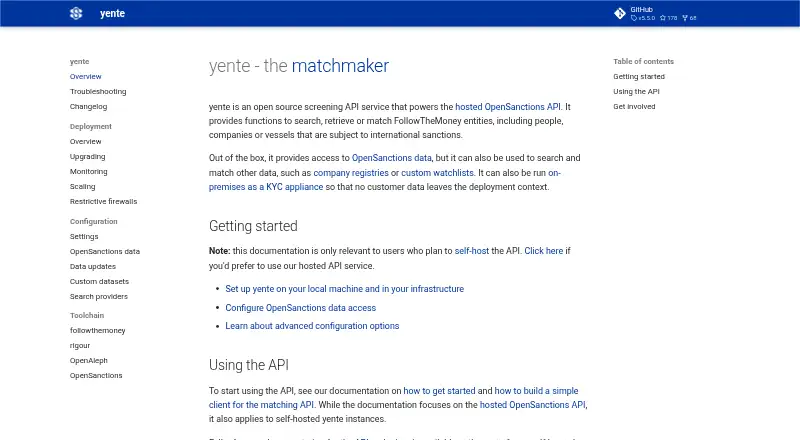
What yente is
Yente is an open-source API for searching, retrieving, and matching people, companies, and other entities against watchlists. It uses the OpenSanctions database by default and can also work with company registries and custom watchlists. Operators can add datasets, choose which OpenSanctions data to index, and set scopes through a manifest file; custom data uses line-based JSON feeds of FollowTheMoney entities. Yente checks for OpenSanctions updates hourly by default and reindexes when a new build is available. It can run on premises so customer query data stays within the deployment context. Deployment materials include pre-built Docker containers and example Docker Compose and Kubernetes configurations. The software supports Elasticsearch and OpenSearch, and provides health endpoints plus OpenTelemetry metrics and traces. Its documentation estimates 800 MB of memory per Python service and 4–16 GB of memory and 10–30 GB of disk for the Elasticsearch index. Default match batches accept up to 100 entities and return up to 500 results per query. Yente is released under the MIT License. Commercial use of OpenSanctions data requires a data license; non-commercial and exempt users can use the civic manifest.
Good
- Open-source software released under the MIT License.
- Can run on premises to keep query data in deployment.
- Supports Elasticsearch and OpenSearch backends.
- Custom datasets and scopes can be configured.
- Health endpoints and OpenTelemetry metrics and traces are provided.
Watch out
- Commercial OpenSanctions data use requires a license subscription.
- Default match batches are limited to 100 entities.
- Default match queries return at most 500 results.
- Documentation estimates substantial memory and disk requirements for Elasticsearch.
Who it suits
Yente suits teams building watchlist screening into API-based workflows, including those seeking on-premises deployment or custom datasets. It is listed for PEP screening, ongoing monitoring, and batch screening, but not transaction screening.
Verdict
Yente provides a configurable screening API with self-hosting and custom dataset options. Commercial users should account for OpenSanctions licensing, and operators should check the documented infrastructure and match limits.
The facts
Each one read from yente's own pages, with the date it was checked.
What it does
- API functions
- The API supports searching, retrieving, and matching FollowTheMoney entities.checked 8 Oct 2026
- API limits
- Default configuration accepts at most 100 entities per match batch and returns at most 500 results per match query.checked 8 Oct 2026
- Commercial data licensing
- The documentation says commercial use of OpenSanctions data requires a license subscription; non-commercial users and users exempt from commercial licensing may use the civic manifest.checked 8 Oct 2026
- Commercial data use
- Commercial use of the OpenSanctions dataset requires a data license; the documentation says non-commercial users and exempt users can access OpenSanctions data directly.checked 8 Oct 2026
- Custom datasets
- Users can add datasets, limit which OpenSanctions data is indexed, and define custom scopes through a manifest file.checked 8 Oct 2026
- Data format
- Custom datasets must be line-based JSON feeds of FollowTheMoney entities.checked 8 Oct 2026
- Data source
- By default, Yente fetches the OpenSanctions database, and it can also use other datasets such as company registries and custom watchlists.checked 8 Oct 2026
- Data sources
- Yente provides access to OpenSanctions data by default and can also search and match company registries or custom watchlists.checked 8 Oct 2026
- Data updates
- By default, Yente checks for updated OpenSanctions data hourly and reindexes when a new build is available.checked 8 Oct 2026
- Deployment
- The project provides pre-built Docker containers and example Docker Compose and Kubernetes configurations.checked 8 Oct 2026
- Infrastructure requirements
- The documentation estimates 800 MB of memory per Python service and 4–16 GB of memory plus 10–30 GB of disk for the Elasticsearch index.checked 8 Oct 2026
- License
- Yente is released under the MIT License.checked 8 Oct 2026
- Monitoring
- Yente provides /healthz and /readyz health endpoints and supports OpenTelemetry metrics and traces.checked 8 Oct 2026
- On-premises
- Yente can run on-premises so customer query data stays within the deployment context.checked 8 Oct 2026
- Privacy
- The documentation says an on-premises deployment can keep customer data from leaving the deployment context.checked 8 Oct 2026
- Purpose
- Yente is an open-source screening API for searching, retrieving, and matching people, companies, and other entities against watchlists.checked 8 Oct 2026
- Search backend
- Yente supports Elasticsearch and OpenSearch backends.checked 8 Oct 2026
- Search backends
- Yente supports Elasticsearch and OpenSearch backends.checked 8 Oct 2026
- Self-hosting
- Yente can run on premises as a KYC appliance so customer data stays within the deployment context.checked 8 Oct 2026
- Support and contributions
- The project welcomes issue reports and contributions on GitHub.checked 8 Oct 2026
The company
- Founded
- 2023checked 28 Sep 2026
- Headquarters
- Berlin, Germanychecked 28 Sep 2026
The full review of yente
Yente is an open-source screening API for teams that need to search and match people, companies, and other entities inside their own environment. It is strongest for organizations able to run search infrastructure and manage compliance data themselves; smaller teams seeking a hosted service may find the operational burden less attractive.
Overview
Yente provides search, retrieval, and matching for FollowTheMoney entities. OpenSanctions is the default source, while company registries and custom watchlists can also be indexed. A manifest lets operators restrict which OpenSanctions data is indexed and create custom scopes, giving compliance teams more control than a fixed, vendor-defined list.
On-premises deployment keeps customer query data within the deployment context, a meaningful advantage for organizations with strict data-residency or confidentiality requirements. Yente is MIT-licensed and free as software, but that does not remove data-licensing costs: commercial use of OpenSanctions requires a separate license subscription. Non-commercial and exempt users can use the civic manifest.
Key features
Screening and monitoring
The API supports individual searches, entity retrieval, and matching, with batch screening, PEP screening, and ongoing monitoring. Transaction screening is not supported, so teams focused on payment-by-payment controls need another product or an additional system. Custom list management covers organization-specific watchlists rather than only the default sanctions source.
Datasets and updates
Custom datasets must be line-based JSON feeds containing FollowTheMoney entities. That standard is useful when your data pipeline already produces the format, but it creates conversion work for teams maintaining spreadsheets, relational exports, or another entity model. By default, Yente checks for new OpenSanctions builds hourly and reindexes when an update is available, reducing manual refresh work.
Deployment and operations
Pre-built Docker containers, example Docker Compose files, and Kubernetes configurations provide a practical starting point for self-hosting. Elasticsearch and OpenSearch are supported backends, so operators can choose between those search stacks. The documented sizing is substantial for a small deployment: each Python service is estimated at 800 MB of memory, while the Elasticsearch index needs 4–16 GB of memory and 10–30 GB of disk.
Operational visibility is better than a bare API: /healthz and /readyz endpoints support service checks, and OpenTelemetry metrics and traces can feed an existing observability setup. Default matching limits accept up to 100 entities per batch and return up to 500 results per match query; larger workloads will require configuration review or additional processing design.
Pricing
Yente is free and open source under the MIT License, with no paid software tiers or seat charges. The important commercial term is the data, not the application: commercial OpenSanctions use requires a license subscription, while non-commercial and exempt users may access the data through the civic manifest. Teams should therefore budget for licensing when deploying Yente in a commercial compliance program.
Platforms
Yente is available as an API for Linux, web-connected workflows, and self-hosted or on-premises deployments. Docker and Kubernetes examples suit organizations with container infrastructure; Elasticsearch or OpenSearch must be operated as the search backend.
Who it's for
Yente fits compliance, engineering, and platform teams that need screening inside their own network, want to combine OpenSanctions with registries or private watchlists, and can maintain indexing infrastructure. It is also a good foundation for organizations that need API-based PEP screening and ongoing monitoring with customized scopes.
It is a weaker fit for teams wanting a turnkey hosted product, transaction screening, or minimal infrastructure ownership. The JSON feed requirement, search-cluster sizing, match caps, and commercial OpenSanctions licensing all add implementation and operating responsibilities.
Pros and cons
Pros
- Self-hosting and privacy: on-premises operation keeps query data within the deployment context.
- Flexible data control: manifests, custom scopes, registries, and private watchlists let teams tailor screening coverage.
- Open integration model: MIT licensing, API access, Docker, Kubernetes, Elasticsearch, and OpenSearch support work well with existing platforms.
- Built-in observability: health endpoints and OpenTelemetry support simplify production monitoring.
Cons
- Commercial data cost: using OpenSanctions commercially requires a separate license subscription.
- Infrastructure overhead: operators must run Python services and a search backend with documented memory and disk requirements.
- Format and scale constraints: custom feeds must use line-based FollowTheMoney JSON, while default matching is capped at 100 entities per batch and 500 results.
- No transaction screening: payment screening is outside Yente's scope.
Alternatives
OFACScreen is a better choice for a hosted API and web workflow with a 14-day trial, 25 searches, three users, five monitored names, and CSV imports up to 25 rows. SanctionsScreening.io suits buyers seeking a managed API/web service with a published Pro plan at $29 a month. Choose ScreeningHub when a hosted or self-hosted product with a free allowance of 100 screens per month is preferable.
FinCrimeRadar is a free web option for teams that do not need an API-led deployment. Eastnets SafeWatch AML is a paid web alternative. NICE Actimize is a paid API/web platform with custom pricing. Enlighta Sanctions Screening and Kharon Compliance are paid API/web alternatives.
Verdict
Choose Yente if you need an extensible, self-hosted screening API and have the engineering capacity to operate its search stack and data feeds. Its strongest reason to choose is control over deployment and datasets; its main reason to look elsewhere is the infrastructure work and separate OpenSanctions licensing required for commercial use.
Alternatives to yente
- 1
OpenSanctions
Free planOpen sourceWebAPILinuxmacOS8.2Free plan - 2
OFACScreen
Free planWebAPI6.7From $49 a month - 3
ScreeningHub
Free planWebAPISelf-hosted6.7From €79 a month - 4
SanctionsScreening.io
Free planWebAPI6.6From $29 a month - 5

Lexis+
AndroidiOSWeb6.5 - 6

NICE Actimize
WebAPI6.2