OpenSanctions
OpenSanctions provides a structured database of sanctions, politically exposed persons, and other public-interest information collected from hundreds of sour…
What OpenSanctions is
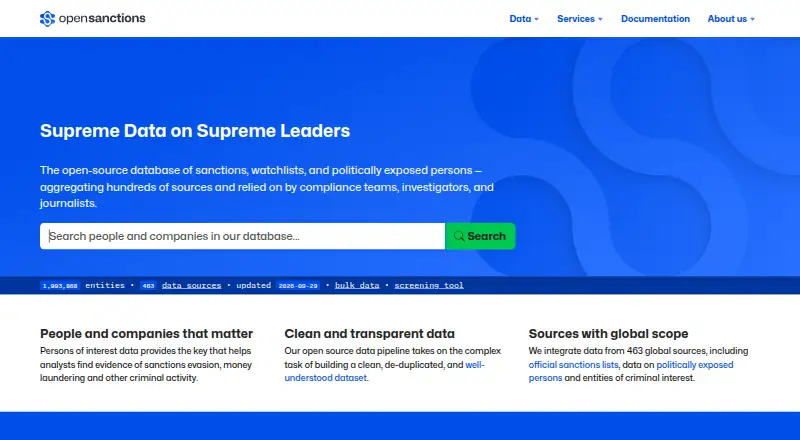
OpenSanctions provides a structured database of sanctions, politically exposed persons, and other public-interest information collected from hundreds of sources. It deduplicates records and models relationships such as ownership, family connections, political positions, and sanctions designations. Its hosted API offers entity matching, full-text search, and complete record retrieval. The /match endpoint returns ranked candidates based on details such as names, dates of birth, nationality, or tax identifiers. Customers can download the full dataset, and commercial license customers can run the matching API on their own infrastructure. OpenSanctions says data points are traceable to their sources and the data pipeline is open source. The API is listed at €0.10 per query, with a 30-day trial; commercial screening and reseller licenses are quoted. It provides database and matching technology rather than a complete compliance application with alert review, case management, and approval workflows. Its data collection is licensed as a whole, not as selected portions.
Good
- Records cover sanctions, PEPs, and public-interest information.
- API offers matching, full-text search, and record retrieval.
- Full dataset is available to download.
- Commercial customers can run matching on their infrastructure.
- On-premise matching can keep customer PII in-house.
Watch out
- It does not include case-management workflows.
- Data is licensed as a complete collection.
- No ready-made CRM or ERP integrations are provided.
- Commercial license prices are quoted.
Who it suits
OpenSanctions may suit compliance platforms, fintechs, investigators, government agencies, researchers, journalists, and others building screening or research tools. Its matching API and downloadable or self-hosted data options serve teams that need to integrate screening technology into their own systems.
Verdict
OpenSanctions supplies data and matching tools for teams building their own screening workflows, rather than a finished compliance application. Review the whole-collection licensing terms and quoted commercial options if you need more than the metered API.
Plans and prices
From OpenSanctions's own pricing page, checked 15 Oct 2026.
| Plan | Price | What it gives you |
|---|---|---|
| Non-commercial access | Free | Bulk data free for non-commercial use · free public-interest API keys |
| Screening API | €0.10, paid once | 30 day API trial · /entities and /statements are free · matching and search API · €0.10 per query; search is €0.10 per request. The API page lists €0.10/query; API FAQ lists metered endpoint costs. New prepaid credit bundles are available, but bundle prices are shown during booking. |
| Screening API 500 credits | €50, paid once | 500 credits · €0.10 per query · credits valid one year · prepaid |
| Screening API 5,000 credits | €400, paid once | 5,000 credits · €0.08 per query · 20% saving · credits valid one year · prepaid |
| Screening API 30,000 credits | €2,000, paid once | 30,000 credits · €0.067 per query · 33% saving · credits valid one year · prepaid |
| Screening API 100,000 credits | €5,000, paid once | 100,000 credits · €0.05 per query · 50% saving · credits valid one year · prepaid |
| Screening API 500,000 credits | €15,000, paid once | 500,000 credits · €0.03 per query · 70% saving · credits valid one year · prepaid |
| Reseller license | Priced on request | Full dataset · redistribution inside products sold to customers · quote |
| Screening license | Priced on request | Full dataset · internal organizational use · transaction monitoring · flat-rate quote |
The facts
Each one read from OpenSanctions's own pages, with the date it was checked.
What it does
- API documentation
- Interactive endpoint documentation and an OpenAPI JSON specification are provided for client generation.checked 15 Oct 2026
- Bulk data and self-hosting
- The full dataset is available for download, and commercial license customers can run the matching API on their own infrastructure.checked 30 Sep 2026
- Bulk formats
- Bulk exports are available as FollowTheMoney JSON, CSV, names-only text and Senzing entity data, with statement-level CSV for provenance.checked 15 Oct 2026
- Continuous monitoring
- Documentation describes re-screening counterparties when watchlist data changes.checked 15 Oct 2026
- Coverage
- The licensing page lists 30 entity types, more than 470 sources and over 47 million facts.checked 15 Oct 2026
- CRM and ERP integrations
- OpenSanctions says it does not provide ready-made integrations for specific CRM or ERP products.checked 30 Sep 2026
- Data model
- OpenSanctions uses the FollowTheMoney model to represent entities, ownership, family, political and sanctions relationships.checked 15 Oct 2026
- Data provenance
- The company says every data point can be traced back to its source and that its data pipeline is open source.checked 30 Sep 2026
- Data updates
- The default collection is republished about every six hours, while source lists update every four to twelve hours or on slower schedules.checked 15 Oct 2026
- Entities API
- The /entities endpoint returns a complete record for one entity, including nested related records.checked 15 Oct 2026
- Entity categories
- The published collection includes people, organizations, securities, crypto addresses, vessels and aircraft, and enforcement notices.checked 15 Oct 2026
- Entity resolution
- OpenSanctions deduplicates entities across sources and models links such as ownership, family ties, political positions, and sanctions designations.checked 30 Sep 2026
- Explainability
- The API exposes auditable explanations for match scores and publishes its matching methodology.checked 15 Oct 2026
- Hosted API features
- The API provides entity matching, full-text search, and retrieval of complete entity records.checked 30 Sep 2026
- Independent package metadata
- PyPI describes the project as an open-source sanctions and PEP data codebase, with a Python API appliance and technical documentation.checked 15 Oct 2026
- Independent repository
- The public GitHub repository describes parsing, cleaning, deduplication and export functions and is marked MIT licensed.checked 15 Oct 2026
- Independent repository activity
- GitHub displays 846 stars, 192 forks and more than 19,000 commits for the public repository.checked 15 Oct 2026
- Integrations
- Documented integration options include OpenRefine, Senzing exports, OpenAPI-generated clients and the Taktile platform partnership.checked 15 Oct 2026
- Intended users
- The company describes compliance platforms, fintechs, investigation tools, government agencies, research institutions, journalists, and researchers as users of its data.checked 30 Sep 2026
- Legal entity
- Companyhouse identifies the legal entity as OpenSanctions Datenbanken GmbH, registered in Berlin under HRB 251172, with €25,000 capital and registration on 29 March 2023.checked 15 Oct 2026
The company
- Company history
- OpenSanctions says the project began in 2015, was rebuilt for commercial use with a 2021 BMBF Prototype Fund grant and incorporated as a GmbH in 2023.checked 15 Oct 2026
- Company profile
- LinkedIn lists OpenSanctions as a privately held IT services company founded in 2021, headquartered in Berlin, with 11–50 employees.checked 15 Oct 2026
- Founded
- 2023checked 28 Sep 2026
- Headquarters
- Berlin, Germanychecked 28 Sep 2026
The full review of OpenSanctions
Overview
OpenSanctions is best suited to teams building compliance products, screening services, or research workflows around public-interest data. It combines a broad, traceable dataset with matching technology, but leaves the customer to build the operational layer around screening results.
The dataset brings together sanctions, politically exposed persons, and other public-interest records from hundreds of sources. Entity resolution connects duplicate records and models relationships such as ownership, family ties, political positions, and sanctions designations. OpenSanctions was founded in 2023 and is headquartered in Berlin.
Key features
Screening and data access
The hosted API supports full-text search, complete entity-record retrieval, and entity matching. Its /match endpoint ranks potential candidates using query details such as names, dates of birth, nationality, or tax identifiers. That makes it useful as a screening component, while the quality of the final decision and the surrounding workflow remain the customer's responsibility.
OpenSanctions supports PEP, transaction, ongoing, and batch screening, with selectable list management. Customers can download the full dataset; commercial license customers can also run the matching API on their own infrastructure. OpenSanctions says on-premise matching keeps customer personally identifiable information within the customer's environment, an important option for organizations with strict data-handling requirements.
Integration, provenance, and operations
The Python yente-client includes a typed SDK, command-line tool, and MCP server, and OpenSanctions documents an OpenRefine Reconciliation API. Its open-source data pipeline and source traceability help users inspect where records come from. OpenSanctions also says it holds ISO 27001:2022 certification and operates under a 99.8% uptime SLA.
The trade-off is substantial for teams seeking a ready-made screening desk: OpenSanctions does not provide alert review, case management, or approval workflows, nor does it offer ready-made integrations for specific CRM or ERP products. Its support team helps customers evaluate and integrate the data before a license is signed, but the implementation work still belongs to the buyer.
Pricing
The freemium offer combines a free plan with a 30-day API trial. The Screening API is metered at €0.10 per query; search costs €0.10 per request. The /entities and /statements endpoints are free, while matching and search are chargeable. Prepaid credit bundles are available, with prices shown during booking. This is a relatively direct way to test or adopt API screening without committing to a full license, but usage-based charges make query volume a cost to manage.
The Screening license has custom pricing, quoted during an initial conversation, with flat-rate pricing for the full dataset, in-house screening, transaction monitoring, and internal use only. It suits organizations that need a locally operated screening service or broad internal use, but the complete-collection licensing rule means buyers cannot license only selected parts of the dataset.
The Reseller license also has custom pricing, quoted during the first conversation. It provides a wholesale license to redistribute data inside products a customer sells, with a reseller API. This is the relevant route for product builders embedding OpenSanctions data commercially; it is not the internal-use option. No seat limits are stated for these plans.
Platforms
OpenSanctions is available through API, self-hosted deployment, and web access. The API is the natural fit for product teams integrating screening into software, while self-hosting is aimed at commercial license customers needing to run matching on their own infrastructure. Web access offers a way to work with the service without building solely around an API.
Who it's for
OpenSanctions is a strong fit for compliance platforms, fintechs, investigation tools, government agencies, research institutions, journalists, and researchers that can make use of a structured, continuously updated dataset. Product teams can choose between metered hosted access, in-house screening under a license, or redistribution under a reseller license.
It is a weaker fit for organizations that need a finished compliance application or turnkey CRM and ERP connections. Such buyers would need to provide their own alert handling, casework, approvals, and product integrations.
Pros and cons
- Pros: Broad coverage of sanctions, PEPs, and other public-interest records, with source traceability and modeled entity relationships, gives teams a richer basis for matching than an unlinked list.
- Pros: The free endpoints, 30-day API trial, and €0.10-per-query matching make it possible to begin with API screening before considering a larger license.
- Pros: Full-data downloads and commercial self-hosting support internal deployments, while the reseller license supports redistribution in products.
- Cons: It is data and matching technology, not a complete screening application, so alert review and case management must come from elsewhere or be built in-house.
- Cons: Licensing the complete collection rather than selected portions can be a poor fit for buyers seeking only a narrow subset.
- Cons: No ready-made CRM or ERP integrations means additional integration work for organizations relying on those systems.
Alternatives
For a category-wide comparison, browse Sanctions Screening Software.
- SanctionsScreening.io is worth comparing for teams seeking a freemium API and web option; its Pro plan is $29 a month, and it is built and operated by Arventra, a technology studio focused on regulatory, compliance, and data-intensive products.
- Eastnets SafeWatch AML is a paid web-based alternative.
- FinCrimeRadar is a free web-based alternative.
- LSEG Corporate Treasury Risk is a paid web-based alternative with pricing available by contacting sales.
- OFACScreen is a freemium web-based alternative.
- ScreeningHub is a freemium web-based alternative.
- FinScan is a paid alternative across API, self-hosted, and web platforms; pricing is provided on request and a demo is required.
- ThetaRay RAY Platform is a paid API and web alternative; pricing requires a discovery call.
Verdict
Choose OpenSanctions if you need a traceable, relationship-aware sanctions and PEP dataset plus matching technology that you can integrate or host yourself. Its central advantage is the combination of broad data access and deployment options; its central drawback is that you must supply the case-management application and integrations around it. Teams seeking a turnkey compliance workflow should look elsewhere.
Alternatives to OpenSanctions
- 1
OFACScreen
Free planWebAPI6.7From $49 a month - 2
ScreeningHub
Free planWebAPISelf-hosted6.7From €79 a month - 3
SanctionsScreening.io
Free planWebAPI6.6From $29 a month - 4

Lexis+
AndroidiOSWeb6.5 - 5

NICE Actimize
WebAPI6.2 - 6
FinCrimeRadar
Free planWeb6.0Free plan