
Yarken
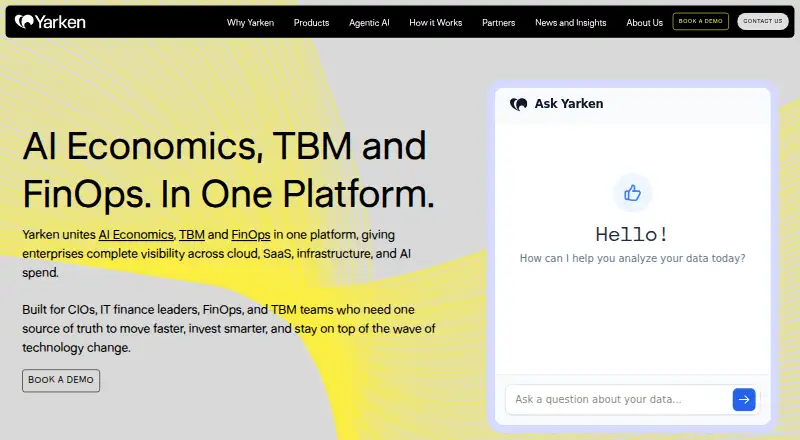
Yarken unifies AI Economics, Technology Business Management, and FinOps to show enterprise spending across cloud, SaaS, infrastructure, and AI.
What Yarken is
Yarken unifies AI Economics, Technology Business Management, and FinOps to show enterprise spending across cloud, SaaS, infrastructure, and AI. It connects AI usage, spend, and ownership with business value, including cost per request, seat, workload, and outcome. Cost workflows include budgeting, forecasting, allocation, anomaly detection, unit economics, showback, and chargeback. Ask Yarken takes natural-language questions and returns structured observations, root causes, and recommendations. Integrations span AWS, Azure, Google Cloud, and SaaS, ERP, identity, HR, data, observability, and ITSM systems. Ingestion options include APIs, SFTP and files, cloud buckets, local agents, webhooks and streaming, and query federation. Advanced integrations are not enabled by default and can vary by environment; required connections are enabled during implementation or onboarding. Yarken says it offers single-tenant deployment options and customer choice of data location, and has SOC 2 Type II audited controls. Pricing is custom and on request; module and capability access depends on the organization’s license.
Good
- Connects AI spend with business value measures.
- Includes budgeting, forecasting, and cost allocation.
- Supports showback and chargeback workflows.
- Offers multiple data ingestion methods.
Watch out
- Pricing is on request.
- Advanced integrations are not enabled by default.
- Module access depends on the organization’s license.
Who it suits
Yarken is aimed at CIOs, IT finance leaders, FinOps teams, and TBM teams seeking visibility into enterprise technology and AI spending. It may suit organizations that need budgeting, allocation, and showback or chargeback workflows.
Verdict
Yarken brings spending visibility and cost-management workflows across several technology areas. Account for integration enablement and license-dependent capabilities when considering it.
Plans and prices
From Yarken's own pricing page, checked 4 Oct 2026.
| Plan | Price | What it gives you |
|---|---|---|
| Control | Priced on request | Custom pricing and implementation options available; AI Economics package for teams seeking a trusted view of AI spend |
| Forecast | Priced on request | Custom pricing and implementation options available; AI Economics package for organizations managing AI usage, ownership, budgets, and governance |
| Value | Priced on request | Custom pricing and implementation options available; AI Economics package for leaders connecting AI investment to business value and financial accountability |
The facts
Each one read from Yarken's own pages, with the date it was checked.
What it does
- AI assistant
- Ask Yarken accepts natural-language questions and returns structured observations, root causes, and recommendations.checked 4 Oct 2026
- AI economics
- The platform connects AI usage, spend, and ownership to business value, including cost per request, seat, workload, and outcome.checked 4 Oct 2026
- Audience
- Yarken says it is built for CIOs, IT finance leaders, FinOps teams, and TBM teams.checked 4 Oct 2026
- Deployment and data location
- Yarken says it offers single-tenant deployment options and lets customers choose data location.checked 4 Oct 2026
- FinOps certification
- Yarken says it is FinOps Foundation certified and supports the FOCUS cloud cost and usage specification.checked 4 Oct 2026
- Integration availability
- Advanced integrations are not enabled by default and can vary by environment; Yarken enables required integrations during implementation or onboarding.checked 4 Oct 2026
- Integration methods
- Supported ingestion methods include APIs, SFTP and files, cloud buckets, local agents, webhooks and streaming, and query federation.checked 4 Oct 2026
- Integrations
- The integrations page lists cloud platforms including AWS, Azure, and Google Cloud, plus SaaS, ERP, identity, HR, data, observability, and ITSM systems.checked 4 Oct 2026
- Licensing
- Yarken’s help documentation says module and capability access depends on the organization’s license, which administrators manage using .lic files.checked 4 Oct 2026
- Product
- Yarken unifies AI Economics, Technology Business Management (TBM), and FinOps to give enterprises visibility across cloud, SaaS, infrastructure, and AI spend.checked 4 Oct 2026
- Security
- Yarken states that it has SOC 2 Type II audited controls and supports GDPR-regulated environments, role-based access control, and encryption at rest and in transit.checked 4 Oct 2026
- Support
- Yarken’s help center directs users to email [email protected] for support.checked 4 Oct 2026
The company
- Company locations
- Yarken lists offices in New York, Auckland, Slough, and Hyderabad.checked 4 Oct 2026
Money
- Cost management
- Yarken supports budgeting, forecasting, allocation, anomaly detection, unit economics, showback, and chargeback workflows.checked 4 Oct 2026
The full review of Yarken
Overview
Yarken is an enterprise platform for connecting technology costs with financial management across cloud, SaaS, infrastructure, and AI. It is best suited to CIOs, IT finance leaders, FinOps teams, and TBM teams that need a shared view of spend and business value. Its breadth is compelling, but integration enablement and license-dependent capabilities make implementation and scope important parts of the decision.
Key features
Yarken brings AI Economics, Technology Business Management, and FinOps together. Its AI Economics workflows connect usage, ownership, and spend to business value, including costs per request, seat, workload, and outcome. That framing can help teams move beyond tracking AI bills toward understanding who owns the spend and what it delivers.
For broader cost management, it supports budgeting, forecasting, allocation, anomaly detection, unit economics, showback, and chargeback. Scenario planning and multiple reporting and export options add useful finance workflows, while both showback and chargeback let organizations choose how to make technology costs visible or assign them to consumers.
Ask Yarken accepts natural-language questions and returns structured observations, root causes, and recommendations. This offers a direct route from a cost question to an explanation, though access to modules and capabilities depends on the organization’s license.
Integrations span cloud providers such as AWS, Azure, and Google Cloud, alongside SaaS, ERP, identity, HR, data, observability, and ITSM systems. Data can be ingested through APIs, SFTP and files, cloud buckets, local agents, webhooks and streaming, or query federation. The range is a strength for complex environments; advanced integrations are not enabled by default and may vary by environment, so required connections are enabled during implementation or onboarding.
Yarken states that it has SOC 2 Type II audited controls and supports GDPR-regulated environments, role-based access control, and encryption at rest and in transit. Single-tenant deployment options and customer choice of data location address deployment and residency needs. Its FinOps Foundation certification and support for the FOCUS cloud cost and usage specification are relevant for teams working to a common FinOps framework.
Pricing
Yarken uses paid, custom pricing, with implementation options available. It does not publish prices for Forecast, Control, or Value, so buyers should plan to discuss scope and implementation with Yarken rather than compare fixed fees.
- Forecast: An AI Economics package for organizations managing AI usage, ownership, budgets, and governance. It suits teams that need those management workflows together.
- Control: An AI Economics package for teams seeking a trusted view of AI spend. It is the clearest fit when spend visibility is the primary need.
- Value: An AI Economics package for leaders connecting AI investment to business value and financial accountability. It fits organizations focused on linking investment and outcomes.
These package descriptions distinguish their focus, but access to modules and capabilities is governed by the organization’s license, which administrators manage using .lic files. Confirm that the required workflows and integrations are included before committing.
Platforms
Yarken supports API, self-hosted, and web platforms. That combination gives buyers options for integrating it into existing systems or choosing a self-hosted deployment, while single-tenant options and customer-selected data location provide further deployment flexibility.
Who it's for
Yarken is a strong candidate for enterprises whose CIO, IT finance, FinOps, and TBM teams need to coordinate technology budgets and costs across cloud, SaaS, infrastructure, and AI. It is less suitable for buyers seeking a self-serve, fixed-price product: pricing is custom, implementation options are part of the purchase, and advanced integrations require enablement.
Pros and cons
- Pro: Combines AI Economics, TBM, and FinOps, giving cross-functional teams a way to connect technology spending with financial accountability.
- Pro: Supports budgeting, forecasting, allocation, scenario planning, showback, and chargeback, covering key cost-management workflows.
- Pro: Offers several data-ingestion methods and broad integration categories, which can accommodate varied enterprise data environments.
- Pro: Single-tenant deployment options, selectable data location, and stated security controls support organizations with deployment and governance requirements.
- Con: Custom pricing and implementation options make cost and rollout planning less straightforward than with a published, self-serve plan.
- Con: Advanced integrations are not enabled by default, and capability access depends on licensing, so buyers must align integration and module scope before adoption.
Alternatives
For a broader comparison, see IT Financial Management Software.
- MagicOrange is another paid option, available through API and web platforms.
- Nicus ITFM Platform is another paid option with a web platform.
- Upland ComSci is another paid option with a web platform.
- Choose CostPerform if a free trial and an API or web platform suit your evaluation; its cloud and AI product pricing is based on organizational cloud spend and available on request.
- ClearCost IT Financial Management is another paid option with pricing available by contacting ClearCost or booking a demo.
- Choose CIO COCKPIT if a free trial and a published five-year contract option fit your requirements; it supports API, Linux, self-hosted, web, and Windows platforms.
- CostLens AI is another paid option with a web platform and a free trial.
- Omnia Financial Management is another paid option available for self-hosted and web platforms.
Verdict
Choose Yarken if your enterprise needs a common cost-management platform across technology areas, especially one that connects AI usage and spend to financial value. Its broad workflows, integration methods, and deployment options are meaningful strengths. Look elsewhere if you need transparent fixed pricing or expect advanced integrations and capabilities to be available without implementation and license scoping.
Alternatives to Yarken
- 1
CostPerform
AndroidiOSWebAPI7.6From $80,000 a year - 2

CIO COCKPIT
WebAPILinuxSelf-hosted7.2From €799 a month - 3
Planview AdaptiveWork
AndroidiOSWebAPI6.9 - 4

Flexera One IT Asset Management
WebSelf-hosted6.4 - 5

CostLens AI
Web5.7 - 6
KP-One
Web5.7