
webpack
webpack is a static module bundler for modern JavaScript applications.
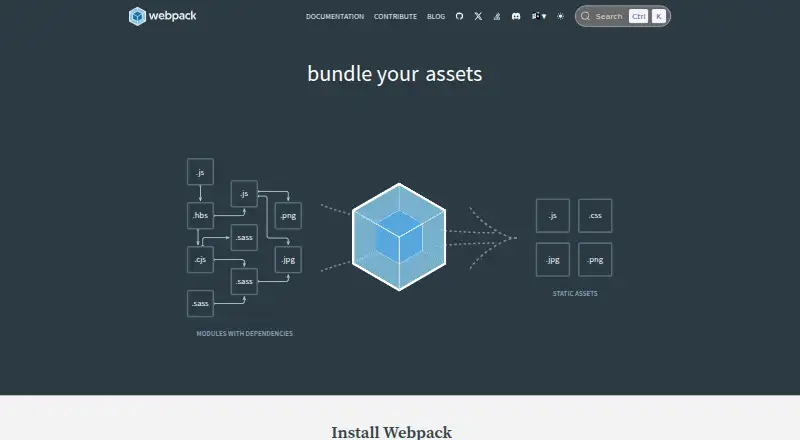
What webpack is
webpack is a static module bundler for modern JavaScript applications. It builds a dependency graph and combines modules into bundles, with code splitting to let parts of an application load on demand. Built-in support covers JavaScript, JSON, WebAssembly, CSS, and HTML; loaders can transform sources such as Sass and TypeScript. Plugins can customize the build process through compilation lifecycle hooks, and ModuleFederationPlugin enables runtime sharing between independently built applications. Since version 4.0.0, a configuration file is optional, though webpack remains highly configurable. It offers CLI, Node API, loader, and plugin interfaces, and documents integrations with Browserify, Brunch, Grunt, Gulp, Mocha, and Karma. The project recommends local npm installation with a fresh Node.js installation; command-line use from webpack v4 onward also requires webpack-cli. It is free open-source software under the MIT license. CSP is not enabled by default, and native CSS and HTML support are experimental.
Good
- Free under the MIT license
- Supports code splitting
- Loaders transform source files
- Module Federation shares modules at runtime
- Provides CLI, Node API, loader, and plugin interfaces
Watch out
- Command-line use needs webpack-cli
- Global installation is not recommended
- CSP is not enabled by default
- Native CSS and HTML support are experimental
Who it suits
webpack suits JavaScript developers who need to bundle application modules and control build customization. Its low-level approach and several interfaces are relevant to people comfortable configuring development tools.
Verdict
webpack offers extensive ways to bundle and customize modern JavaScript applications, including code splitting and runtime module sharing. Its low-level nature and setup requirements are worth considering before choosing it.
Plans and prices
From webpack's own pricing page, checked 30 Sep 2026.
| Plan | Price | What it gives you |
|---|---|---|
| Open-source webpack | Free | MIT license · self-managed software · Free of charge |
The facts
Each one read from webpack's own pages, with the date it was checked.
What it does
- Built-in modules
- Webpack understands JavaScript, JSON, WebAssembly, CSS and HTML through built-in support.checked 30 Sep 2026
- Code splitting
- Webpack supports code splitting so parts of an application can load on demand.checked 30 Sep 2026
- Configuration
- Since version 4.0.0, webpack does not require a configuration file, although it remains highly configurable.checked 30 Sep 2026
- Experimental features
- Native CSS and Native HTML support are documented as experimental features.checked 30 Sep 2026
- Installation
- The project recommends local npm installation and requires a fresh Node.js installation, with webpack-cli additionally needed for command-line use from webpack v4 onward.checked 30 Sep 2026
- Integrations
- Official integrations documentation covers Browserify, Brunch, Grunt, Gulp, Mocha and Karma.checked 30 Sep 2026
- Interfaces
- Webpack provides CLI, Node API, loader and plugin interfaces for configuring and extending compilation.checked 30 Sep 2026
- Loaders
- Loaders transform source files, including compiling Sass to CSS and TypeScript to JavaScript.checked 30 Sep 2026
- Module Federation
- The built-in ModuleFederationPlugin shares modules between independently built applications at runtime.checked 30 Sep 2026
- Notable limitation
- Global installation is not recommended because it locks projects to one webpack version and can fail when projects require different versions.checked 30 Sep 2026
- Plugins
- Plugins can customize the build process and access the compilation lifecycle through hooks.checked 30 Sep 2026
- Project maintenance
- The webpack repository is maintained by its Core Working Group and most contributors do the open-source work in their free time.checked 30 Sep 2026
- Security
- Webpack can add nonces to loaded scripts and supports Trusted Types for dynamically constructed scripts, but CSP is not enabled by default.checked 30 Sep 2026
- Support model
- The project describes webpack as a low-level tool, points beginners to its documentation, and directs bug reports and feature suggestions to GitHub issues.checked 30 Sep 2026
- What it does
- Webpack is a static module bundler for modern JavaScript applications that builds a dependency graph and combines modules into bundles.checked 30 Sep 2026