
Vite
Vite is a free build tool for developing modern web projects.
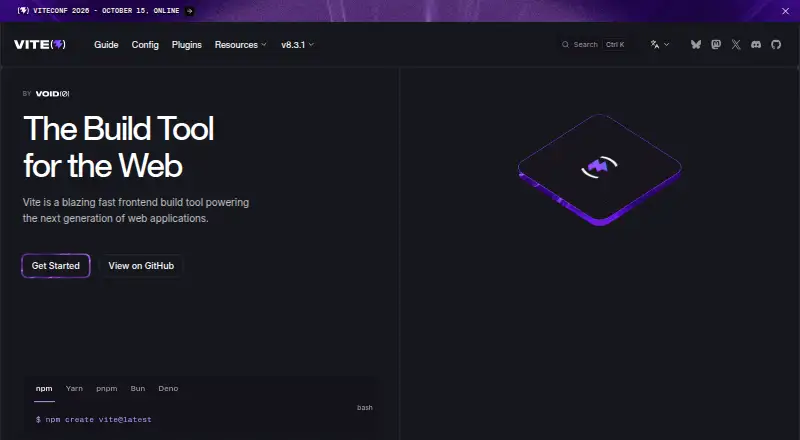
What Vite is
Vite is a free build tool for developing modern web projects. Its development server serves source files on demand using native ES modules and supports Hot Module Replacement. For production, the `vite build` command bundles assets into an application suitable for static hosting. Vite supports TypeScript, JSX, CSS, web workers, and WebAssembly, while plugins can add capabilities. Its plugin interface builds on Rollup’s interface and can extend the development server and SSR functionality. Documented framework integrations include Vue, React, Preact, Svelte, Solid, Qwik, Nuxt, SvelteKit, Astro, and React Router. Developers can try it in a browser through StackBlitz framework templates. Vite runs on Linux, macOS, Windows, and the web. It requires Node.js 20.19+ or 22.12+, and some templates may need a higher version. Vite transpiles TypeScript but does not type-check it, so type checking must be handled separately. Legacy browser support can be added with the official `@vitejs/plugin-legacy`. Vite is MIT licensed and free and open source.
Good
- Free and open source under the MIT license.
- Development server supports Hot Module Replacement.
- Production builds suit static hosting.
- Integrates with a range of web frameworks.
- Can be tried online through StackBlitz.
Watch out
- Requires Node.js 20.19+ or 22.12+.
- Some templates may require a higher Node.js version.
- Transpiles TypeScript but does not type-check it.
Who it suits
Vite may suit developers building modern web projects who want a development server and production build tool. It supports a range of frameworks and can be extended with plugins.
Verdict
Vite provides a development server, production bundling, and a plugin interface for web projects. Developers need a supported Node.js version and should handle TypeScript checks separately.
Plans and prices
From Vite's own pricing page, checked 30 Sep 2026.
| Plan | Price | What it gives you |
|---|---|---|
| Vite | Free | MIT licensed · free and open source |
The facts
Each one read from Vite's own pages, with the date it was checked.
Money
- Browser trial
- Vite can be tried online in a browser through StackBlitz using supported framework templates.checked 30 Sep 2026
What it does
- Community support
- Vite directs users who need help to its Discord community and GitHub Discussions.checked 30 Sep 2026
- Core components
- Vite consists of a development server with native ES module support and a build command that bundles production assets with Rolldown.checked 30 Sep 2026
- Development server
- Vite serves source files on demand over native ES modules and supports Hot Module Replacement.checked 30 Sep 2026
- Features
- Vite supports TypeScript, JSX, CSS, web workers, and WebAssembly, with additional features available through plugins.checked 30 Sep 2026
- Framework integrations
- Vite documents integrations with frameworks including Vue, React, Preact, Svelte, Solid, Qwik, Nuxt, SvelteKit, Astro, and React Router.checked 30 Sep 2026
- Maintainer
- Vite's site credits VoidZero Inc. and Vite contributors, and VoidZero's about page identifies Evan You as Founder and CEO.checked 30 Sep 2026
- Plugins
- Vite's plugin interface builds on Rollup's plugin interface and supports extending the development server and SSR functionality.checked 30 Sep 2026
- Production builds
- The `vite build` command produces an application bundle suitable for static hosting.checked 30 Sep 2026
- Purpose
- Vite is a build tool for faster, leaner development of modern web projects.checked 30 Sep 2026
- Runtime requirement
- Vite requires Node.js 20.19+ or 22.12+, and some templates may require a higher version.checked 30 Sep 2026
- Security reporting
- VoidZero says security reports for its packages can be submitted using GitHub's reporting feature.checked 30 Sep 2026
- TypeScript limitation
- Vite transpiles TypeScript but does not perform type checking; its documentation recommends handling type checks separately.checked 30 Sep 2026
Where it runs
- Legacy browsers
- Legacy browser support can be added with the official `@vitejs/plugin-legacy`, which generates legacy chunks and language feature polyfills.checked 30 Sep 2026
The full review of Vite
Vite is a build tool for developing and bundling modern web projects, aimed at developers who want a fast local workflow and a production bundle without a paid plan. Its combination of an on-demand development server and plugin support makes it a strong fit for current web projects, with a separate type-checking step needed for TypeScript.
Overview
Vite serves source files as native ES modules and supports Hot Module Replacement, so changes can appear during development without rebuilding the whole application. For production, vite build creates an application bundle suitable for static hosting. That split gives developers a focused development workflow and a clear path to deployable assets.
Vite covers TypeScript, JSX, CSS, web workers, and WebAssembly, and its plugin interface extends the tool into development-server and server-side-rendering workflows. It builds on Rollup’s plugin interface, which gives plugin authors a familiar base. Framework integrations include Vue, React, Preact, Svelte, Solid, Qwik, Nuxt, SvelteKit, Astro, and React Router.
Key features
- On-demand development server: Native ES modules and Hot Module Replacement suit iterative work on modern projects.
- Production bundling: The build command produces assets for static hosting, with code splitting, tree shaking, and source maps among its supported capabilities.
- Plugin interface: Rollup-compatible plugins can extend both the development server and SSR functionality, making Vite adaptable beyond its core features.
- TypeScript support: Vite transpiles TypeScript but does not check types. Teams must run type checks separately, so Vite alone is not a complete TypeScript validation workflow.
- Legacy browser support: The official @vitejs/plugin-legacy can generate legacy chunks and language-feature polyfills, though projects targeting older browsers need that additional plugin.
Pricing
Vite is free and open source under the MIT license. Its free plan costs nothing and has no paid tier to weigh against it. Developers still need a supported Node.js installation: Vite requires Node.js 20.19+ or 22.12+, and some templates may require a newer version.
Vite can also be tried in a browser through StackBlitz using supported framework templates. That is useful for a quick evaluation without setting up a local project, but local development requires meeting the Node.js runtime requirement.
Platforms
Vite is available for Linux, macOS, Windows, and the web. The online StackBlitz option offers a browser-based way to try supported framework templates; local use depends on the required Node.js version.
Who it's for
Vite suits developers building modern web applications who want native ES module development, hot updates, and a production bundler at no software cost. Its broad framework integrations and plugin interface make it a practical choice for teams already working in those ecosystems. It is less suitable as the sole tool for TypeScript quality checks, and projects needing older-browser support should plan to add the legacy plugin.
Pros and cons
Pros
- Free, MIT-licensed software: There is no paid plan to unlock its development server or production build workflow.
- Development and production in one tool: Native-module serving with Hot Module Replacement pairs with bundling for static hosting.
- Broad framework and plugin support: Documented integrations span many popular frameworks, while the Rollup-based plugin interface can extend server and SSR behavior.
- Online trial option: Supported templates can be explored through StackBlitz before local setup.
Cons
- Type checks are separate: Transpiling TypeScript does not catch type errors, so teams need another check in their workflow.
- Runtime version matters: Local use requires Node.js 20.19+ or 22.12+, and some templates may demand more.
- Older browsers need an add-on: Legacy chunks and polyfills require the official plugin rather than the core workflow alone.
Alternatives
For a wider comparison, see JavaScript Build Tools.
- esbuild is another free option; consider it when a native executable or WebAssembly version better fits your setup.
- Rolldown is free and open source; consider it if you want to evaluate the bundler Vite uses for production builds as a separate tool.
- Rspack is a free, MIT-licensed alternative to compare for your build-tool needs.
- webpack is free, MIT-licensed, self-managed software; consider it if that deployment model suits your project.
- Parcel is a free open-source alternative supported by code and financial contributions.
- SWC is a free, open-source Rust-based developer toolchain; consider it if that toolchain is a closer fit.
- Rollup is another free build-tool option to compare.
- Google Closure Compiler is a free open-source Java application, Bazel library, and NPM package; consider it if those forms suit your environment.
Verdict
Choose Vite for modern web projects that benefit from native-module development, Hot Module Replacement, and a production build in a free, plugin-friendly tool. Its broad framework support is a persuasive reason to make it a default candidate. Look elsewhere or add companion tooling if you need TypeScript type checking built into this workflow, and account for the Node.js requirement before committing.