Virtual Labs
Virtual Labs provides remote access to simulation-based laboratories in science and engineering.
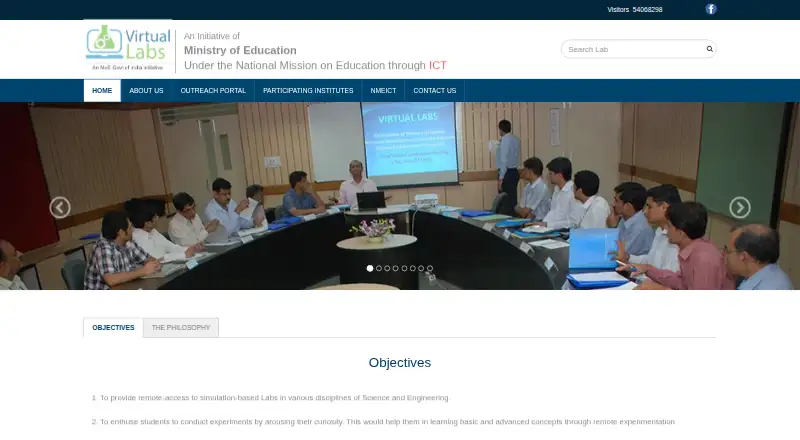
What Virtual Labs is
Virtual Labs provides remote access to simulation-based laboratories in science and engineering. The project comprises over 175 Virtual Labs and approximately 1590+ web-enabled experiments, spanning fields such as electronics, computer science, electrical, mechanical, chemical, biotechnology, civil, physical sciences, and mathematics. Users can access simulations over the internet with a PC or smartphone and broadband connectivity, without additional infrastructure at their premises. Labs include step-by-step instructions, while learning resources include web materials, video lectures, animated demonstrations, and self-evaluation. Most experiments are available without registration, though some simulation labs require one-time registration on the individual lab website. Specific software is generally not required; some labs with software dependencies provide a free download link. The simulations are available 24×7, including weekends, and users can email queries to the support team. Virtual Labs is free of cost to users. It is an initiative of India's Ministry of Education under the National Mission on Education through ICT, and a consortium of twelve participating institutes with IIT Delhi as the coordinating institute.
Good
- Free of cost to users
- More than 175 labs and approximately 1590+ experiments
- Available 24×7, including weekends
- Most experiments do not require registration
Watch out
- Broadband connectivity is needed
- Some labs require one-time registration
- Some labs may require a free software download
Who it suits
The project identifies science and engineering students and faculty, high-school students, researchers, and engineering colleges as intended users. It may suit learners who want remote access to guided simulations across multiple scientific and technical fields.
Verdict
Virtual Labs offers free, remote simulations across a wide range of subjects, with learning materials and experiment guidance. Users need broadband, and a few labs may require registration or a software download.
The facts
Each one read from Virtual Labs's own pages, with the date it was checked.
What it does
- Access
- The FAQ says users can access the labs with a PC or smartphone and broadband connectivity.checked 7 Oct 2026
- Availability
- The FAQ says simulation-based labs are available 24×7, including weekends.checked 7 Oct 2026
- Fields
- Labs cover areas including electronics, computer science, electrical, mechanical, chemical, biotechnology, civil, physical sciences, and mathematics.checked 7 Oct 2026
- Guidance
- Each lab provides step-by-step instructions to help users conduct experiments.checked 7 Oct 2026
- Institutional participation
- Institutes can apply to become a Nodal Centre by submitting an Expression of Interest form.checked 7 Oct 2026
- Intended users
- The project identifies science and engineering college students and faculty, high-school students, researchers, and engineering colleges as intended beneficiaries.checked 7 Oct 2026
- Learning resources
- The project describes a learning management system with web resources, video lectures, animated demonstrations, and self-evaluation.checked 7 Oct 2026
- Nodal centres
- Institutes can enroll as a Nodal Centre by submitting an Expression of Interest form.checked 7 Oct 2026
- Participating institutes
- The project is a consortium activity of twelve participating institutes, with IIT Delhi as the coordinating institute.checked 7 Oct 2026
- Project scale
- The About page says the project comprises over 175 Virtual Labs and approximately 1590+ web-enabled experiments.checked 7 Oct 2026
- Project sponsor
- Virtual Labs is an initiative of India's Ministry of Education under the National Mission on Education through ICT.checked 7 Oct 2026
- Purpose
- Virtual Labs provides remote access to simulation-based laboratories in science and engineering disciplines.checked 7 Oct 2026
- Registration
- The FAQ says users can perform experiments directly, while some simulation labs require one-time registration on the respective website.checked 7 Oct 2026
- Registration limit
- Most experiments can be performed without registration, while some simulation-based labs require one-time registration on the respective lab website.checked 7 Oct 2026
- Remote access
- Simulations can be accessed remotely over the internet without additional infrastructure at the user's premises.checked 7 Oct 2026
- Scale
- The project says it includes over 175 Virtual Labs and approximately 1590+ web-enabled experiments.checked 7 Oct 2026
- Software requirements
- The FAQ says the labs do not require specific software, though some labs with software dependencies provide a free download link.checked 7 Oct 2026
- Support
- Users can email queries to the Virtual Labs support team.checked 7 Oct 2026
- Who it serves
- Intended users include science and engineering students and faculty, high-school students, researchers, and engineering colleges.checked 7 Oct 2026
Money
- Cost
- The FAQ says Virtual Labs is free of cost to the user.checked 7 Oct 2026
- Price
- The FAQ says Virtual Labs are free of cost to the user.checked 7 Oct 2026
Where it runs
- Device access
- The FAQ says users can access Virtual Labs using a PC or smartphone with broadband connectivity.checked 7 Oct 2026
The company
- Headquarters
- New Delhi, Indiachecked 28 Sep 2026
Alternatives to Virtual Labs
- 1

Beyond Labz
Free planAndroidiOSWebmacOS8.2$31.95 one-time - 2
PraxiLabs
Free planAndroidiOSWeb8.1From $29.99 a year - 3
Molecular Workbench
Free planOpen sourceWebLinuxmacOSWindows7.6Free plan - 4
ChemCollective Virtual Lab
Free planAndroidiOSWebmacOS7.5Free plan - 5

Labster
AndroidiOSWebmacOS7.0From $5,000 a year - 6
Pivot Interactives
iOSWebmacOSWindows7.0From $6.10 a year