Viglet Turing ES
Viglet Turing ES is a free, open-source enterprise search platform for organizations that want search, content integration and generative AI on infrastructur…
What Viglet Turing ES is
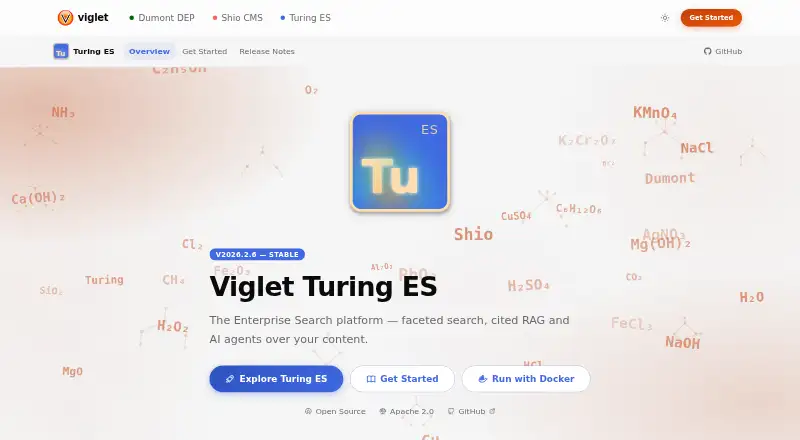
Viglet Turing ES is a free, open-source enterprise search platform for organizations that want search, content integration and generative AI on infrastructure they host themselves. Its semantic navigation includes faceted search, autocomplete, spotlights, targeting rules, result ranking and per-site AI insights. For AI workflows, it supports retrieval-augmented generation over indexed content, LLM instances, AI agents, tool calling and MCP server integration. Search backends include Apache Solr, Apache Lucene and Elasticsearch. Documented content connections include Adobe AEM and web crawlers, plus Dumont DEP connectors for databases, file systems and WordPress. Listed LLM provider types include OpenAI, Anthropic, Gemini, Ollama, Amazon Bedrock, Cohere, Mistral and Vertex AI. Authentication options include native sessions, OAuth2 social login and Keycloak SSO. Deployment choices include Docker, standalone JAR, source builds, Docker Compose and Kubernetes; the runtime requires Java 21. The embedded-H2 setup is for local development and evaluation, not production. The product is labeled Apache 2.0.
Good
- Free and open source under Apache 2.0.
- Offers Solr, Lucene and Elasticsearch backends.
- Supports multiple LLM provider types and AI agents.
- Deployment options include Docker and Kubernetes.
- Supports Keycloak SSO and OAuth2 social login.
Watch out
- Requires Java 21.
- Embedded-H2 setup is for evaluation, not production.
- Self-hosted deployment requires customer infrastructure.
Who it suits
It suits teams building self-hosted enterprise search that need content connectors, configurable search behavior or AI workflows. Java 21 is required, and the simple embedded-H2 setup is not intended for production.
Verdict
Viglet Turing ES combines enterprise search, content integration and generative AI in a self-hosted package. Its deployment options and search backends are broad, but production use requires an appropriate hosting setup rather than the embedded-H2 configuration.
Plans and prices
From Viglet Turing ES's own pricing page, checked 8 Oct 2026.
| Plan | Price | What it gives you |
|---|---|---|
| Viglet Turing ES | Free | Open source · Apache 2.0 · Self-hosted |
The facts
Each one read from Viglet Turing ES's own pages, with the date it was checked.
What it does
- API credential security
- REST API token values are encrypted at rest in the database.checked 8 Oct 2026
- API security
- The integration proxy rejects requests to private IP ranges, loopback addresses, or disallowed schemes as SSRF protection.checked 8 Oct 2026
- Authentication
- Authentication options include native sessions, social login through OAuth2, and Keycloak SSO with OAuth2/OpenID Connect.checked 8 Oct 2026
- Content connectors
- Documented content integrations include Adobe AEM and web crawlers, with connectors communicating with Turing ES through REST.checked 8 Oct 2026
- Content integrations
- The documentation lists AEM and web crawler integrations, and identifies Dumont DEP connectors for databases, file systems, and WordPress.checked 8 Oct 2026
- Data hosting
- The maker says Turing ES is self-hosted on the customer’s infrastructure.checked 8 Oct 2026
- Deployment
- The installation guide documents Docker, standalone JAR, source builds, Docker Compose, and Kubernetes deployment options.checked 8 Oct 2026
- Deployment limitation
- The simple setup with embedded H2 is documented as suitable for local development and evaluation only, not production.checked 8 Oct 2026
- Generative AI
- It supports RAG over indexed content, LLM instances, AI agents, tool calling, and MCP server integration.checked 8 Oct 2026
- License
- The product documentation labels Turing ES open source under Apache 2.0.checked 8 Oct 2026
- LLM providers
- The documentation lists provider types including OpenAI, Anthropic, Gemini, Ollama, Amazon Bedrock, Cohere, Mistral, and Vertex AI.checked 8 Oct 2026
- Product
- Viglet Turing ES is an open-source enterprise search platform combining Semantic Navigation, content integration, and Generative AI.checked 8 Oct 2026
- Purpose
- Viglet Turing ES is an open-source enterprise search platform combining semantic navigation, content integration, and generative AI.checked 8 Oct 2026
- Runtime requirement
- The installation guide says Turing ES requires Java 21.checked 8 Oct 2026
- Search engines
- Turing ES supports Apache Solr, Apache Lucene, and Elasticsearch search backends.checked 8 Oct 2026
- Search features
- Its semantic navigation features include faceted search, autocomplete, spotlights, targeting rules, result ranking, and per-site AI insights.checked 8 Oct 2026
- SSO security
- With Keycloak enabled, Turing ES delegates authentication to Keycloak and validates access tokens as JWTs.checked 8 Oct 2026
- Support
- The maker’s homepage points users to GitHub for source code, issues, and pull requests, and to the r/TuringES community for discussion.checked 8 Oct 2026
The full review of Viglet Turing ES
Viglet Turing ES is a self-hosted enterprise search platform that brings content integration and generative AI into search workflows. It suits organizations able to run and maintain their own infrastructure. Its broad search backends and deployment options are compelling, but the embedded H2 setup is for evaluation, not production.
Overview
Turing ES combines semantic navigation with content connectors and AI features, including retrieval-augmented generation over indexed content. It is open source under Apache 2.0, and the maker says it runs on customer infrastructure. That gives organizations control over hosting, but also means they must provide an appropriate production environment.
Key features
Search tools include faceted search, autocomplete, spotlights, targeting rules, result ranking, and AI insights for individual sites. These features support more tailored discovery than a basic keyword index, particularly for organizations managing multiple sites or content collections.
Turing ES supports Apache Solr, Apache Lucene, and Elasticsearch backends. Content integrations include Adobe AEM and web crawlers, plus Dumont DEP connectors for databases, file systems, and WordPress; documented connectors communicate through REST. This range offers flexibility, though teams should choose integrations and a backend that fit their existing environment.
For generative AI, it supports RAG over indexed content, LLM instances, agents, tool calling, and MCP server integration. Documented provider types include OpenAI, Anthropic, Gemini, Ollama, Amazon Bedrock, Cohere, Mistral, and Vertex AI. Answer citations are supported, which can help readers trace responses to indexed material.
Authentication options include native sessions, OAuth2 social login, and Keycloak SSO through OAuth2/OpenID Connect. With Keycloak enabled, the product delegates authentication and validates access tokens as JWTs. Its integration proxy blocks requests to private IP ranges, loopback addresses, and disallowed schemes, and REST API token values are encrypted at rest.
Pricing
Viglet Turing ES: free. The plan is open source under Apache 2.0 and self-hosted. There is no paid tier or seat allowance described in the plan; the practical cost is running and maintaining the required infrastructure.
Platforms
Turing ES supports API, Linux, macOS, Windows, web, and self-hosted use. Installation options include Docker, a standalone JAR, source builds, Docker Compose, and Kubernetes. Java 21 is required. The embedded H2 setup is intended only for local development and evaluation, so production deployments need a different, suitable hosting configuration.
Who it's for
Turing ES is a strong fit for organizations that want open-source enterprise search, control over where data is hosted, and the flexibility to connect multiple search backends and AI providers. It is less suitable for readers seeking a turnkey hosted service or teams unable to manage Java-based deployment and production infrastructure. The maker directs users to GitHub for source code, issues, and pull requests, and to the r/TuringES community for discussion.
Pros and cons
- Pros: Apache 2.0 licensing and self-hosting give organizations control over deployment and data hosting.
- Pros: Multiple search backends, content connectors, and LLM provider types make it adaptable to varied systems.
- Pros: RAG, answer citations, agents, tool calling, and MCP integration extend search beyond retrieval.
- Cons: Production use requires an appropriate hosting setup; the embedded H2 configuration is limited to development and evaluation.
- Cons: Java 21 and self-managed deployment place operational responsibility on the organization.
Alternatives
Explore other AI Enterprise Search Software if you want to compare the category broadly. Korra is worth considering for its Android and iOS support and a free plan capped at 100MB. Choose Fess as another free, self-hosted option. OpenSearch is another Apache 2.0, no-licensing-fee choice for self-managed deployments.
Elastic Search AI offers a self-managed Free and open plan alongside a usage-based serverless option. GoSearch Analytics may suit teams seeking a paid Pro plan with private connectors and unlimited searches and GoAI conversations, at $20 a month, billed user/month. PipesHub offers a forever-free, self-hosted Community Edition with Docker deployment, core indexing and search, and BYO LLMs and embeddings.
Onyx is an alternative for teams considering a $20 a month Business plan on annual billing, with 40+ app connectors and community support. Dropbox Dash is a paid option with a 19.00 USD monthly Teams plan for up to 100 users.
Verdict
Choose Viglet Turing ES if your organization wants open-source, self-hosted enterprise search with a broad choice of backends, content integrations, and AI providers. Its main advantage is that flexibility; its main trade-off is the operational work of building and maintaining a production deployment. Look elsewhere if you need a hosted service or cannot take on that responsibility.
Getting started
- Visit the Turing ES website.
- Choose a deployment route: Docker, standalone JAR, source build, Docker Compose, or Kubernetes.
- Prepare a Java 21 runtime.
- Select a supported search backend and configure the content integrations you need.
- Use embedded H2 only for local development or evaluation.
Limits worth knowing
The free plan is open source and self-hosted. Its embedded-H2 setup is documented for local development and evaluation, not production.
Questions
How much does Viglet Turing ES cost?
The listed plan is free at no cost.
Is Turing ES open source?
Yes. Product documentation labels it open source under Apache 2.0.
Where is Turing ES hosted?
It is self-hosted on the customer’s infrastructure.
Which search backends does it support?
It supports Apache Solr, Apache Lucene, and Elasticsearch.
What are its deployment options?
The installation guide documents Docker, a standalone JAR, source builds, Docker Compose, and Kubernetes.
Which authentication options are available?
Options include native sessions, OAuth2 social login, and Keycloak SSO using OAuth2/OpenID Connect.
Alternatives to Viglet Turing ES
- 1
Onyx
Free planOpen sourceWebAPIExtensionLinux8.2From $20 a month - 2

Korra
Free planAndroidiOSWebAPI8.1From $199 a month - 3
Dropbox Dash
AndroidiOSWebAPI7.7From $15 a month - 4

GoSearch Analytics
Free planWebAPIExtension6.8From $20 a month - 5
Google Agent Search
WebAPI6.7 - 6

OpenSearch
Free planWebAPILinuxmacOS6.7Free plan