Tilda
Tilda is a free, open-source GTK terminal emulator for Linux that appears from the top of the screen when activated by a hotkey.
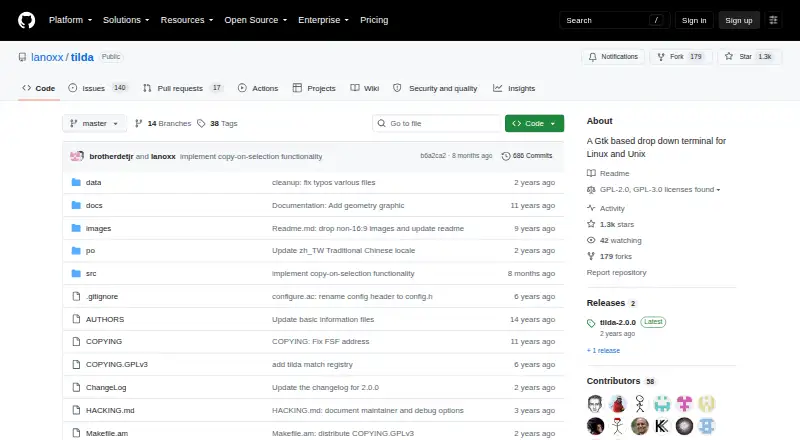
What Tilda is
Tilda is a free, open-source GTK terminal emulator for Linux that appears from the top of the screen when activated by a hotkey. Users can configure keybindings, transparency, appearance, and other behavior. Its search bar handles forward and backward searches, case sensitivity, and regular expressions. Built-in shortcuts support opening, switching between, and closing tabs. Tilda includes a scripting API and a D-Bus interface that can toggle its window when launched with the --dbus argument. It works on Xorg-based desktops and can run on Wayland through the Xwayland plugin. Installation is available through distribution package managers or from source. The project says it should be packaged for Debian-based distributions and notes support for some BSD systems. Most code uses GPLv2-or-later licensing, with some files potentially GPLv3 or later. The latest listed release is 2.0.0, dated 2024-02-03.
Good
- Free open-source software
- Configurable keybindings and appearance
- Search supports regular expressions
- Scripting API and D-Bus interface
- Runs on Xorg and via Xwayland
Watch out
- Linux-focused platform support
- Wayland requires the Xwayland plugin
- Some BSD support is only noted
- Builds require listed dependencies
Who it suits
Tilda suits Linux users who want a configurable drop-down terminal and customizable shortcuts. It is also useful for users comfortable with package installation or source builds.
Verdict
Tilda provides a focused, configurable terminal with tabs, search, scripting, and desktop integration. Its main boundary is platform scope, especially the separate Xwayland requirement for Wayland use.
Plans and prices
From Tilda's own pricing page, checked 11 Oct 2026.
| Plan | Price | What it gives you |
|---|---|---|
| Tilda | Free | GPL-2.0 or GPL-3.0 licensed open-source software |
The facts
Each one read from Tilda's own pages, with the date it was checked.
Where it runs
- Appearance
- Tilda supports transparency and appearance adjustments.checked 11 Oct 2026
- Platform limit
- Tilda works only on Xorg-based desktops, with Wayland use via Xwayland described separately.checked 11 Oct 2026
- Supported platforms
- Linuxchecked 20 Sep 2026
What it does
- Configuration
- Users can configure keybindings, appearance, and other behavior options.checked 11 Oct 2026
- Configuration storage
- Tilda stores configuration and cache files in XDG directories, normally ~/.config/ and ~/.cache/.checked 11 Oct 2026
- D-Bus
- Tilda provides a D-Bus interface that can toggle its window when started with the --dbus argument.checked 11 Oct 2026
- Dependencies
- The build guide lists GLib, GTK+ 3, VTE, libConfuse, and libx11-dev as dependencies.checked 11 Oct 2026
- Development
- The project describes itself as an open-source volunteer project and welcomes pull requests and patches.checked 11 Oct 2026
- Distribution
- The project says Tilda should be packaged for Debian and Debian-derived distributions, and can also be installed from source.checked 11 Oct 2026
- Installation
- Users can install Tilda through a distribution package manager or build it from source.checked 11 Oct 2026
- Keybindings
- Users can configure hotkeys for various functions and change keybindings in the settings.checked 11 Oct 2026
- Latest release shown
- The GitHub releases page lists Tilda 2.0.0 as the latest release, dated 2024-02-03.checked 11 Oct 2026
- License
- The majority of the source code is licensed under GPLv2 or later, while individual files may use GPLv3 or later.checked 11 Oct 2026
- Project model
- The project describes itself as open source and maintained by volunteers who contribute in their spare time.checked 11 Oct 2026
- Purpose
- Tilda is a configurable GTK terminal emulator that drops down from the top of the screen using a hotkey.checked 11 Oct 2026
- Scripting API
- Yeschecked 20 Sep 2026
- Search
- The search bar supports forward and backward searches, case sensitivity, and regular expressions.checked 11 Oct 2026
- Security
- The opened project pages do not state security certifications or compliance claims.checked 11 Oct 2026
- Support
- The README directs users to tilda --help, the project wiki, email to listed developers, and GitHub issues for bug reports.checked 11 Oct 2026
- Supported systems
- The project says Tilda should be packaged for Debian-based distributions and notes that some BSD systems are supported.checked 11 Oct 2026
- Tabs
- Tilda supports tabbed terminals.checked 11 Oct 2026
- Wayland support
- Tilda works on Xorg-based desktops and can run on Wayland through the Xwayland plugin.checked 11 Oct 2026
- What it does
- Tilda is a GTK-based terminal emulator that drops down from the top of the screen when triggered by a hotkey.checked 11 Oct 2026
Money
- Free plan
- Yeschecked 20 Sep 2026
Alternatives to Tilda
- 1
Termalin
Free planiOSWebAPILinux7.7From $8 a month - 2

Warp
Free planLinuxmacOSSelf-hostedWindows7.6From $50 a month - 3

MobaXterm
Free planWindows7.4From $69 a year - 4
Cool Retro Term
Free planOpen sourceLinuxmacOSSelf-hosted7.1Free plan - 5

Contour
Free planLinuxmacOSWindows6.8Free plan - 6
gitsome
Free planLinuxmacOSSelf-hostedWindows6.8Free plan