Third Room
Third Room is a free, open-source social platform for communicating and collaborating in immersive 3D worlds.
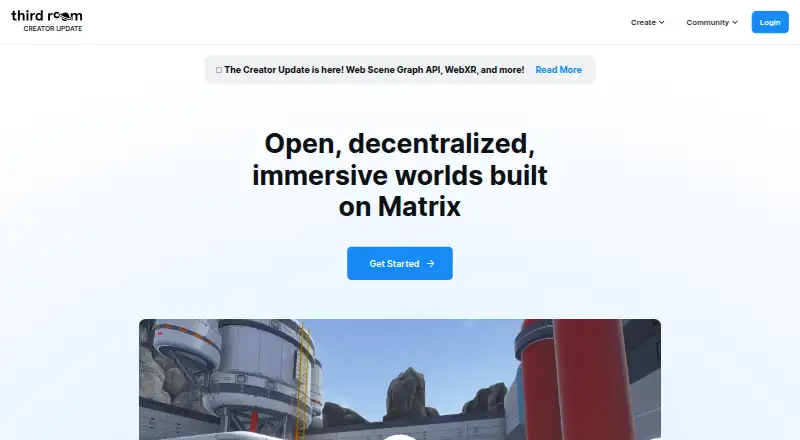
What Third Room is
Third Room is a free, open-source social platform for communicating and collaborating in immersive 3D worlds. Communities can create public or private worlds, invite people, and manage privacy, roles, and permissions. Built on Matrix, it lets users communicate with people on other Matrix-supporting platforms. Its getting started guide describes communication as end-to-end encrypted, with messages and files accessible only to intended recipients. Users can choose a homeserver or set up their own; the guide says data is distributed across homeservers. The single-page web client can be hosted on a static web server, and running a personal Matrix homeserver is optional. Third Room supports desktop and XR, spatial audio, and guest access. Creators can use glTF content and a Unity exporter to add lightmaps, spawn points, and physics. Developers can script interactive worlds with WebAssembly-compatible languages through the Web Scene Graph API; a JavaScript runtime and in-world editor are also available. Voice chat and networking use Matrix Group VoIP Calls, while the WebSG networking API uses peer-to-peer WebRTC data channels. The creator guide recommends binary glTF scene files under 50 MB.
Good
- Free and open source.
- Supports public and private worlds with guest access.
- Works with other platforms that support Matrix.
- Supports desktop, XR, and spatial audio.
- Includes scripting tools and an in-world editor.
Watch out
- The creator guide recommends scenes under 50 MB.
- Some glTF material extensions are not yet supported.
- A TURN server is recommended for all networking scenarios.
Who it suits
Third Room suits communities that want to gather, share, collaborate, host events, or explore 3D concepts such as architecture and industrial design. It also offers tools for creators and developers building interactive worlds.
Verdict
Third Room combines Matrix communication with 3D spaces, creator tools, and self-hosting options. Review its scene-size recommendation and supported material extensions if you plan to build worlds.
The facts
Each one read from Third Room's own pages, with the date it was checked.
What it does
- 3D content
- Third Room supports glTF content and recommends its Unity exporter, which can bake lightmaps, set spawn points, and add physics to objects.checked 9 Oct 2001
- Audience
- The homepage presents Third Room for communities to gather, share, collaborate, host events, and explore 3D concepts, including architecture and industrial design use cases.checked 4 Oct 2001
- Content limit
- The creator guide recommends uploading binary glTF scenes under 50 MB.checked 4 Oct 2001
- Creators
- Creators can build 3D content in glTF and use the Unity exporter to add features such as lightmaps, spawn points, and physics.checked 4 Oct 2001
- Decentralization
- Users can choose a homeserver, including setting up their own, and the guide says data is distributed across homeservers.checked 4 Oct 2001
- Developer tools
- The Web Scene Graph API supports interactive world scripting from WebAssembly-compatible languages, with JavaScript runtime and an in-world editor also available.checked 4 Oct 2001
- Encryption
- The documentation says communication is protected by end-to-end encryption so messages and files can be accessed only by intended recipients.checked 9 Oct 2001
- Homeservers
- Users can choose Third Room’s default homeserver, another listed homeserver, or set up their own.checked 9 Oct 2001
- Matrix
- Third Room is built on Matrix and supports communication with users on other platforms that support Matrix.checked 4 Oct 2001
- Matrix interoperability
- Third Room users can communicate with people on other platforms that support Matrix, including Element.checked 9 Oct 2001
- Networking
- Third Room uses Matrix Group VoIP Calls for networking and voice chat, and its WebSG networking API uses peer-to-peer WebRTC data channels.checked 4 Oct 2001
- Notable compatibility limits
- The Unity exporter guide says Third Room does not yet support KHR_materials_iridescence, KHR_materials_specular, or KHR_materials_clearcoat extensions.checked 9 Oct 2001
- Purpose
- Third Room is an open-source social platform for communicating and collaborating in immersive 3D worlds.checked 4 Oct 2001
- Scripting
- The Web Scene Graph API supports WebAssembly-compatible languages, and Third Room includes a JavaScript runtime and in-world script editor.checked 9 Oct 2001
- Self-hosting
- The open-source web client can be self-hosted as a single-page app on any static web server; hosting a Matrix homeserver is optional.checked 9 Oct 2001
- Support
- The documentation directs users with questions or feedback to the Third Room Matrix chat.checked 9 Oct 2001
- Voice and networking
- Third Room uses Matrix Group VoIP Calls for networking and voice chat; its developer guide recommends a TURN server such as Coturn for connections across all networking scenarios.checked 9 Oct 2001
- What it does
- Third Room is an open-source social platform for communicating and collaborating in immersive 3D worlds, built on Matrix.checked 9 Oct 2001
- Worlds
- Users can create and join public or private worlds for discussions, project collaboration, and events.checked 9 Oct 2001
- World upload limit
- The creator guide recommends uploading binary glTF scene files under 50 MB.checked 9 Oct 2001
- XR
- The getting started guide describes support for desktop and XR.checked 4 Oct 2001
Alternatives to Third Room
- 1

Glue
Free planAndroidiOSWebmacOS7.3From €50 a month - 2

Topia
Free planAndroidiOSWeb7.2From $4 a month - 3

WorkAdventure
Free planAndroidiOSWebAPI7.2From €8 a month - 4
Watch2Gether
Free planAndroidiOSWebWindows7.1From $9.99 a month - 5

RAUM
AndroidiOSWebmacOS6.9From €99 a month - 6
Frame
AndroidiOSWeb6.8From $10 a month