TextGrad
TextGrad is a free Python package for building pipelines that optimize text and other targets with language-model feedback.
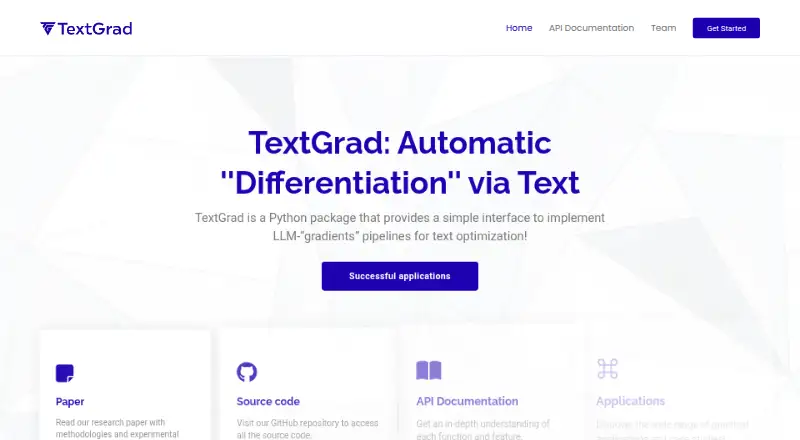
What TextGrad is
TextGrad is a free Python package for building pipelines that optimize text and other targets with language-model feedback. Its method applies backpropagation through natural-language responses from LLMs. An API modeled on PyTorch lets users define loss functions and run optimization, making the approach familiar to people who know PyTorch. The project describes targets including text, code, problem solutions, molecules, and prompts, with applications in coding, scientific problem solving, reasoning, chemistry, and medicine. TextGrad supports prompt variables, prompt testing, API access, multiple model providers, and automated optimization. It runs on Linux or in a self-hosted setup. Installation documentation covers pip, conda-forge, a GitHub development install, and an optional vLLM extra. Its experimental LiteLLM engine supports models available through LiteLLM, including Bedrock, Together, and Gemini. Tutorials using OpenAI or Anthropic models require a provider key. The repository also documents an external OpenAI-compatible client, with LM Studio as an example. TextGrad is released under the MIT License.
Good
- Free plan available
- PyTorch-modeled optimization API
- Supports multiple model providers
- Runs on Linux or self-hosted setups
- Prompt variables and testing included
Watch out
- Tutorials require OpenAI or Anthropic keys
- LiteLLM engine is experimental
- No stated security or compliance features
- Self-hosted setup required
Who it suits
TextGrad suits developers and researchers who know PyTorch and want to optimize prompts, text, code, or other listed targets with LLM feedback. It is also relevant to users working in coding, science, reasoning, chemistry, or medicine.
Verdict
TextGrad provides a PyTorch-style way to optimize text and related targets through language-model feedback. Its free, self-hosted format and provider integrations suit technical users comfortable with Python and model credentials.
The facts
Each one read from TextGrad's own pages, with the date it was checked.
What it does
- Additional installs
- The repository also documents conda-forge installation, a GitHub development install, and an optional vLLM extra.checked 4 Oct 2026
- API style
- Its API resembles PyTorch and lets users define loss functions and optimize variables using text feedback.checked 5 Oct 2026
- Credentials
- The project’s tutorials say an OpenAI or Anthropic key is needed to run the LLMs in those tutorials.checked 4 Oct 2026
- How it works
- The framework implements backpropagation through natural-language feedback provided by LLMs.checked 4 Oct 2026
- Install
- The documentation gives `pip install textgrad` as an installation command.checked 5 Oct 2026
- Integrations
- The maker's GitHub README says a LiteLLM-based engine supports models available through LiteLLM, including Bedrock, Together, and Gemini.checked 5 Oct 2026
- Intended users
- The site says TextGrad mirrors PyTorch’s syntax and abstraction, and that people who know PyTorch will find it familiar.checked 4 Oct 2026
- License
- The maker's GitHub repository lists the project license as MIT.checked 5 Oct 2026
- Local model use
- The maker's GitHub repository documents an external OpenAI-compatible client, with LM Studio as an example.checked 5 Oct 2026
- Maintainers
- The website lists TextGrad team members affiliated with Stanford University.checked 5 Oct 2026
- Method
- It implements backpropagation through textual feedback provided by language models.checked 5 Oct 2026
- Model access
- The maker's GitHub README says its tutorials require an OpenAI or Anthropic key to run the language models.checked 5 Oct 2026
- Model providers
- The repository says its experimental LiteLLM engine supports models available through LiteLLM, including Bedrock, Together, and Gemini.checked 4 Oct 2026
- Optimization targets
- The documentation shows TextGrad optimizing text answers and prompts.checked 5 Oct 2026
- Product
- TextGrad is a Python package for building LLM-gradient pipelines that optimize text.checked 5 Oct 2026
- Research status
- The repository states that TextGrad was published in Nature on 19 March 2025.checked 4 Oct 2026
- Security
- The official website and documentation pages reviewed do not state security or compliance features.checked 5 Oct 2026
- Support
- The official website links to API documentation and a public GitHub repository for source code.checked 5 Oct 2026
- Use cases
- The maker lists coding, scientific problem solving, reasoning, chemistry, and medicine as applications.checked 5 Oct 2026
Alternatives to TextGrad
- 1
Vellum
Free planOpen sourceAndroidiOSWebAPI8.7From $30 a month - 2

Agenta
Free planOpen sourceWebAPISelf-hosted8.0From $29 a month - 3
Latitude
Free planOpen sourceWebAPILinuxSelf-hosted7.7From $99 a month - 4
VantagePrompt
Free planWeb7.3From $3 a month - 5

PromptLayer
Free planWebAPISelf-hosted7.0From $49 a month - 6
PromptWizard
Free planAPILinuxmacOSSelf-hosted6.8Free plan