Testrium
Testrium is a free, self-hosted system for managing test cases, test runs, results, and reports.
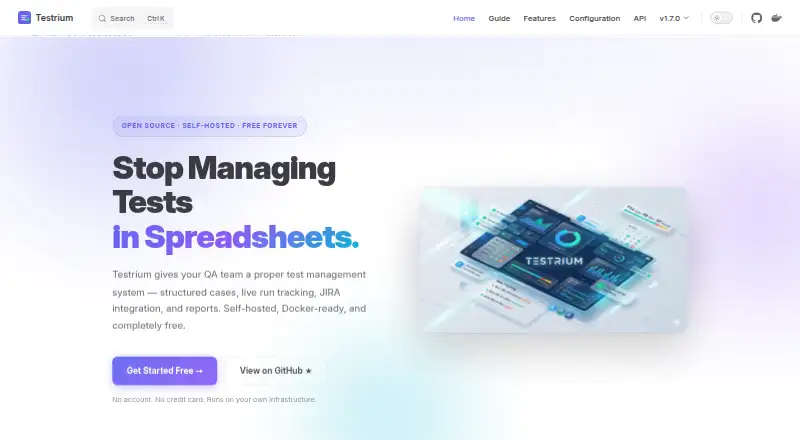
What Testrium is
Testrium is a free, self-hosted system for managing test cases, test runs, results, and reports. Teams can define cases with steps, expected results, priorities, and types, or import them from Excel and CSV. Runs can be executed individually or in bulk, with progress, results, comments, and execution time tracked. PDF and Excel reports include charts, pass rates, and trend metrics. Testrium can file JIRA bugs when executions fail. Its REST API can fetch environment-specific test data and post or bulk-update execution results; documentation names Selenium, RestAssured, Playwright, and Cypress. Admin and User roles, project-level permissions, JWT authentication, and BCrypt password encryption are included. Teams host the software and data on their own infrastructure; the privacy policy says there is no telemetry, analytics, third-party data sharing, or communication back to Testrium servers. Docker Compose is recommended, and the free plan has no seat limits or feature paywalls. Testrium does not include test planning or requirements linking.
Good
- Free plan has no seat limits or feature paywalls.
- Imports cases from Excel or CSV.
- Supports individual and bulk test execution.
- Generates PDF and Excel reports with charts and trends.
- JIRA integration can file bugs from failed executions.
Watch out
- Does not provide hosting; teams supply infrastructure.
- Does not include test planning.
- Does not include requirements linking.
- No free trial is listed.
Who it suits
Testrium suits QA engineers and managers, automation engineers, and development teams that want to manage test cases and execution on their own infrastructure. It is also relevant to teams connecting test workflows through its API or named automation tools.
Verdict
Testrium brings case management, execution tracking, reporting, and automation support into a self-hosted tool with a free plan. Teams should account for hosting it themselves and for the absence of test planning and requirements linking.
Plans and prices
From Testrium's own pricing page, checked 9 Oct 2001.
| Plan | Price | What it gives you |
|---|---|---|
| Free | Free | Self-hosted · no seat limits · no feature paywalls · Forever |
The facts
Each one read from Testrium's own pages, with the date it was checked.
What it does
- Access control
- Testrium provides Admin and User roles with project-level permissions and uses JWT authentication and BCrypt password encryption.checked 9 Oct 2001
- Automation
- Its REST API supports fetching environment-specific test data and posting or bulk-updating test execution results; the docs name Selenium, RestAssured, Playwright, and Cypress.checked 9 Oct 2001
- Data location
- Testrium does not provide hosting, and its privacy policy says team data is stored on the operator’s own infrastructure.checked 9 Oct 2001
- Deployment
- The maker recommends Docker Compose for setup and says Testrium can run on a laptop, local server, or cloud VM.checked 9 Oct 2001
- JIRA
- The JIRA integration can file bugs from failed test executions and stores the API token encrypted in the local database.checked 9 Oct 2001
- License
- Testrium is released under the Apache License 2.0, which permits commercial use, modification, and redistribution subject to its stated conditions.checked 9 Oct 2001
- Privacy
- The privacy policy says Testrium has no telemetry, analytics, third-party data sharing, or communication back to Testrium servers.checked 9 Oct 2001
- Product
- Testrium is a self-hosted test case management system for organizing test cases, executing runs, tracking results, and generating reports.checked 9 Oct 2001
- Reporting
- Testrium generates PDF and Excel reports with charts, pass rates, and trend metrics.checked 9 Oct 2001
- Requirements
- For Docker deployment, the maker says no Java or Node.js installation is required; local development lists Java JDK 17+, Node.js 18+, and Maven 3.9+.checked 9 Oct 2001
- Support
- The maker directs users to GitHub issues for questions and bug reports.checked 9 Oct 2001
- Test cases
- Users can create test cases with steps, expected results, priorities, and types, and import cases from Excel or CSV.checked 9 Oct 2001
- Test execution
- Test runs support individual or bulk execution with progress tracking, results, comments, and execution time.checked 9 Oct 2001
- Who it is for
- The maker identifies QA Engineers, QA Managers, Automation Engineers, and Development Teams as intended users.checked 9 Oct 2001
The full review of Testrium
Testrium is a self-hosted test management system for teams that need structured cases, repeatable execution, and QA reporting without a per-seat bill. It suits QA and development groups willing to run their own service; the trade-off is that deployment and maintenance stay with you.
Overview
Testrium covers the central test-management workflow: author cases, execute them, capture outcomes, and summarize results. A case can contain steps, expected results, priorities, and types, and existing libraries can be imported from Excel or CSV. Runs support single-case or bulk execution, with progress, results, comments, and execution time recorded along the way.
The self-hosted design keeps team data on infrastructure controlled by the operator. Testrium's privacy policy states that it sends no telemetry or analytics, shares no data with third parties, and communicates back to no Testrium servers. That is a strong fit for organizations with strict data-location requirements, but it also means there is no vendor-provided hosting. Docker Compose is the recommended deployment method, and the application can run on a laptop, local server, or cloud VM.
The Apache License 2.0 permits commercial use, modification, and redistribution subject to its conditions. Questions and bug reports are directed to GitHub issues, so teams should be comfortable with that support channel.
Key features
Execution and reporting
Execution tracking is more useful than a simple pass/fail checklist: teams can see run progress, add comments, and retain execution timing for individual or bulk work. PDF and Excel reports include charts, pass rates, and trend metrics, giving QA managers material for release or quality reviews without a separate reporting product.
JIRA and automation
When an execution fails, the JIRA integration can file a bug. Its API token is encrypted in the local database, which is appropriate for a self-managed installation handling issue-tracker credentials. The REST API can retrieve environment-specific test data and post or bulk-update execution results. Documentation names Selenium, RestAssured, Playwright, and Cypress, making the tool a sensible bridge for teams that want automated results alongside manual runs.
Permissions and security
Admin and User roles provide project-level permissions. JWT authentication and BCrypt password encryption supply the stated access and password protections, while the no-telemetry policy favors organizations that want operational data to remain inside their own environment.
Pricing
Free — free, billed Forever. This self-hosted plan has no seat limits and no feature paywalls. It is an unusually straightforward fit for growing QA groups, consultants, or development teams that can provide their own infrastructure. There is no free trial because the plan itself is free. The savings come with an operational cost: your team supplies hosting, upgrades, backups, and day-to-day administration.
Platforms
Testrium is available through its web interface and API on Linux, macOS, and Windows environments, with self-hosted deployment. For Docker deployment, the maker says Java and Node.js are not required. Local development requires Java JDK 17 or newer, Node.js 18 or newer, and Maven 3.9 or newer.
Who it's for
QA Engineers can use it to organize cases and document execution. QA Managers gain pass-rate and trend reporting for oversight. Automation Engineers can connect framework output through the REST API, while Development Teams can combine manual coverage, automated results, and JIRA defect creation in one system.
It is not the right choice for organizations seeking vendor-managed hosting or formal test planning and requirements traceability: Testrium does not provide hosting, test planning, or requirements linking.
Pros and cons
Pros
- Unlimited-seat free plan: teams can expand participation without per-user charges or feature paywalls.
- Strong data control: self-hosting and the stated absence of telemetry or third-party sharing keep QA data on your infrastructure.
- Useful automation path: REST endpoints support environment data and bulk result updates, with named integrations for Selenium, RestAssured, Playwright, and Cypress.
- Practical reporting: PDF and Excel exports include charts, pass rates, and trend metrics.
- Open licensing: Apache 2.0 allows commercial use, modification, and redistribution under its terms.
Cons
- Self-hosting is mandatory: your team must operate the deployment because no hosted service is provided.
- No planning or requirements links: organizations needing those capabilities will need another process or product.
- Support is issue-based: the maker directs questions and bug reports to GitHub issues rather than a stated managed support service.
Alternatives
Browse the broader Test Management Software category when you want to compare more tools.
- Kualitee is a better fit if you want web, desktop, and mobile platforms plus a freemium cloud plan capped at one project, 500 test cases, 200 defects, and three users.
- aqua suits teams wanting freemium plans, a free trial, and a Guest tier with unlimited read-only seats.
- Klaros-Testmanagement is another freemium option with Android, API, Linux, self-hosted, web, and Windows support.
- TestPlanIt is worth choosing when a self-hosted free tier with unlimited users, projects, and all features is the priority, alongside a free trial.
- ThoroTest offers a free self-hosted edition using SQLite or PostgreSQL, with a managed hosted edition also available.
- Tricentis Testim is aimed at teams that prefer a paid testing product with a free tier of up to 1,000 runs per month.
- Tuskr fits smaller teams wanting a hosted-style free tier limited to five users, five projects, 1,000 cases, 1 GB of file space, and 100 runs per project.
- TestBench is an alternative with a free package and a free trial.
Verdict
Choose Testrium if you want unlimited, no-paywall test management, local control of QA data, and an API that connects automated results with documented runs. Look elsewhere if you need managed hosting, formal test planning, or requirements traceability, or if your team does not want to own deployment and maintenance.
Alternatives to Testrium
- 1

TestMu AI
Free planAndroidiOSWebAPI8.2From $17 a month - 2

aqua
Free planWebAPIExtensionLinux7.7From €19 a month - 3
Kualitee
Free planAndroidiOSWebWindows7.4From $24.33 a month - 4
Meliora Testlab
WebAPILinuxmacOS7.3From €45 a month - 5
Tuskr
Free planAndroidiOSWebAPI7.3From $7.50 a month - 6
Tricentis Testim
Free planAndroidiOSWebAPI7.2Free plan