Tarantella
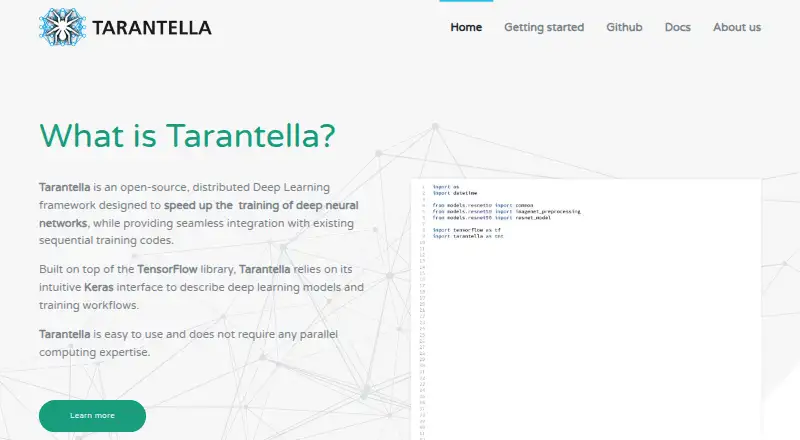
The facts below are what the maker publishes about Tarantella, checked and dated. Our editors have not written about it yet.
The facts
Each one read from Tarantella's own pages, with the date it was checked.
What it does
- Cluster access
- Using Tarantella on a cluster requires passwordless SSH between nodes.checked 11 Oct 2026
- Cluster limit
- For multi-node execution, the documented hostfile must contain unique hostnames and the nodes must have the same number and type of CPUs and GPUs.checked 10 Oct 2026
- Command line
- Users can launch distributed training through the tarantella command-line interface, including on multiple nodes using a hostfile.checked 10 Oct 2026
- Dependencies
- Installation requires building from source and depends on TensorFlow, GPI-2, GaspiCxx, pybind11, and a GCC C++17 compiler.checked 10 Oct 2026
- Developer
- Tarantella is developed at the Competence Center for High Performance Computing, part of Fraunhofer ITWM.checked 11 Oct 2026
- Documentation
- The site links to installation guidance, tutorials, and technical documentation for getting started.checked 11 Oct 2026
- Ease of use
- Its minimal API abstracts parallel computing details, and the maker says users do not need parallel computing expertise.checked 10 Oct 2026
- Framework
- It is built on TensorFlow and uses the Keras interface for describing models and training workflows.checked 10 Oct 2026
- Hardware
- It supports CPU and GPU clusters independently of hardware type and vendor.checked 11 Oct 2026
- Installation
- The installation guide says Tarantella must be built from source and requires TensorFlow, GaspiCxx, GPI-2, and pybind11.checked 11 Oct 2026
- Integration
- The maker says Tarantella supports the full TensorFlow Keras API and can be added to an existing model with two lines of code.checked 10 Oct 2026
- Interface
- Tarantella provides a command-line interface for running distributed training.checked 11 Oct 2026
- Model integration
- It is built on TensorFlow and supports the full TensorFlow Keras API for integrating distributed training into existing workflows.checked 11 Oct 2026
- Models
- The maker describes use with convolutional computer vision networks and Transformer natural language processing models.checked 10 Oct 2026
- Parallel training
- It supports scalable training across multiple GPUs and multiple nodes using data parallelism.checked 10 Oct 2026
- Performance
- The site reports speedups of up to 50x on GPU and CPU clusters using data parallelism.checked 11 Oct 2026
- Purpose
- Tarantella is an open-source distributed deep learning framework designed to speed up neural network training.checked 11 Oct 2026
- Reproducibility
- The site says Tarantella distributes data and computation so that serial results are reproduced.checked 11 Oct 2026
- Requirements
- The guide specifies at least Python 3.7, TensorFlow 2.4 or later, and a recent GCC compiler with C++17 support.checked 11 Oct 2026
- Scaling
- It supports distributed training on multi-GPU and multi-node systems.checked 11 Oct 2026
- Security
- The installation guide requires passwordless SSH between cluster nodes to run Tarantella programs.checked 10 Oct 2026
- Support
- The documentation directs users to bug reports, feature requests, tutorials, and technical documentation for help and community participation.checked 10 Oct 2026
Where it runs
- Platform limit
- The FAQ states Tarantella is supported only on Linux; it does not support macOS because GPI-2 depends on the Linux epoll API.checked 10 Oct 2026
Alternatives to Tarantella
- 1
Paperspace Gradient
Free planOpen sourceWebAPIExtensionLinux8.3From $8 a month - 2
Apache TVM
Free planOpen sourceAndroidiOSWebAPI7.8Free plan - 3
Lightning AI Studios
Free planWebAPILinuxmacOS7.8From $20 a month - 4
ONNX Runtime
Free planAndroidiOSWebLinux7.2Free plan - 5
Ludwig
Free planAPILinuxmacOSSelf-hosted6.7Free plan - 6
MegEngine
Free planAndroidiOSLinuxmacOS6.7Free plan