Ludwig
Ludwig is a free, open-source framework for building, fine-tuning, and deploying custom deep learning models.
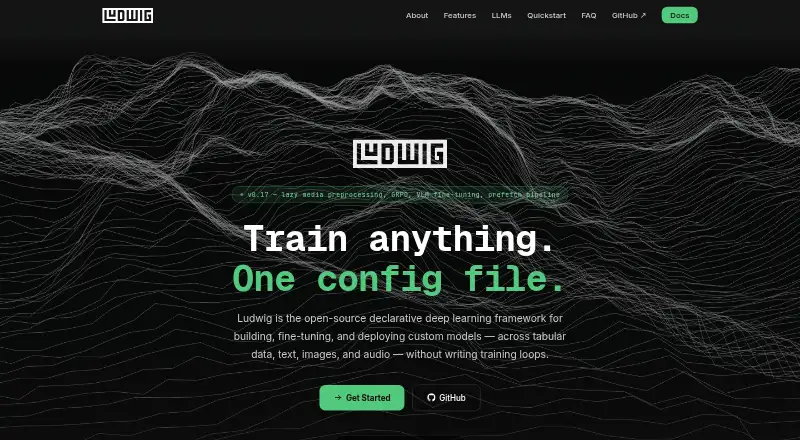
What Ludwig is
Ludwig is a free, open-source framework for building, fine-tuning, and deploying custom deep learning models. It supports data types and tasks including tabular data, text, images, audio, time series, geospatial and vector data, sequences, and anomaly detection. Users define preprocessing, encoders, architecture, training, and hyperparameter optimization in a validated YAML configuration, without writing training loops. Ludwig supports multimodal and multi-task models, as well as LLM tuning methods SFT, DPO, KTO, ORPO, and GRPO; parameter-efficient options include LoRA, QLoRA, DoRA, and VeRA. Its Ray-based distributed training supports DDP, FSDP, and DeepSpeed, with Kubernetes and KubeRay also listed. Hyperparameter optimization integrates Ray Tune and Optuna, with SQLite or PostgreSQL persistence. Models can be served through a REST API or exported to SafeTensors, ONNX, and torch.export. Users can customize model components and connect experiment-tracking tools; the framework also provides generated reports, visualizations, and explainability features. Ludwig is intended for beginners using YAML or auto_train() and experts customizing PyTorch components. It is available under the Apache 2.0 License at no charge.
Good
- Open source under the Apache 2.0 License
- YAML configuration avoids writing training loops
- Supports multimodal and multi-task models
- Includes Ray Tune and Optuna integrations
- Serves REST APIs and exports multiple model formats
Watch out
- Unsloth may be faster for LLM-only tuning when maximum throughput is needed
Who it suits
Ludwig suits people building or tuning deep learning models across varied data types, from YAML-based beginners to experts who customize PyTorch components. It supports both local and distributed deployment approaches.
Verdict
Ludwig covers model building, fine-tuning, optimization, and deployment in an open-source framework with extensive customization and scaling options. The listed limitation matters for users focused solely on maximum-throughput LLM fine-tuning.
Plans and prices
From Ludwig's own pricing page, checked 9 Oct 2026.
| Plan | Price | What it gives you |
|---|---|---|
| Open source | Free | Apache 2.0 license · no paid plans listed on the official site |
The facts
Each one read from Ludwig's own pages, with the date it was checked.
What it does
- Configuration
- Users define preprocessing, encoders, architecture, training, and hyperparameter optimization in a validated YAML file.checked 9 Oct 2026
- Customization
- Users can plug in custom encoders, decoders, combiners, loss functions, and metrics, and use HuggingFace models as backbones.checked 9 Oct 2026
- Data and tasks
- The framework supports tabular, text, image, audio, time series, geospatial, vector, date/time, sequence, and anomaly data tasks.checked 9 Oct 2026
- Distributed training
- A Ray backend enables distributed training using DDP, FSDP, or DeepSpeed, and the site also lists Kubernetes and KubeRay support.checked 9 Oct 2026
- Experiment tracking
- The site says Ludwig integrates with W&B, MLflow, TensorBoard, Comet ML, and Aim, and generates training reports and visualizations.checked 9 Oct 2026
- Explainability
- The site lists automatic baseline training, feature importance, model explainability, and visualizations.checked 9 Oct 2026
- Extensibility
- Users can plug in custom encoders, decoders, combiners, loss functions, and metrics, and use HuggingFace models as backbones.checked 8 Oct 2026
- Formats
- Supported data formats include CSV, TSV, JSON, Parquet, Feather, HDF5, Pandas DataFrames, and Dask DataFrames.checked 9 Oct 2026
- Hyperparameter optimization
- Built-in HPO integrates Ray Tune and Optuna, with SQLite or PostgreSQL persistence.checked 9 Oct 2026
- Integrations
- Listed integrations include HuggingFace Transformers, Ray, PyTorch, W&B, MLflow, TensorBoard, Optuna, Ray Tune, Docker, Kubernetes, vLLM, DeepSpeed, ONNX, SafeTensors, Dask, PyArrow, Comet ML, and Aim.checked 9 Oct 2026
- License
- The site identifies Ludwig as open source under the Apache 2 License.checked 8 Oct 2026
- License and hosting
- The project is described as open source under the Apache 2.0 License and hosted by Linux Foundation AI & Data.checked 9 Oct 2026
- LLM fine-tuning
- The site lists SFT, DPO, KTO, ORPO, and GRPO, plus LoRA, QLoRA, DoRA, and VeRA methods.checked 8 Oct 2026
- LLM tuning
- Ludwig supports SFT, DPO, KTO, ORPO, and GRPO, with parameter-efficient methods including LoRA and QLoRA.checked 9 Oct 2026
- Modalities
- The framework supports multimodal and multi-task models combining features such as text, images, audio, tabular data, and time series.checked 8 Oct 2026
- Notable limitation
- The FAQ says Unsloth may be faster when a user only fine-tunes LLMs and needs maximum throughput.checked 9 Oct 2026
- Optimization
- Built-in hyperparameter optimization integrates Ray Tune and Optuna and supports SQLite or PostgreSQL persistence.checked 8 Oct 2026
- Scaling
- Ludwig supports distributed training with Ray, including DDP, FSDP, DeepSpeed, and KubeRay deployment.checked 8 Oct 2026
- Serving and export
- Ludwig can serve models as a REST API and export to SafeTensors, ONNX, or torch.export.checked 9 Oct 2026
- Support and community
- The site links to Discord, GitHub Issues, GitHub Discussions, and contribution resources.checked 9 Oct 2026
- What it does
- Ludwig is an open-source declarative deep learning framework for building, fine-tuning, and deploying custom models without writing training loops.checked 9 Oct 2026
- Who it is for
- The FAQ says Ludwig is for both beginners using YAML and auto_train() and experts customizing PyTorch encoders and hyperparameters.checked 8 Oct 2026
Alternatives to Ludwig
- 1
Paperspace Gradient
Free planOpen sourceWebAPIExtensionLinux8.3From $8 a month - 2
Apache TVM
Free planOpen sourceAndroidiOSWebAPI7.8Free plan - 3
Lightning AI Studios
Free planWebAPILinuxmacOS7.8From $20 a month - 4
ONNX Runtime
Free planAndroidiOSWebLinux7.2Free plan - 5
MegEngine
Free planAndroidiOSLinuxmacOS6.7Free plan - 6
TensorFlow
Free planAndroidiOSWebAPI6.7Free plan