SWE-bench
SWE-bench is a benchmark for evaluating language models on software issues collected from GitHub.
What SWE-bench is
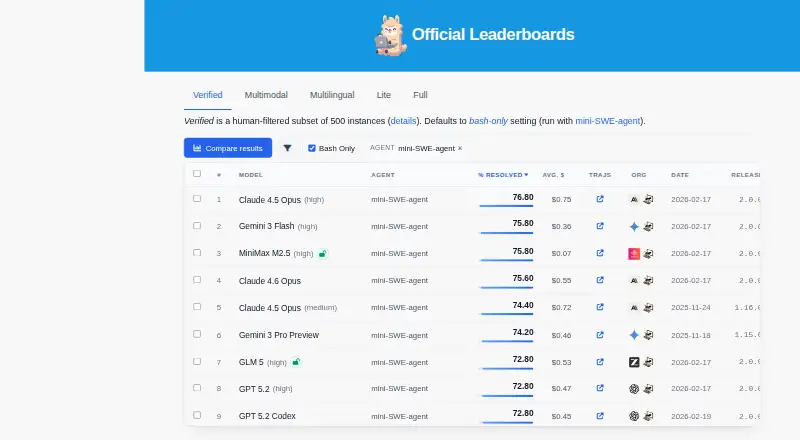
SWE-bench is a benchmark for evaluating language models on software issues collected from GitHub. A model generates a patch for an issue; the evaluation harness applies it in Docker and runs the repository tests to check whether the issue is resolved. The original benchmark contains 2,294 tasks from 12 Python repositories. Other available datasets include Lite, Verified, Multimodal, and Multilingual: Verified has 500 engineer-checked solvable instances, while Multilingual covers 300 instances across 9 languages and 42 repositories. Multimodal has 100 development instances with screenshots and interface elements, with test evaluation through the SWE-bench API. Its CLI can submit predictions, retrieve reports, manage evaluation runs, and track cloud performance. Evaluations can run locally or through cloud options using Modal and sb-cli. The project is free. Installation requires Python 3.9 or later and Docker; setup instructions cover macOS, Linux, and Windows, with WSL 2 required for Windows. The Docker guide recommends at least 120 GB of free disk space and 16 GB of RAM; caching all Docker images can require about 2,000 GB.
Good
- Uses issues drawn from GitHub repositories.
- Includes Verified, Multilingual, and Multimodal datasets.
- CLI manages predictions, reports, and evaluation runs.
- Cloud evaluations are available through Modal and sb-cli.
- Free to use.
Watch out
- Docker is required for consistent evaluation environments.
- The guide recommends at least 120 GB of free disk space.
- Caching all Docker images can require about 2,000 GB.
- Windows setup requires WSL 2.
Who it suits
SWE-bench suits people evaluating language models on real software issues and patches. It is also relevant to teams that want to run evaluations locally with Docker or submit them to the cloud.
Verdict
SWE-bench provides several datasets and an evaluation process based on patches and repository tests. Docker and substantial storage are important setup considerations, while cloud evaluation is also documented.
The facts
Each one read from SWE-bench's own pages, with the date it was checked.
What it does
- Benchmark variants
- The site lists SWE-bench Lite, Verified, Multimodal, and Multilingual datasets alongside the original benchmark.checked 8 Oct 2026
- CLI
- SWE-bench CLI can submit model predictions for evaluation, retrieve reports, manage evaluation runs, and track performance in the cloud.checked 8 Oct 2026
- Cloud evaluation
- Evaluations can run in the cloud using Modal, or be submitted through the sb-cli tool.checked 9 Oct 2026
- Cloud evaluations
- The documentation describes cloud-based evaluations using Modal and the sb-cli tool.checked 8 Oct 2026
- Dataset variants
- The project lists SWE-bench, SWE-bench Lite, SWE-bench Verified, and SWE-bench Multimodal as available datasets.checked 9 Oct 2026
- Evaluation limit
- Docker is required for consistent evaluation environments, according to the FAQ.checked 8 Oct 2026
- Evaluation limits
- The guide notes that caching all Docker images can require about 2,000 GB of storage.checked 9 Oct 2026
- Evaluation method
- Evaluation applies generated patches to repositories and runs tests in Docker containers to check whether issues are resolved.checked 9 Oct 2026
- Installation
- The project requires Python 3.9 or later and Docker for the evaluation environment.checked 9 Oct 2026
- Integrations
- The project documents using Hugging Face datasets to load SWE-bench data and Modal for cloud evaluations.checked 9 Oct 2026
- Multilingual dataset
- SWE-bench Multilingual contains 300 tasks from 42 repositories across nine programming languages.checked 9 Oct 2026
- Multimodal dataset
- SWE-bench Multimodal contains 480 instances with issues described using visual elements.checked 9 Oct 2026
- Operating systems
- The Docker setup guide provides installation instructions for macOS, Linux, and Windows, with WSL 2 required on Windows.checked 9 Oct 2026
- Original dataset
- The original benchmark contains 2,294 task instances drawn from pull requests and issues in 12 Python repositories.checked 9 Oct 2026
- Purpose
- SWE-bench evaluates language models on real-world GitHub software issues by asking them to generate patches that resolve the issues.checked 9 Oct 2026
- Resource requirements
- The Docker guide recommends at least 120 GB of free disk space and 16 GB or more of RAM.checked 9 Oct 2026
- Support
- The contact page directs general inquiries to the SWE-bench team by email.checked 9 Oct 2026
- Verified dataset
- SWE-bench Verified is a human-filtered subset containing 500 instances.checked 9 Oct 2026
The company
- Founded
- 2023checked 28 Sep 2026
Alternatives to SWE-bench
- 1

DeepEval
Free planOpen sourceWebAPILinuxmacOS8.3From $200 a month - 2

Promptfoo
Free planOpen sourceWebAPILinuxmacOS7.8Free plan - 3

Braintrust
Free planWebAPISelf-hosted7.7From $249 a month - 4

Giskard
Free planOpen sourceWebAPILinuxSelf-hosted7.6Free plan - 5
TruLens
Free planOpen sourceAPISelf-hosted7.2Free plan - 6

Arena (formerly Chatbot Arena)
Free planOpen sourceWebAPISelf-hosted7.1Free plan