Student Peer Review
Student Peer Review is a web-based assessment and peer-learning tool for schools and other organizations.
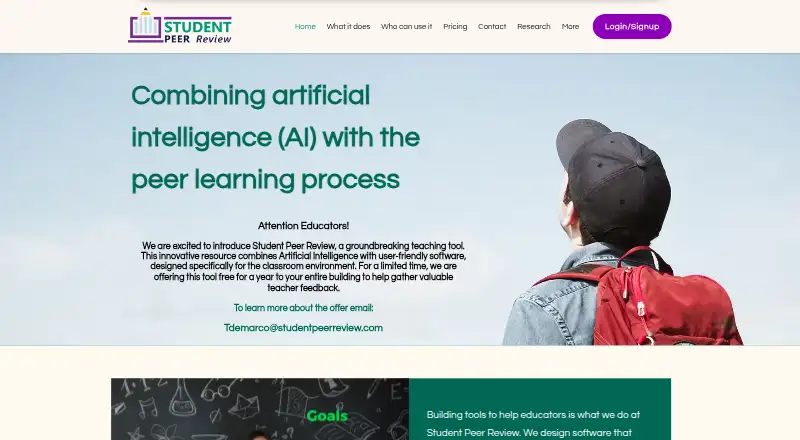
What Student Peer Review is
Student Peer Review is a web-based assessment and peer-learning tool for schools and other organizations. It is designed to assess students, gauge their understanding, and support learning of curricular concepts while reducing teachers’ clerical work. Instructors can create assessments in formats such as essays, videos, graphics, and multiple-choice questions. The system combines peer learning with AI, including ChatGPT-assisted assessment creation. AI features can generate assessments, quizzes, questions, rubrics, passages, sample answers, and other content. Listed instructor capabilities include controlling an AI robot, limiting student use of selected AI tools, measuring individual results collaboratively, and locating concepts students misunderstand. The service describes use in K-12 schools, colleges, universities, trade schools, businesses, corporations, and government. A free plan covers one course, 50 students, and 10 assessments for six months, with no credit card required. AI generation has a 30-day trial with 10,000 words; the AI Subscription costs $3 a month and allows 600,000 generated words with no expiration.
Good
- Supports essays, videos, graphics, and multiple-choice assessments
- AI generates quizzes, rubrics, passages, and sample answers
- Free plan covers one course and 50 students
- Free plan requires no credit card
Watch out
- Free plan is valid for six months
- Free plan is limited to 10 assessments
- AI trial allows 10,000 words for 30 days
Who it suits
It may suit teachers and educational organizations seeking peer assessment and AI-generated assessment materials. The service also describes use by colleges, trade schools, businesses, corporations, and government.
Verdict
Student Peer Review combines peer learning, assessment formats, and AI content generation for a range of educational and organizational settings. Its free plan has course, student, assessment, and duration limits.
Plans and prices
From Student Peer Review's own pricing page, checked 7 Oct 2026.
| Plan | Price | What it gives you |
|---|---|---|
| Artificial Intelligence TRIAL | Free | 10,000 words · 30 days validity · Assessment, passage, question, sample answer, and rubric generation |
| Free | Free | No credit card · Up to 1 course · Valid 6 months · 50 students · 10 assessments · Unlimited features |
| AI Subscription | $3 a month | 600,000 words can be generated using AI · No expiration · Assessment, passage, question, sample answer, and rubric generation · $3 Per Month |
| $ 8 / yr | $8 a year | Up to 2 courses · Valid 1 year · 100 students · 50 assessments · Unlimited features · $ 8 / yr |
| $ 25 / yr | $25 a year | Up to 10 courses · Valid 1 year · 500 students · 100 assessments · Unlimited features · $ 25 / yr |
| Enterprise | Priced on request | Institutional purchase · Request a demo |
The facts
Each one read from Student Peer Review's own pages, with the date it was checked.
What it does
- AI and peer learning
- The product combines artificial intelligence with the peer learning process and describes using ChatGPT to help instructors create assessments.checked 7 Oct 2026
- AI content generation
- The AI features generate assessments, quizzes, questions, rubrics, passages, sample answers, and other content.checked 7 Oct 2026
- Assessment formats
- The site says instructors can create assessments such as essays, videos, graphics, and multiple-choice questions.checked 7 Oct 2026
- Higher education audience
- The site describes the product for colleges and universities.checked 7 Oct 2026
- Institutional offer
- The site advertises a limited-time offer of the tool free for a year to an entire building in exchange for teacher feedback.checked 7 Oct 2026
- Instructor tools
- The system lists controlling an AI robot, limiting student use of various AI tools, measuring individual results collaboratively, and pinpointing misunderstood concepts among its capabilities.checked 7 Oct 2026
- K-12 audience
- The site describes the product for K-12 schools and educational organizations.checked 7 Oct 2026
- Other audiences
- The site also describes use by trade schools, post-K-12 secondary schools, corporations, government, and businesses.checked 7 Oct 2026
- Purpose
- Student Peer Review assesses students, measures their understanding, and helps them learn curricular concepts with minimal teacher clerical effort.checked 7 Oct 2026
- Signup
- The site links to an online login and signup application, whose page says it requires JavaScript to work properly.checked 7 Oct 2026
- Support
- The site lists [email protected] and 412-849-8556 as contact details.checked 7 Oct 2026
The company
- Company identity
- The site footer identifies the organization as Student Peer Review and shows a 2022 copyright.checked 7 Oct 2026
The full review of Student Peer Review
Student Peer Review is a peer-assessment platform for educators and organizations that need to evaluate learning across essays, media, and quizzes. It fits instructors who want rubric-based review plus AI-assisted content creation, especially for small or clearly bounded cohorts. The low entry price is appealing, but course, student, assessment, and AI-generation limits determine whether it works beyond a pilot.
Overview
The service is built to measure student understanding while reducing teachers’ clerical workload. It combines peer learning with assessment workflows and describes using ChatGPT to help instructors create instructional material. Supported assessment types include essays, videos, graphics, and multiple-choice questions, so it is not restricted to a single assignment style.
Its stated audiences include K–12 schools, colleges and universities, trade schools, other post-K–12 programs, corporations, businesses, and government organizations. That range makes the platform relevant to both formal education and structured training, although the inexpensive plans are sized for limited groups rather than broad institutional deployment.
Key features
Peer assessment and controls
Rubric scoring gives peer reviews a defined evaluation framework instead of relying only on unstructured comments. The system describes collaborative measurement of individual results and tools for pinpointing misunderstood concepts, connecting review activity with possible instructional follow-up. Instructors can control an AI robot and limit student use of various AI tools, which is useful when a course needs explicit boundaries around AI-assisted work.
AI content generation
AI features can generate assessments, quizzes, questions, rubrics, passages, and sample answers. This can shorten preparation for instructors who routinely need multiple versions of learning material, but generation is governed by word quotas: the trial provides 10,000 words, while the subscription allows 600,000 words with no expiration.
Pricing
The Free plan costs nothing, requires no credit card, and is valid for six months. It allows one course, 50 students, and 10 assessments, with unlimited features. Those caps make it a sensible way to run a small class or evaluate the workflow, not a durable choice for a department with several cohorts.
The Artificial Intelligence TRIAL is free for 30 days and includes 10,000 generated words plus assessment, passage, question, sample-answer, and rubric generation. It is useful for testing the AI workflow, but the short validity period and modest quota limit extended or high-volume use.
The AI Subscription costs $3 a month, billed $3 Per Month. It provides 600,000 words that can be generated using AI, with no expiration, and includes the same listed generation categories. This is the practical add-on for instructors who outgrow the trial quota; it is separate from the course-and-student plans.
The $ 8 / yr plan costs $8 a year, billed $ 8 / yr. It supports up to two courses, 100 students, and 50 assessments for one year, with unlimited features. The $ 25 / yr plan costs $25 a year and covers up to 10 courses, 500 students, and 100 assessments for one year, also with unlimited features. Both annual plans expand capacity substantially over Free, but neither changes the separate AI-generation subscription model. Enterprise uses custom pricing through an institutional purchase and demo request, making it the route for organizations that need a larger arrangement.
A limited-time institutional offer provides the tool free for a year to an entire building in exchange for teacher feedback. That is potentially valuable for a school willing to participate, but it is not the same as a standard, recurring plan.
Platforms
Student Peer Review is offered on the web. Account access and signup use an online application that requires JavaScript to work properly.
Who it's for
It is best suited to teachers and training designers who want peer review, rubric scoring, varied assignment formats, and AI-generated preparation in one web service. Small classes can use Free, while instructors managing several bounded courses should consider the $ 8 / yr or $ 25 / yr plans. Larger institutions should investigate Enterprise rather than assume the low annual prices will cover their scale. Organizations that need substantial AI drafting should budget for the separate $3-per-month subscription.
Pros and cons
- Pro: Essays, videos, graphics, and multiple-choice assessments support varied curricula.
- Pro: Rubric scoring and concept-identification tools tie peer review to instructional decisions.
- Pro: The Free plan has unlimited features and needs no credit card, making a small pilot straightforward.
- Pro: AI can produce assessments, passages, questions, sample answers, and rubrics rather than only one content type.
- Con: Free is limited to one course, 50 students, 10 assessments, and six months.
- Con: The 30-day AI trial is capped at 10,000 words, and ongoing generation requires a separate subscription.
- Con: The web-only platform does not provide a native mobile option in its stated platform offering.
Alternatives
For a broader comparison, see Peer Assessment Software.
Marka is a better fit when Android access matters or when a basic account covering up to three classes and 50 students per class is sufficient; its free tier offers only a full report preview.
Choose CrowdGrader when assignment-based pricing and a free instructor-sponsored option for up to 20 students better match the class structure.
Eli Review suits users seeking unlimited instructor courses with a separate one-term student-access purchase.
Kritik360 is an alternative for educators wanting permanently free professor access with course activation and ongoing support.
PeerEvals is a free web option with no paid tier required for its core job.
Expertiza is appropriate when open-source licensing and self-hosting options are priorities.
TEAMMATES is a free web service, though its service may change or be terminated at its discretion.
ComPAIR is a free alternative available on the web and for self-hosting.
Verdict
Choose Student Peer Review if you need peer learning, rubric-based assessment, varied assignment formats, and AI content generation for a small course or controlled training program. Its strongest advantage is the combination of instructional assessment and content creation at very low plan prices. Look elsewhere if you need mobile apps, uncapped cohorts on inexpensive plans, or AI generation included without a separate quota-based subscription.
Alternatives to Student Peer Review
- 1
CrowdGrader
Free planWeb7.3Free plan - 2

Marka
Free planAndroidWeb7.0Free plan - 3

PeerAssessment.com
AndroidiOSWeb6.9$18 one-time - 4

Eli Review
Free planWeb6.6From $52.95 a year - 5

Kritik360
Free planWeb6.6$29 one-time - 6
PeerEvals
Free planWeb5.9Free plan