CrowdGrader
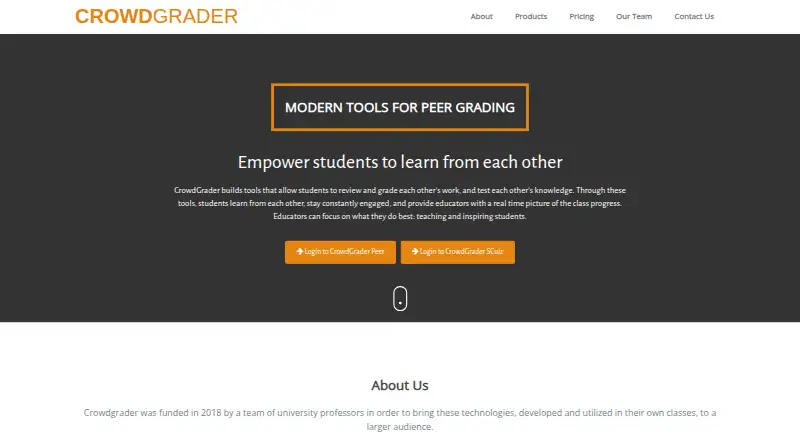
CrowdGrader is a web service for student homework submission and collaborative peer grading.
What CrowdGrader is
CrowdGrader is a web service for student homework submission and collaborative peer grading. Students submit work and review classmates' submissions, while instructors monitor assignments and keep control of final grades. The system combines peer assessments into a consensus grade and removes outliers; a student's crowd-grade also reflects how accurately they review others' work. Students can write reports, math, or code in a built-in editor, or upload files such as ZIP archives. Reviews are anonymous: authors' identities are hidden from reviewers, and uploaded files are renamed. Instructors can view similarity clusters and compare submissions side by side. Institutional subscriptions offer optional LMS integration, access monitoring, and long-term data retention for auditing. Student work is sent over HTTPS, and Google authentication uses only the user's email address for identification. The free instructor-sponsored plan covers up to 20 students per assignment; paid assignment options vary by size, and a student-supported option is listed at $1.99 per six months.
Good
- Combines peer grades into consensus grades and removes outliers.
- Reviews hide authors' identities and rename uploaded files.
- Supports reports, math, code, and ZIP submissions.
- Shows similarity clusters and side-by-side comparisons.
- Institutional subscriptions include optional LMS integration.
Watch out
- The free instructor-sponsored plan is limited to 20 students.
- Users must be at least 13.
- Google is used for authentication.
- The $1.99 student-supported fee covers six months and is non-refundable.
Who it suits
CrowdGrader is intended for instructors managing assignments and students who can benefit from peer feedback and practice reviewing others' work. Its assignment options include classes up to 20 students on the free plan and larger paid tiers.
Verdict
CrowdGrader brings peer assessment, anonymous reviews, and instructor oversight together in a web-based assignment workflow. Review the student limits, age requirement, and paid plan terms when deciding whether it fits a class.
Plans and prices
From CrowdGrader's own pricing page, checked 14 Oct 2026.
| Plan | Price | What it gives you |
|---|---|---|
| Free | Free | up to 20 students · per assignment |
| Free (instructor-sponsored) | Free | Up to 20 students · Per assignment; up to 20 students |
| Student-supported assignment | $1.99 a year | Non-refundable subscription fee; access period determines when students can submit · Six months of access; page states "$1.99/six months" |
| Student subscription | $1.99 a year | three-week free trial · six months access · six-month, non-refundable subscription |
| Small | $2.99, paid once | up to 35 students · per assignment |
| Small (instructor-sponsored) | $2.99, paid once | Up to 35 students · Per assignment |
| Medium (instructor-sponsored) | $6.99, paid once | Up to 100 students · Per assignment |
| Medium | $6.99, paid once | up to 100 students · per assignment |
| Large (instructor-sponsored) | $13.98, paid once | Unlimited students · Per assignment |
| Large | $13.98, paid once | unlimited students · per assignment |
| Institutional license | Priced on request | all affiliated instructors can use without individual charge · usage-based institutional pricing |
The facts
Each one read from CrowdGrader's own pages, with the date it was checked.
What it does
- Age requirement
- The Terms of Use say users must be at least 13 and prohibit use when any participating student is younger than 13.checked 30 Sep 2026
- Anonymous reviewing
- Reviews hide the submission author's identity and rename uploaded files to preserve anonymity.checked 14 Oct 2026
- Anonymous reviews
- Reviews are anonymous; CrowdGrader hides submission authors' identities from reviewers and renames uploaded files to preserve anonymity.checked 30 Sep 2026
- Assignment setup
- Teachers create assignments with a class roster or self-enrollment URL, without a full-course setup.checked 14 Oct 2026
- Authentication
- Users sign up and log in with a Google account; CrowdGrader says it uses the email address but not the Google password.checked 14 Oct 2026
- Class size
- The FAQ says there is no specific maximum class size, reports successful use for classes of about 800, and invites inquiries for classes of tens of thousands.checked 30 Sep 2026
- Class-size claim
- The FAQ reports successful use with about 800 students and says there is no specific class-size limit, with larger deployments handled by contacting CrowdGrader.checked 14 Oct 2026
- Consensus grading
- The system combines peer grades into a submission grade, removes outliers, and adjusts for reviewer bias and precision.checked 14 Oct 2026
- Data export
- Instructors and teaching assistants download assignment metadata as JSON and use a Python GitHub downloader to retrieve submissions, attachments and reviews.checked 14 Oct 2026
- Downloader licence
- The publicly supplied assignment-downloader code is released under the MIT licence.checked 14 Oct 2026
- Grade-bias behavior
- The algorithm can reduce a perfect-looking score when reviewers are judged overly generous, while instructors can recurve results manually.checked 14 Oct 2026
- Group work
- Assignments can allow individual or group submissions, with CrowdGrader managing group formation and review allocation.checked 14 Oct 2026
- Infrastructure
- CrowdGrader says it runs on Google Cloud with automatic scaling and geographically replicated data.checked 14 Oct 2026
- Instructor control
- Instructors may adopt crowd-grades as final grades, edit grades manually, or interpolate missing grades.checked 14 Oct 2026
- Integrations
- Institutional subscriptions include optional integration with existing Learning Management Systems; the pricing page does not name specific systems.checked 30 Sep 2026
- Late submissions
- Students cannot submit late work directly; an instructor must add or modify a late submission.checked 14 Oct 2026
- Limit: accessibility
- Western University's evaluation rated accessibility compliance 1 out of 5 because no AODA or WCAG compliance information was provided.checked 14 Oct 2026
- Limit: customization
- Western's evaluation rated customization 2 out of 5 and said rubric design is somewhat limited.checked 14 Oct 2026
- Limit: integration
- Western's evaluation rated OWL integration 1 out of 5 because the tool was available there only through a link rather than a native integration.checked 14 Oct 2026
- Limit: mobile and offline use
- Western's evaluation said advanced mobile functions are limited and rated offline access 1 out of 5 because the platform cannot be used offline.checked 14 Oct 2026
The company
- Company address
- The site lists CrowdGrader LLC at 922 New Road, Floor 2, Wilmington, Delaware 19805.checked 14 Oct 2026
- Company origin
- CrowdGrader says it was funded in 2018 by university professors to commercialize classroom technologies they had developed and used.checked 14 Oct 2026
- Company team
- The homepage identifies Mark Billion as chief operating officer, Anthony Bastardi as lead software engineer, and Luca de Alfaro and Massimo Di Pierro as professor/advisors.checked 14 Oct 2026
- Headquarters
- Wilmington, Delaware, United Stateschecked 23 Sep 2026
The full review of CrowdGrader
Overview
CrowdGrader is a web-based peer-assessment tool for courses that want students to learn by reviewing one another’s work. It is best suited to instructors who want peer grades to inform assessment while keeping authority over final marks.
Its strongest case is a structured review process that combines peer feedback with instructor oversight. The main trade-offs are per-assignment fees above the small free tier and a firm minimum-age rule.
Key features
CrowdGrader combines the grades a student receives with how accurately that student grades other submissions, then calculates a consensus grade and removes outliers. This gives peer assessment a role in scoring while rewarding careful reviewers; instructors still control final grades. Rubrics, automatic review allocation, and moderation tools make the process more structured than informal comment-swapping.
Students can work in a built-in editor for reports, math, and code, or upload files, including ZIP archives. Reviews are anonymous: reviewers cannot see authors’ identities, and uploaded files are renamed. That can support candid feedback, though it is one-way anonymity rather than a claim that every participant is mutually anonymous.
The monitoring page groups similar submissions and supports side-by-side comparison, giving instructors a way to identify work that merits closer attention. Student work is transmitted over HTTPS. Google is used for authentication, and CrowdGrader says it uses only the user's email address for identification, not other Google account information. Institutional subscriptions add access monitoring and long-term data retention for auditing; optional LMS integration is also available on those subscriptions, with no named systems. Those institutional controls are relevant to colleges, but they are not included as stated benefits of the assignment-level plans.
The maker reports successful use in classes of about 800, says there is no specific maximum class size, and invites inquiries for classes in the tens of thousands. That suggests scale is possible, but instructors planning unusually large courses should discuss the arrangement directly. Support is offered by email and phone, and educator testimonials describe responsive help from the founder.
Pricing
CrowdGrader uses a freemium model, with assignment-level charges for larger classes and a separate student-supported option. The free instructor-sponsored plan costs nothing and covers up to 20 students, making it a sensible fit for small classes or a first assignment. Its cap rules out larger cohorts.
The Small instructor-sponsored plan is $2.99 per assignment for up to 35 students; Medium is $6.99 per assignment for up to 100; and Large is $13.98 per assignment for unlimited students. The stepped fees let instructors match each assignment to class size, but recurring assignments mean recurring per-assignment costs. Large removes the student cap, not the per-assignment charge.
Student-supported assignment is priced at 1.99 USD/six months. The fee is non-refundable, access lasts six months, and the access period determines when students can submit. This shifts the charge away from the instructor, but the time window and refund restriction matter for students.
The institutional license has custom pricing based on predicted or past usage. In return, all instructors affiliated with the institution can use CrowdGrader without charge, and institutional subscriptions include optional LMS integration, access monitoring, and long-term audit retention. A 21-day trial is also offered; classes should still check the age requirement before inviting students.
Platforms
CrowdGrader runs on the web. There is no listed native mobile platform, so it is most appropriate for courses whose students can use a browser-based workflow.
Who it's for
Choose CrowdGrader if you teach a course that can benefit from structured peer review, want reviewers to practice evaluating work, and need to retain control of final grades. Its unlimited-student assignment tier and reported use in large classes also make it worth considering for bigger cohorts, subject to confirming the right arrangement.
It is not suitable for any class with a participating student younger than 13: the terms require users to be at least 13 and prohibit use in that situation. Instructors seeking a named LMS connection should confirm compatibility before choosing an institutional subscription.
Pros and cons
- Pros: Consensus grades account for reviewer accuracy and remove outliers, giving peer assessment a defined scoring role.
- Pros: Anonymous reviews, rubrics, automatic allocation, and moderation support a managed review workflow rather than ad hoc exchanges.
- Pros: Per-assignment plans range from a free 20-student tier to unlimited students, so instructors can align the fee with class size.
- Cons: The free instructor plan stops at 20 students, and paid instructor plans charge per assignment.
- Cons: Student-supported access is non-refundable and tied to a six-month submission window.
- Cons: Use is barred when any participating student is under 13, and web is the only stated platform.
Alternatives
Peer Assessment Software is the broader category to consult when comparing tools for this type of work.
Consider Eli Review if you want unlimited free instructor access to all platform features and prefer a student access option billed for one term; its listed student term lasts four months. Kritik360 is another freemium web option, with free educator access that includes course activation, instructional design, and ongoing support.
Expertiza may suit teams looking for a free, MIT-licensed option that can be self-hosted or run on Linux, macOS, or the web. ComPAIR is also free and supports self-hosted and web deployment.
PeerAssessment.com is worth comparing if Android and iOS support matter alongside web access; it offers a free trial for one class, one term, one instructor, up to 100 students, and up to 12 assessments. For an institutional purchase, Peerceptiv offers campus-wide subscriptions with unrestricted campus use, an administrator dashboard, and a custom API. peerScholar is another paid option, with a listed WCET promotional plan priced at $4,500 a year for unlimited courses, faculty, team members, students, and activities. Marka is a freemium web alternative.
Verdict
CrowdGrader is a strong fit for instructors who want anonymous peer review to shape grades without giving up final authority, especially when reviewer accuracy and outlier handling matter. Look elsewhere if the class includes anyone under 13, if native mobile access is essential, or if per-assignment costs do not fit the course budget.
Getting started
- Visit the CrowdGrader website.
- Use Google authentication to sign in.
- Have an instructor create an assignment under an instructor-sponsored plan, or use the student-supported option.
- Submit work with the built-in editor or upload a file.
- Review other submissions as part of collaborative peer grading.
Limits worth knowing
The free instructor-sponsored plan covers up to 20 students per assignment. The student-supported plan is listed at $1.99 a year and provides six months of access; the small and medium instructor-sponsored plans cover up to 35 and 100 students respectively.
Questions
Is CrowdGrader free?
Yes. Its free instructor-sponsored plan is free per assignment and covers up to 20 students.
What do the paid plans cost?
Instructor-sponsored plans are $2.99 per assignment for up to 35 students, $6.99 per assignment for up to 100, and $13.98 per assignment for unlimited students. The student-supported option is $1.99 a year and states six months of access.
Does CrowdGrader offer a trial?
Yes. The pricing note lists a 21-day trial.
Which platforms does it support?
CrowdGrader is listed for web.
Does it integrate with learning management systems?
Institutional subscriptions include optional integration with existing Learning Management Systems. Specific systems are not named in the listed facts.
How does CrowdGrader handle student anonymity and authentication?
Reviews are anonymous, and uploaded files are renamed to preserve anonymity. Google authentication uses only the user’s email address for identification, according to the maker.
Alternatives to CrowdGrader
- 1

Marka
Free planAndroidWeb7.0Free plan - 2

PeerAssessment.com
AndroidiOSWeb6.9$18 one-time - 3

Eli Review
Free planWeb6.6From $52.95 a year - 4

Kritik360
Free planWeb6.6$29 one-time - 5
Student Peer Review
Free planWeb6.6From $8 a year - 6
PeerEvals
Free planWeb5.9Free plan