spaCy
spaCy is a free, open-source Python library for building natural language processing applications, with an emphasis on production use and large volumes of te…
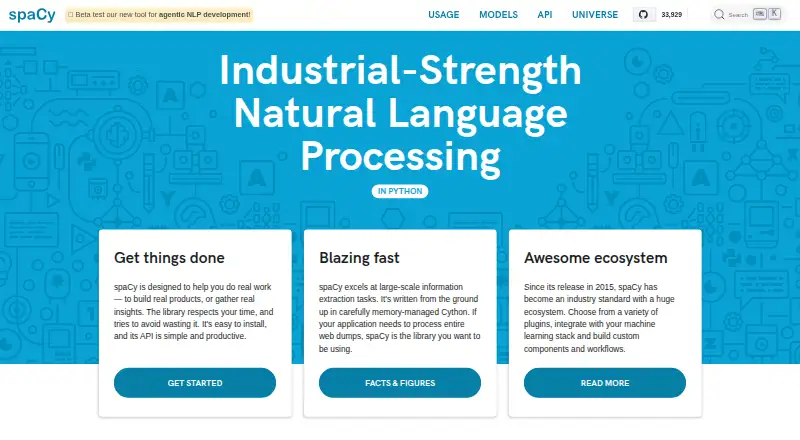
What spaCy is
spaCy is a free, open-source Python library for building natural language processing applications, with an emphasis on production use and large volumes of text. Its components handle named entity recognition, part-of-speech tagging, dependency parsing, sentence segmentation, text classification, lemmatization, morphological analysis and entity linking. The maker lists support for more than 75 languages and 84 trained pipelines covering 25 languages, although trained pipelines are not available for every supported language.
Developers can configure and train custom pipelines, describe training runs in configuration files, and package finished pipelines for installation. spaCy Projects supports workflows such as downloading source assets, running commands, checking file integrity and caching resources; its integrations include experiment tracking, model demos, serving, distributed training and uploads to Hugging Face Hub. Pretrained transformer models can be loaded through spacy-transformers, and pipeline components can share transformer embeddings. Custom models built with PyTorch, TensorFlow and other frameworks are also supported. Installation is available through pip, conda or source on Linux, macOS and Windows. spaCy can run on a user's own servers, keeping data there. Transformer models need a GPU to run effectively, while word vectors are computationally efficient. The library is available under AGPL or a commercial license.
Good
- Free, open-source library for natural language processing.
- Supports 75+ languages and 84 trained pipelines for 25 languages.
- Covers entity recognition, tagging, parsing, classification and other NLP tasks.
- Custom pipelines can be trained and packaged as Python packages.
- Can run on the user's own servers, keeping data there.
Watch out
- Trained pipelines are not available for every supported language.
- Transformer models need a GPU to run effectively.
- It is a library, not a hosted web application.
- Available under AGPL or a commercial license.
Who it suits
spaCy suits developers building production NLP applications, especially those processing substantial amounts of text or creating custom pipelines. It is also a fit for teams that need on-premise deployment and can work with a Python library rather than a hosted application.
Verdict
Choose spaCy if you are building NLP applications in Python and want configurable pipelines, broad language support and deployment on your own infrastructure. Look elsewhere if you need a ready-made hosted web application; transformer workloads also need a GPU to run effectively.
Plans and prices
From spaCy's own pricing page, checked 7 Oct 2026.
| Plan | Price | What it gives you |
|---|---|---|
| spaCy | Free | Free, open-source library; available under AGPL or a commercial license |
The facts
Each one read from spaCy's own pages, with the date it was checked.
What it does
- Custom pipelines
- Users can configure and train custom pipelines, package them as Python packages, and manage end-to-end workflows with spaCy Projects.checked 7 Oct 2026
- Data privacy
- Explosion says spaCy can run without data leaving the user's servers.checked 7 Oct 2026
- Deployment
- Trained pipelines can be installed as Python packages, and their data can be stored anywhere on the file system.checked 7 Oct 2026
- Framework integration
- The homepage says spaCy supports custom models in PyTorch, TensorFlow and other frameworks.checked 7 Oct 2026
- Hardware limit
- The documentation says transformer models require a GPU to run effectively, while word vectors are computationally efficient.checked 7 Oct 2026
- Installation
- The documentation lists installation through pip, conda or source, with CPU and GPU options.checked 7 Oct 2026
- Integrations
- The documentation describes integrations with transformer pipelines, CuPy for GPU support and an extension for Visual Studio Code configuration files.checked 7 Oct 2026
- Languages
- The site lists support for 75+ languages and 84 trained pipelines for 25 languages.checked 7 Oct 2026
- Language support
- The maker’s homepage states that spaCy supports 75+ languages and offers 84 trained pipelines for 25 languages.checked 7 Oct 2026
- Model availability
- The documentation notes that although spaCy supports tokenization for many languages, trained pipelines are not available for every language.checked 7 Oct 2026
- NLP features
- Its components include named entity recognition, part-of-speech tagging, dependency parsing, sentence segmentation, text classification, lemmatization and morphological analysis.checked 7 Oct 2026
- NLP tasks
- Its components cover named entity recognition, part-of-speech tagging, dependency parsing, sentence segmentation, text classification, lemmatization, morphology and entity linking.checked 7 Oct 2026
- Operating systems
- The installation documentation says spaCy runs on Unix/Linux, macOS/OS X and Windows and is compatible with 64-bit CPython 3.7+.checked 7 Oct 2026
- Paid services
- Explosion offers custom NLP consulting and implementation, with fees quoted up front; the page does not publish a price list.checked 7 Oct 2026
- Product boundary
- spaCy is a library for building NLP applications; it does not provide a software-as-a-service product or web application.checked 7 Oct 2026
- Project integrations
- spaCy Projects describes integrations for data and experiment tracking, demos, model serving, distributed training and uploading pipelines to Hugging Face Hub.checked 7 Oct 2026
- Purpose
- spaCy is a Python library for advanced natural language processing, designed for production use and processing large volumes of text.checked 7 Oct 2026
- Security
- The official pages opened for this research did not state a security certification or compliance standard.checked 7 Oct 2026
- Support
- The site links to GitHub Discussions, an issue tracker and Stack Overflow for community help.checked 7 Oct 2026
- Training
- Its training system uses configuration files to describe training runs and make experiments reproducible.checked 7 Oct 2026
- Transformer integration
- spaCy can load pretrained transformer models through spacy-transformers and supports sharing transformer embeddings across pipeline components.checked 7 Oct 2026
The company
- Founded
- 2015checked 28 Sep 2026
- Headquarters
- Berlin, Germanychecked 28 Sep 2026
- Maker
- Explosion identifies itself as the maker of spaCy and describes itself as a software company specializing in developer tools and services for AI and natural language processing.checked 7 Oct 2026
The full review of spaCy
spaCy is an open-source Python library for building natural language processing into production software. It is best suited to developers who need to process substantial volumes of text and control their own models and deployment. Its broad NLP toolkit and flexible pipelines make it a strong foundation, but it is not a finished application.
Overview
Made by Explosion, a company focused on AI and NLP developer tools, spaCy handles tasks including entity extraction and linking, text classification, part-of-speech tagging, dependency parsing, sentence segmentation, lemmatization and morphological analysis. It supports 75+ languages and provides 84 trained pipelines across 25 languages. Tokenization reaches more languages than trained pipelines do, so support for a language does not guarantee a ready-to-use model.
Trained pipelines can be installed as Python packages, with their data stored anywhere on the file system. spaCy can run on a user's own servers without sending data elsewhere, a meaningful advantage for teams that need control over data location. The trade-off is responsibility: users build and operate the application around the library.
Key features
Custom pipelines and training
Developers can configure and train custom pipelines, then package them for installation. Training runs are described with configuration files, which helps make experiments reproducible. This flexibility is useful when standard pipelines do not match a task, but it calls for Python and machine-learning development work rather than point-and-click setup.
Projects and integrations
spaCy Projects coordinates workflows such as downloading source assets, running commands, verifying checksums and caching assets across different backends. Its integrations cover data and experiment tracking, demos, model serving, distributed training and uploads to Hugging Face Hub. That gives teams ways to organize a pipeline lifecycle, though it does not turn spaCy into a hosted application.
Transformers and compute
Through spacy-transformers, spaCy can load pretrained transformer models, including BERT, and share transformer embeddings across pipeline components. It also supports custom models built with PyTorch, TensorFlow and other frameworks. Transformer models need a GPU to run effectively; word vectors are more computationally efficient. The latter can suit tighter compute budgets, while transformer-heavy workloads need appropriate hardware.
Pricing
The spaCy library costs nothing. It is open source and available under either the AGPL or a commercial license. The free library is the relevant option for developers building their own NLP software; there are no paid library tiers described. Explosion also offers custom NLP consulting and implementation for custom pricing, with fees quoted up front.
Installation is available through pip, conda or source, with CPU and GPU options. The documentation states compatibility with 64-bit CPython 3.7+.
Platforms
spaCy runs on Linux, macOS and Windows, and can be deployed on premises. Its installation documentation also describes Unix/Linux and macOS/OS X support. This is software for development and deployment in a user's environment, not a browser-based spaCy product.
Who it's for
Choose spaCy if you are building Python applications that need configurable NLP pipelines, broad language coverage and control over where models and data run. It is a particularly good fit when a team can manage training, packaging and deployment itself. Look elsewhere if you need an immediately usable hosted web application, or if your target language lacks a suitable trained pipeline and you cannot build one.
Pros and cons
Pros
- Broad task coverage: Entity extraction, tagging, parsing, classification and other core NLP tasks live in one library.
- Deployment control: Pipelines can be packaged for installation and run on a user's servers without data leaving them.
- Flexible workflows: Custom training, framework integrations and spaCy Projects support tailored pipelines and repeatable work.
- Free core library: The open-source library has no subscription price.
Cons
- Not a finished app: Users must build and operate their own NLP application rather than sign into a hosted spaCy service.
- Uneven model availability: Tokenization support across 75+ languages does not mean trained pipelines exist for all of them.
- Transformer hardware demands: Transformer models run effectively with a GPU, which can rule them out for teams without suitable compute.
- License choice matters: The library is available under AGPL or a commercial license, so teams need to select the terms that fit their use.
Alternatives
For a different kind of text-analysis workflow, CATMA is free and supports web and self-hosted use, with no listed project or collaboration count limit; it is not designed for massive quantitative or statistical text analysis.
KH Coder is worth considering for users who want a desktop analysis tool: it has a free Windows Starting Edition with limited data and features, plus a 99.00 USD once Mac edition for Apple silicon.
MAXQDA is a paid macOS and Windows option with a free trial, better suited to readers who prefer a commercial desktop product. Taguette is another free option, usable on a computer, a self-hosted server or a hosted server.
Transana is a paid macOS and Windows alternative with a trial; its free demo has tight data limits and is not intended for real analysis. Voyant Tools offers a free open-source text analysis environment as a hosted web app or downloadable local server.
QualCoder is free, open-source qualitative data analysis software for Linux, macOS and Windows, with optional AI features that may require a separate provider account or paid usage. Dovetail may suit teams seeking a web-based text analytics platform; its free plan includes one channel and one project, basic chat and AI summaries.
Browse more options in Text Analytics Software.
Verdict
spaCy is a strong choice for Python developers building production NLP applications who want to shape pipelines, support multiple languages and deploy on their own infrastructure. Its main advantage is the combination of breadth and control at no library cost; its main limitation is that it leaves application-building and operations to the user, with GPUs needed for effective transformer workloads.
Getting started
- Choose Linux, macOS or Windows for installation.
- Install spaCy through pip, conda or from source.
- Select CPU or GPU options for the installation.
- Configure a pipeline and train it using configuration files.
- Package a trained pipeline for installation as a Python package.
Limits worth knowing
The free library is available under AGPL; a commercial license is also offered. Trained pipelines do not cover every language, and transformer models need a GPU to run effectively.
Questions
How much does spaCy cost?
The listed spaCy plan is free. The library is available under AGPL or a commercial license.
Which operating systems does spaCy support?
The installation documentation lists Linux, macOS and Windows, as well as self-hosted deployment.
Is spaCy open source?
Yes. It is a free, open-source Python library available under AGPL or a commercial license.
What languages and tasks does it support?
The maker lists support for 75+ languages and 84 trained pipelines for 25 languages. Components cover tasks including entity recognition, part-of-speech tagging, dependency parsing, text classification and lemmatization.
Can spaCy run on my own infrastructure?
Yes. Trained pipelines can be installed as Python packages, and spaCy can run without data leaving the user's servers.
Does spaCy offer a hosted web app?
No. spaCy is a library for building NLP applications, rather than a software-as-a-service product or web application.
Alternatives to spaCy
- 1

Azure AI Speech
Free planWebAPISelf-hosted6.7Free plan - 2

Symanto
WebAPI6.0 - 3
 5.7
- 44.8
- 5
fastText
WebLinuxmacOS4.8 - 6
Gensim
LinuxmacOSWindows4.8