SourcererCC
SourcererCC is free GPL-3.0 software for token-based code clone detection across very large codebases and Internet-scale repositories.
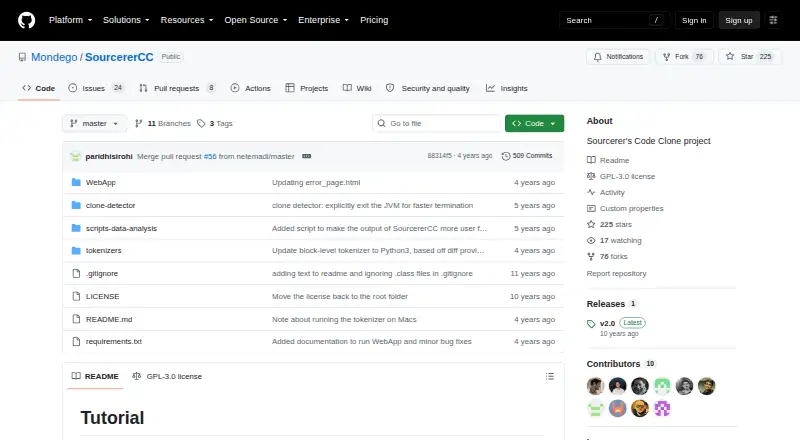
What SourcererCC is
SourcererCC is free GPL-3.0 software for token-based code clone detection across very large codebases and Internet-scale repositories. It can compare complete files, methods, statements, or blocks, and the project says any programming language can be handled when tokenizer settings and file extensions are configured. Source must be tokenized before detection. The default similarity threshold is 80%, and users can change it. File-level detection ignores files below 65 tokens or above 500,000 tokens under the documented defaults. A controller divides work across multiple nodes, after which results are aggregated. The project provides a virtual-machine artifact with prepared steps from raw source through a database of clone mappings. DéjàVu is described as a supporting web tool for quick clone analysis. SourcererCC is intended for Linux and self-hosted use. The tutorial warns that tokenizer multiprocessing does not work on Macs with Python versions later than 3.6 and recommends avoiding that workflow on Mac.
Good
- GPL-3.0 open-source software
- Detects clones at multiple code levels
- Configurable for any language
- Adjustable similarity threshold
- Distributed processing across nodes
Watch out
- Source must be tokenized first
- Default file bounds exclude very small or large files
- Mac multiprocessing requires Python 3.6
- Self-hosted Linux workflow
Who it suits
It suits Linux or self-hosted teams analyzing code similarity at repository, file, method, statement, or block level. It is useful when configurable tokenization and distributed processing are needed.
Verdict
SourcererCC offers configurable, large-scale clone detection with distributed processing and a ready virtual-machine path. Users should prepare tokenization settings and account for the documented Mac and file-size limitations.
The facts
Each one read from SourcererCC's own pages, with the date it was checked.
What it does
- DéjàVu
- The project says SourcererCC supports DéjàVu, a large-scale study of code cloning on GitHub, and describes DéjàVu as a web tool for clone analysis.checked 9 Oct 2026
- Detection scope
- It can detect clones between files, methods, statements, or blocks, in any language.checked 9 Oct 2026
- File size bounds
- The documented file-level clone detection configuration ignores files below 65 tokens or above 500000 tokens by default.checked 4 Oct 2026
- Getting started
- The project provides a virtual machine with instructions and programs for processing source code into a database with clone mappings.checked 9 Oct 2026
- Granularity
- It can detect clones between files, methods, statements, or blocks.checked 4 Oct 2026
- Input preparation
- Source code must first be tokenized, and the documented tokenizer accepts configured file extensions and project paths.checked 4 Oct 2026
- Input size limits
- The documented configuration ignores files below 65 tokens or above 500,000 tokens.checked 9 Oct 2026
- Languages
- The tokenizer can be configured with language comment syntax and a list of file extensions to analyze.checked 9 Oct 2026
- Language support
- The README says it can detect clones in any language, with tokenizer language settings and file extensions configured by the user.checked 4 Oct 2026
- License
- The GitHub repository identifies its license as GPL-3.0.checked 9 Oct 2026
- Parallel processing
- The tool splits clone detection across multiple nodes, whose output must be aggregated.checked 9 Oct 2026
- Processing
- Source code must be tokenized before SourcererCC runs, and the repository provides a tokenizer for that step.checked 9 Oct 2026
- Purpose
- SourcererCC is a token-based code clone detector for very large code bases and Internet-scale project repositories.checked 9 Oct 2026
- Similarity threshold
- The documented default flags clones at 80% similarity, and the threshold can be changed.checked 9 Oct 2026
- Support
- The tutorial invites users to contact the team for technical help, including hardware performance tuning.checked 9 Oct 2026
- VM artifact
- The project describes a virtual machine artifact with pre-programmed steps from raw source code to a database with clone mappings and says it is an easy way to get started.checked 4 Oct 2026
- Web tool
- The README describes DéjàVu as a supporting web tool for quick and simple clone analysis.checked 4 Oct 2026
Where it runs
- Notable platform limit
- The README says the tokenizer's multiprocessing features do not work on Macs with Python versions later than 3.6 and recommends avoiding Mac for this workflow.checked 4 Oct 2026
- Platform limitation
- The tutorial says the tokenizer requires Python 3.6 on Mac because later versions have multiprocessing incompatibilities.checked 9 Oct 2026
Alternatives to SourcererCC
- 1
Dolos
Free planOpen sourceWebAPILinuxmacOS7.7Free plan - 2

jscpd
Free planOpen sourceAPILinuxmacOSSelf-hosted7.4Free plan - 3
Avidemux
Free planOpen sourceWebLinuxmacOSWindows7.3Free plan - 4
PMD
Free planLinuxmacOSSelf-hostedWindows6.8Free plan - 5
Duplo
Free planLinuxmacOSWindows6.5Free plan - 6
dcd
Free planLinuxmacOS6.2Free plan