Sotto
Sotto is free, open-source, self-hosted language-learning software built around CEFR courses and private practice.
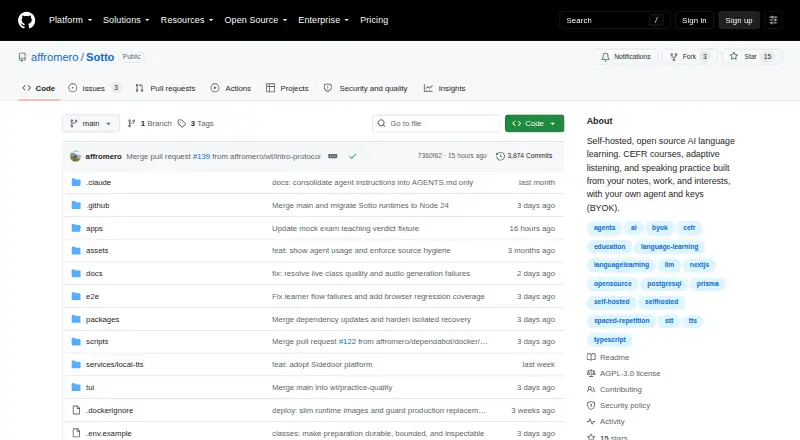
What Sotto is
Sotto is free, open-source, self-hosted language-learning software built around CEFR courses and private practice. Its graded course covers grammar, reading, listening, speaking, and writing, with progression tied to demonstrated mastery. Learners can also practice skills without course gates. An SM-2 memory graph schedules vocabulary and grammar reviews and helps shape adaptive listening. Classes can draw on articles, papers, YouTube links, or topics, with material leveled to the learner's CEFR course and citations provided. Users configure AI and speech providers, including OpenAI, Anthropic, Ollama, faster-whisper, Kokoro, and Gemini Live. A documented setup can run language models, speech recognition, and speech generation offline on the user's own hardware. The application, database, and files run on the operator's stack, while content sent to cloud providers is subject to those providers' terms. Access options include an installable browser PWA, desktop launcher, terminal client, and iPad workbook PDF. The software is free to run, modify, and redistribute under AGPL-3.0, but users pay configured AI and speech providers directly. Windows setup uses WSL2; mock exams provide feedback, not official scores.
Good
- Courses cover five language skills.
- SM-2 schedules vocabulary and grammar reviews.
- Classes can use articles, papers, videos, or topics.
- A documented setup runs fully offline.
- Offers PWA, desktop, terminal, and workbook access.
Watch out
- Users pay configured AI and speech providers directly.
- Cloud-sent content follows providers' terms.
- Windows setup uses WSL2.
- Mock exams do not provide official scores.
Who it suits
Sotto suits language learners who want CEFR structure and private rehearsal before speaking with others. It may appeal to learners comfortable self-hosting and configuring their own AI and speech providers.
Verdict
Sotto combines structured CEFR study with adaptive review and customizable practice materials. Its self-hosted approach gives learners control over their own stack, but provider costs and setup requirements matter.
Plans and prices
From Sotto's own pricing page, checked 13 Oct 2026.
| Plan | Price | What it gives you |
|---|---|---|
| Self-hosted | Free | Free to run, modify, and redistribute under AGPL-3.0 · You pay configured providers directly |
The facts
Each one read from Sotto's own pages, with the date it was checked.
What it does
- Access controls
- Self-hosted setup uses a shared password and local learner profiles, with optional WebAuthn passkeys that an administrator can revoke.checked 13 Oct 2026
- Adaptive practice
- A per-course vocabulary and grammar memory graph uses SM-2 spaced repetition to schedule reviews and seed adaptive listening.checked 12 Oct 2026
- AI and speech providers
- Sotto supports provider-selected AI and speech, including OpenAI and Anthropic API keys, local Claude Code or Codex agents, and local Ollama, faster-whisper, and Kokoro components.checked 12 Oct 2026
- Clients
- Sotto offers a browser-installable web app/PWA, a terminal client, and a desktop launcher for macOS, Windows, and Linux; Windows setup uses WSL2.checked 13 Oct 2026
- Course skills
- Its graded classes cover grammar, reading, listening, speaking, and writing, with progression gated by mastery.checked 12 Oct 2026
- Course structure
- Its course covers grammar, reading, listening, speaking, and writing, with progression gated by demonstrated mastery.checked 13 Oct 2026
- Credential security
- The README says provider API keys are encrypted at rest with BYOK_ENCRYPTION_KEY and describes a networkless sidecar for refreshing local CLI credentials.checked 13 Oct 2026
- Data and privacy
- Sotto runs its application, database, and files on the operator's stack; content sent to configured cloud providers is handled under those providers' terms.checked 12 Oct 2026
- Data control
- Users run the application, database, and files on their own stack; content sent to configured cloud providers is subject to those providers’ terms.checked 13 Oct 2026
- Desktop and mobile access
- The maker documents a Tauri desktop launcher for macOS, Windows, and Linux, plus an installable browser PWA for phones, tablets, and laptops.checked 12 Oct 2026
- Integrations
- The maker documents Gemini Live API for real-time spoken translation and an MCP server for connecting Claude Code or Codex workflows.checked 12 Oct 2026
- Intended audience
- The maker describes Sotto as private rehearsal for learners who want to practice before speaking with a teacher, tutor, classmate, or stranger.checked 12 Oct 2026
- iPad workbook
- The web app generates class workbook PDFs for annotation in GoodNotes or another app, and the README says the native iPad app targets iPadOS 18+.checked 13 Oct 2026
- Mock exams
- Practice exams follow Goethe, DELE, Cambridge English, or generic CEFR formats and provide mock feedback, not official scores.checked 13 Oct 2026
- Offline lessons
- Yeschecked 19 Sep 2026
- Offline use
- The project documents an optional fully offline setup using a local LLM, speech recognition, and speech generation on the user’s hardware.checked 13 Oct 2026
- Other learning surfaces
- Sotto provides an iPad workbook PDF for annotation and a Rust terminal client with audio playback and microphone recording.checked 12 Oct 2026
- Personalized content
- Learners can build classes from articles, papers, YouTube links, or their interests, with content leveled to their CEFR course and citations provided.checked 12 Oct 2026
- Personalized review
- Yeschecked 19 Sep 2026
- Placement test
- Yeschecked 19 Sep 2026
Money
- Costs
- The software is described as free to run under AGPL-3.0, while users pay their configured AI and speech providers directly.checked 12 Oct 2026
- Free plan
- Yeschecked 19 Sep 2026
- License and cost
- The project is licensed under AGPL-3.0 and says it is free to run, modify, and redistribute under the same terms; users pay their AI and speech providers directly.checked 13 Oct 2026
Where it runs
- Mobile apps
- Yeschecked 19 Sep 2026
The full review of Sotto
Sotto is open-source language-learning software that combines CEFR coursework with private, self-hosted practice. It suits learners who want to rehearse with material from their own reading and interests, especially before speaking with a teacher or conversation partner. The free software is compelling for technically capable users, but running it and supplying AI or speech services requires ownership of the setup.
Overview
Sotto provides a structured route through grammar, reading, listening, speaking, and writing, while allowing practice outside the main progression. Advancement is tied to demonstrated mastery, so it is better suited to learners who value a deliberate sequence than to those looking only for quick daily drills. Ungated skill practice keeps focused work available when a learner needs to revisit one area.
The project runs under AGPL-3.0 and can be run, modified, and redistributed without a software fee. The trade-off is operational: you run the application, database, and files on your own infrastructure, and pay configured AI and speech providers directly. A managed hosted offering is described as planned rather than as the current model.
Key features
A per-course vocabulary and grammar memory graph uses SM-2 spaced repetition to schedule reviews. Those records also seed adaptive listening, giving review sessions a connection to listening practice instead of treating memorization and comprehension as unrelated tasks.
Personalized classes can start with an article, paper, YouTube link, or a topic of interest. Sotto levels the resulting material to the learner's CEFR course and supplies citations, making it useful for language work tied to study, work, or a particular hobby. Mock exams can follow Goethe, DELE, Cambridge English, or generic CEFR formats; their feedback helps practice, but it is not an official examination score.
Provider flexibility is unusually broad. You can configure OpenAI or Anthropic keys, use local Claude Code or Codex agents, or run local Ollama, faster-whisper, and Kokoro components. Gemini Live API is documented for real-time spoken translation, and an MCP server connects Claude Code or Codex workflows. A fully offline arrangement is possible when the language model, speech recognition, and speech generation run on your own hardware, although that places hardware and maintenance responsibility with you.
Sotto documents encrypted-at-rest per-account API keys using BYOK_ENCRYPTION_KEY. Self-hosted access uses a shared password and local learner profiles, with optional WebAuthn passkeys that an administrator can revoke. Content sent to a configured cloud provider remains subject to that provider's terms, so self-hosting improves control of the stack without making every processing step local.
Pricing
| Plan | Price | What it includes |
|---|---|---|
| Self-hosted | free | Free to run, modify, and redistribute under AGPL-3.0; you pay configured providers directly. |
There are no paid Sotto tiers, seat charges, renewal terms, or trial period to weigh. The meaningful cost is infrastructure plus usage from whichever AI, text-to-speech, or speech-to-text providers you select. Local components can avoid provider bills, but require compatible hardware and administration.
Platforms
Sotto supports Android, iOS, Linux, macOS, Windows, web, API access, and self-hosting. The maker documents a Tauri desktop launcher for macOS, Windows, and Linux; Windows setup uses WSL2. Phones, tablets, and laptops can install the browser PWA. An iPad workbook PDF supports annotation in GoodNotes or another app, and the README describes a native iPad app targeting iPadOS 18 and later. A Rust terminal client adds audio playback and microphone recording.
Who it's for
Choose Sotto if you want CEFR structure, adaptive review, and speaking rehearsal built around your own notes, work, or interests, and you are comfortable administering a self-hosted application. It is particularly well matched to privacy-conscious learners who want local processing options and to technically inclined users who value provider choice.
Look elsewhere if you want a turnkey service with no infrastructure decisions, a formally scored certification exam, or a single subscription covering all speech and AI usage. Sotto's flexibility is an advantage only when you are willing to configure and maintain it.
Pros and cons
Pros
- Free AGPL-3.0 software: You can run, modify, and redistribute the learning stack without a license charge.
- Mastery-led CEFR courses: Progression across five core skills gives structured learners a clear route, while ungated practice prevents the course gates from blocking targeted work.
- Connected adaptive review: SM-2 vocabulary and grammar scheduling also informs adaptive listening.
- Interest-based material: Articles, papers, videos, and topics become leveled classes with citations.
- Local and cloud provider choice: OpenAI, Anthropic, local agents, Ollama, faster-whisper, Kokoro, and Gemini Live support different privacy and cost preferences.
- Broad client coverage: Desktop, PWA, mobile, terminal, and iPad workbook options accommodate different study surfaces.
Cons
- Self-hosting overhead: You must operate the application, database, files, authentication, and—in Windows—WSL2.
- Usage costs are external: Cloud AI and speech bills come directly from your chosen providers and are not bundled into Sotto.
- Practice exams are not credentials: Mock feedback cannot replace an official Goethe, DELE, or Cambridge result.
- Privacy still depends on configuration: Cloud-sent content follows each provider's terms even when the main stack is yours.
Alternatives
Duolingo is the better pick for a mainstream Android, iOS, macOS, or web experience with a freemium model and a one-week free trial, rather than self-hosting.
Busuu suits learners seeking a freemium mobile and web service with paid Premium and Premium Plus options.
Learning with Texts is another free, self-hosted choice for Linux, macOS, Windows, and web users who can run a local PHP and MySQL server.
LingQ is a freemium Android, iOS, web, and browser-extension option with a free tier capped at 20 saved words and phrases, five imported lessons, and one audio playlist.
mLearn is a free multi-platform alternative with optional cloud features and usage limits.
Innovative Language Learning offers a freemium service with free lessons and transcripts, mobile access, and paid tiers.
JapanesePod101 is a freemium Android, iOS, and web option focused on Japanese lessons and a free survival-phrases course.
Talktiko provides a freemium Android, iOS, web, and API service with a free tier limited to one language, three lessons per day, and basic text-to-speech.
Verdict
Sotto is a strong choice for technically capable learners who want CEFR progression, adaptive review, and private practice shaped by their own material. Its decisive advantage is control over the learning stack and provider configuration. Look elsewhere if you want managed convenience, predictable all-in pricing, or an official exam credential rather than self-hosted practice.
Getting started
- Open the Sotto GitHub website.
- Set up the application, database, and files on your own infrastructure.
- Configure a shared password and local learner profiles; an administrator can optionally enable WebAuthn passkeys.
- Choose AI and speech providers, or configure local components for offline use.
- Access Sotto through its browser PWA, desktop launcher, or terminal client; Windows desktop setup uses WSL2.
Limits worth knowing
The software is free to run under AGPL-3.0, but AI and speech provider charges are paid directly by users. Content sent to configured cloud providers is handled under those providers’ terms.
Questions
How much does Sotto cost?
Sotto is free to run, modify, and redistribute under AGPL-3.0. Users pay configured AI and speech providers directly.
Is Sotto open source?
Yes. It is licensed under AGPL-3.0.
What platforms can I use?
Sotto offers a browser-installable PWA, a desktop launcher for macOS, Windows, and Linux, and a Rust terminal client. Windows desktop setup uses WSL2; the README says the native iPad app targets iPadOS 18 or later.
Can Sotto work offline?
A documented setup runs the language model, speech recognition, and speech generation on your hardware.
What does Sotto teach?
Its CEFR course covers grammar, reading, listening, speaking, and writing. It also supports leveled classes from articles, papers, YouTube links, or topics.
Does Sotto provide official exam scores?
No. Its Goethe, DELE, Cambridge English, and generic CEFR practice exams provide mock feedback, not official scores.
Alternatives to Sotto
- 1

Talkpal
Free planAndroidiOSWebmacOS9.0From $6.24 a month - 2

Langua
Free planAndroidiOSWebmacOS8.9Free plan - 3

LingQ
Free planAndroidiOSWebExtension8.8From $215.76 a year - 4

Clozemaster
Free planAndroidiOSWebAPI8.7From $60 a year - 5
Innovative Language Learning
Free planAndroidiOSWebmacOS8.7From $60 a year - 6
Enverson AI
Free planAndroidiOSWeb8.6From $8.25 a month