Solar ERP
Solar ERP is a web-based ERP designed for solar installation companies.
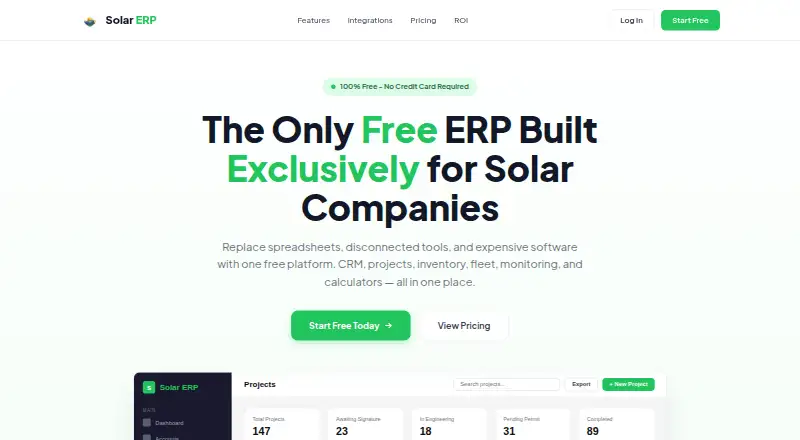
What Solar ERP is
Solar ERP is a web-based ERP designed for solar installation companies. It brings sales and project work together through a solar CRM and a 21-stage project pipeline, with tools for work orders, inventory across locations, fleet management, GPS-enabled timesheets, permitting, and engineering queues. For system monitoring, it connects to Enphase, SolarEdge, and Tesla, syncing automatically every 15 minutes. Solar and detach-and-reset calculators factor in labor, materials, overhead, and margin to produce PDF proposals. Listed connections also include QuickBooks, OpenSolar, Podio, Nearmap, and e-signatures. The Free plan is $0 forever and lists unlimited users, projects, and monitored systems. Enterprise pricing is custom. Pro adds AI tools, premium calculators, a customer portal, advanced reporting, data migration, and priority email support; Enterprise adds custom API integrations, SSO/SAML, audit logs, advanced permissions, multi-branch support, and priority phone and video support.
Good
- Free plan lists unlimited users and projects.
- Monitors Enphase, SolarEdge, and Tesla systems.
- Calculators generate PDF proposals.
- Includes GPS-enabled timesheets and fleet management.
Watch out
- Web is the only listed platform.
- No free trial is listed.
- Pro is listed at $725 a month.
- Companies with 100 or more users require Custom.
Who it suits
Solar installation companies needing sales, project operations, and system monitoring in one web platform may find Solar ERP relevant. Its free plan may suit teams seeking unlimited users, projects, and monitored systems.
Verdict
Solar ERP combines solar-focused CRM, operations, monitoring, and proposal tools. Check its listed user limits and pricing structure against your organization’s needs.
Plans and prices
From Solar ERP's own pricing page, checked 8 Oct 2026.
| Plan | Price | What it gives you |
|---|---|---|
| Free | Free | Unlimited users · Unlimited projects · Unlimited monitored systems · $0/forever |
| Pro | $725 a month | Up to 100 users · Unlimited projects · Unlimited monitored systems · From $495/month with annual subscription ($5,940/year) |
| Enterprise | Priced on request | For companies with 100+ users · Unlimited projects · Unlimited monitored systems · Custom pricing based on the size and needs of your organization |
The facts
Each one read from Solar ERP's own pages, with the date it was checked.
What it does
- CRM and project pipeline
- The platform includes solar sales CRM and a 21-stage project pipeline.checked 8 Oct 2026
- Data retention
- After account termination, the policy says data is retained for 30 days for export and may remain in encrypted backups for up to 90 days after deletion from primary systems.checked 8 Oct 2026
- Enterprise features
- Enterprise adds custom API integrations, SSO/SAML, audit logs, advanced permissions, multi-branch support, and phone and video support with a priority SLA.checked 8 Oct 2026
- Integrations
- The maker lists integrations or connections including QuickBooks, OpenSolar, Podio, Nearmap, and e-signatures, in addition to Enphase, SolarEdge, and Tesla monitoring.checked 8 Oct 2026
- Operations
- It includes work orders, multi-location inventory, fleet management, GPS-enabled timesheets, permitting, and engineering queue tracking.checked 8 Oct 2026
- Pro features
- Pro adds AI tools, premium calculators, a customer project portal, advanced reporting, data migration support, and priority email support.checked 8 Oct 2026
- Pro user limit
- Companies with 100 or more users require a Custom plan because of AI API usage.checked 8 Oct 2026
- Purpose
- Solar ERP describes itself as an all-in-one ERP built for solar installation companies.checked 8 Oct 2026
- Quoting
- Solar and detach-and-reset calculators can account for labor, materials, overhead, and margin and generate PDF proposals.checked 8 Oct 2026
- Security
- The privacy policy says data is encrypted in transit with TLS 1.2 or higher and at rest with AES-256, with database row-level security and role-based access controls.checked 8 Oct 2026
- Support
- The contact page provides a form for general support and says a team member will review submissions and respond promptly.checked 8 Oct 2026
- System monitoring
- The platform connects to Enphase, SolarEdge, and Tesla for system monitoring, with automatic syncing every 15 minutes.checked 8 Oct 2026
Money
- Free plan limits
- The Free plan lists unlimited users, unlimited projects, and unlimited monitored systems.checked 8 Oct 2026
The full review of Solar ERP
Solar ERP is a web-based ERP for solar installation companies that want sales, delivery, monitoring, and quoting in one system. It suits installers coordinating office, engineering, warehouse, and field crews; organizations needing only design or a lightweight mobile tool may find its scope excessive. The free tier is unusually generous on volume, while the paid tiers add the controls and support expected by larger operations.
Overview
Solar ERP brings a solar CRM and 21-stage project pipeline together with work orders, permitting, engineering queues, inventory, fleet activity, and timesheets. That end-to-end structure is valuable when handoffs between sales and installation are a source of delay or duplicated data. Crew scheduling and design handoff extend the workflow beyond a basic CRM.
The platform is web-only, so it fits teams working from browsers rather than companies requiring dedicated mobile applications. Its broad remit can also be unnecessary for a small installer that needs one narrow function. The biggest commercial divide is between the free tier and Pro's annual commitment.
Key features
Sales and delivery control
The 21-stage pipeline gives managers a defined route from lead through project progress. Work orders, permitting, engineering queue tracking, GPS-enabled timesheets, crew scheduling, and fleet management connect administrative planning with field execution. Multi-location inventory is particularly relevant to installers moving equipment among branches or jobs, although a small team with one warehouse may not use all of that depth.
Monitoring connections
Solar ERP connects with Enphase, SolarEdge, and Tesla for system monitoring, synchronizing automatically every 15 minutes. That cadence reduces the need for manual status checks when managing installed systems, provided the business operates with those ecosystems. QuickBooks, OpenSolar, Podio, Nearmap, and e-signature connections broaden its place in an existing software stack.
Quotes and customer access
Solar and detach-and-reset calculators account for labor, materials, overhead, and margin, then produce PDF proposals. This is more useful than a simple price list when margins vary by job type. Pro adds a customer project portal, letting clients follow work through a dedicated interface, alongside AI tools and advanced reporting.
Security and retention
Data is encrypted in transit with TLS 1.2 or higher and at rest with AES-256. Database row-level security and role-based access controls support separation between users and records. After termination, data is retained for 30 days for export and may remain in encrypted backups for up to 90 days, so departing customers should plan their export window.
Pricing
| Plan | Price | Included limits and features |
|---|---|---|
| Free | free, billed $0/forever | Unlimited users, projects, and monitored systems |
| Pro | $725 a month; from $495/month with annual subscription ($5,940/year) | Up to 100 users; unlimited projects and monitored systems; AI tools, premium calculators, customer portal, advanced reporting, migration support, priority email support |
| Enterprise | Custom pricing | For companies with 100+ users; unlimited projects and monitored systems; custom APIs, SSO/SAML, audit logs, advanced permissions, multi-branch support, and phone/video support with a priority SLA |
Free is a credible starting point for a growing installer because its user, project, and monitoring allowances do not impose a stated volume ceiling. It does not include the Pro-specific AI, portal, premium calculators, reporting, migration assistance, or priority support. Pro is aimed at established teams that need those capabilities and can accept a $5,940 annual bill; the advertised monthly figure applies with annual billing. Companies at 100 users or above must use Enterprise custom pricing rather than Pro. There is no free trial, so evaluation starts with the permanent free tier.
Platforms
Solar ERP runs on the web. That is convenient for browser-based office and field coordination, but businesses seeking native Android or iOS applications should compare mobile-first alternatives.
Who it's for
Choose Solar ERP when a solar installation company needs one operational record spanning CRM, project stages, crews, inventory, permitting, monitoring, and proposals. The free plan also suits teams that want to consolidate substantial project or system volume before paying. It is less suitable for a design-only practice, a very small operation with simple workflows, or a business requiring native mobile apps.
Pros and cons
Pros
- Broad solar workflow: sales, delivery, inventory, fleet, permitting, monitoring, and quoting are covered in one platform.
- Generous free limits: unlimited users, projects, and monitored systems make the entry tier usable beyond a short demo.
- Operational automation: monitoring syncs every 15 minutes and calculators include overhead and margin.
- Enterprise controls: SSO/SAML, audit logs, advanced permissions, multi-branch support, and priority SLA support address larger organizations.
Cons
- Large paid commitment: Pro starts at $495/month only on annual billing, totaling $5,940 per year.
- 100-user ceiling on Pro: larger companies must negotiate Enterprise pricing.
- Web-only access: there is no listed native mobile platform.
- No trial period: teams cannot trial a separate time-limited paid plan.
Alternatives
For a wider category comparison, see Solar Installation Software.
- OpenSolar is the better pick for free solar design, sales, and project management across Android, iOS, macOS, web, and API environments, with a free trial.
- FieldExecutives fits teams wanting a paid field platform with Android, iOS, and web apps, a free plan for up to two users, and a free trial.
- InstalTrack is a lower-cost option with a free plan covering up to 10 projects and 50 stages, all features, and an Android app.
- SolarEdge Go is appropriate when free Android and iOS monitoring for SolarEdge systems is the sole requirement.
- SenseHawk is a paid alternative available on Android, iOS, and web.
- SolarSAAS suits buyers seeking contact-priced plans with AI solar design, CRM, and inventory features across a broad platform range.
- Aurora Solar is a paid design-focused choice, with Basic at $159 per user monthly and Premium at $259 per user monthly.
- MightyFields Solar is a per-user SaaS alternative with a 15-user minimum.
Verdict
Solar ERP is a strong choice for solar installers that want a single, solar-specific operating system from lead management through field work, monitoring, and proposals. Its unlimited free-tier volumes make initial adoption practical, while Pro and Enterprise add the reporting, support, security controls, and integrations larger teams need. Look elsewhere if you require native mobile apps, only need design or monitoring, or cannot justify an annual Pro commitment.
Alternatives to Solar ERP
- 1
InstalTrack
Free planAndroidiOSWeb7.9From €25 a month - 2
SolarNexus
Free planAndroidiOSWebAPI7.9From $89 a month - 3
SolarSAAS
AndroidiOSWebAPI7.6From $99 a month - 4

FieldExecutives
Free planAndroidiOSWeb7.3From ₹1,999 a month - 5
Sunbase
AndroidiOSWebAPI7.0From $59 a month - 6
Aurora Solar
AndroidiOSWebAPI6.8From $1,620 a year