SnapBallot
SnapBallot is a self-service online voting platform for member organizations.
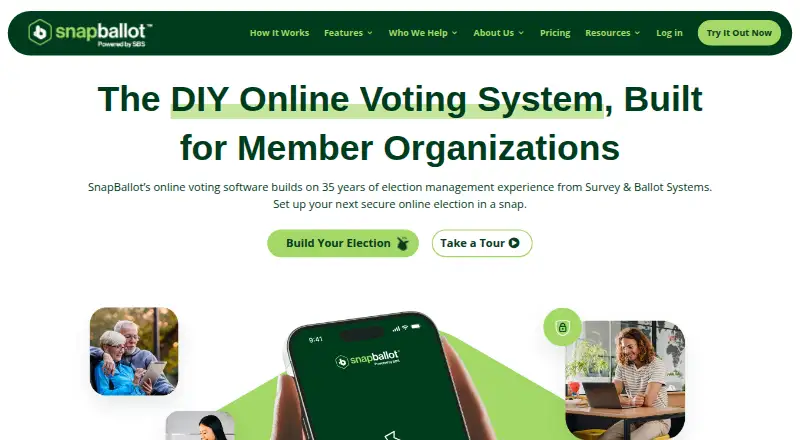
What SnapBallot is
SnapBallot is a self-service online voting platform for member organizations. Administrators can create ballots, invite voters, monitor participation and view results for board elections, bylaw amendments, contract ratifications, referendums, special votes and run-offs. Ballots can apply vote weighting based on ownership, membership class, proxy assignments or other organizational rules, and administrators can set minimum and maximum voting requirements for ballot items. Voting is anonymous in a defined sense: administrators can see who voted, but not individual selections. Reports include daily participation, voter logs and email recaps. Each election includes one invitation email and two reminders; extra reminders cost more. The maker describes encryption, single-use magic-link authentication and audit trails, and says the platform runs on Microsoft Azure. Paper ballots and voters without email need separate handling, with results combined afterward.
Good
- Supports several election and ballot types.
- Administrators can set vote weighting rules.
- Voter selections are hidden from administrators.
- Includes voter logs and audit trails.
- Free plan covers up to 15 voters.
Watch out
- Paper voters must be handled separately.
- Extra reminder emails incur an additional charge.
- The free plan is limited to 15 voters.
Who it suits
SnapBallot suits HOAs, unions, associations, co-ops, clubs, sports organizations, churches and other member-driven groups running elections. It can also fit organizations that need weighted voting or participation reporting.
Verdict
SnapBallot covers common member-organization votes and provides participation reporting alongside configurable ballot rules. Groups using paper ballots or voters without email will need a separate process.
Plans and prices
From SnapBallot's own pricing page, checked 15 Oct 2026.
| Plan | Price | What it gives you |
|---|---|---|
| Free | Free | up to 15 eligible voters · 3 included voter emails · per election |
| 16–250 voters | $49, paid once | 16–250 eligible voters · 3 included voter emails · extra reminders $19 each · per election |
| 251–750 voters | $99, paid once | 251–750 eligible voters · 3 included voter emails · extra reminders $35 each · per election |
| 751–1,500 voters | $149, paid once | 751–1,500 eligible voters · 3 included voter emails · extra reminders $49 each · per election |
| 1,501–3,000 voters | $269, paid once | 1,501–3,000 eligible voters · 3 included voter emails · extra reminders $79 each · per election |
| 3,001–7,500 voters | $449, paid once | 3,001–7,500 eligible voters · 3 included voter emails · extra reminders $99 each · per election |
| Custom | Priced on request | more than 7,500 voters · paper ballots · fully managed services |
The facts
Each one read from SnapBallot's own pages, with the date it was checked.
What it does
- Accessibility
- Survey & Ballot Systems says it maintains an accessibility conformance report covering WCAG 2.2 and provides it on request.checked 15 Oct 2026
- Anonymous voting
- Administrators can see who voted but cannot see how that person voted.checked 15 Oct 2026
- Ballot builder
- A guided builder lets administrators create ballots, add candidates, bylaws and custom voting options.checked 15 Oct 2026
- Ballot controls
- Administrators can set minimum and maximum voting requirements for each office or ballot item.checked 30 Sep 2026
- Board elections
- Administrators can run board-of-directors elections and assign vote weight using units owned, equity or share counts.checked 15 Oct 2026
- Bylaw amendments
- Ballots can present amended sections, track turnout, provide anonymous voting and produce downloadable reports for bylaw votes.checked 15 Oct 2026
- Candidate profiles
- Ballots can include candidate photographs, biographies and supporting information.checked 15 Oct 2026
- Compliance
- The service says it is powered by Survey & Ballot Systems, which is SOC 2 Type 2 compliant, and runs on Microsoft Azure.checked 15 Oct 2026
- Contract ratifications
- Organizations can place contracts or summaries in ballots, send automated reminders and restrict access to eligible bargaining groups.checked 15 Oct 2026
- Documentation
- The help center provides setup articles, tutorials, FAQs and topic areas for voter data, ballot rules, results, billing and troubleshooting.checked 15 Oct 2026
- Duplicate-vote control
- Each voter receives a single-use magic link that cannot be reused after voting.checked 15 Oct 2026
- Election types
- It supports board elections, bylaw amendments, contract ratifications, special votes, referendums, and run-offs.checked 30 Sep 2026
- Email requirement
- The getting-started guidance says voters without an email address should be excluded from uploaded voter lists.checked 15 Oct 2026
- Independent feature coverage
- Capterra lists 26 capabilities, including online voting, voter authentication, encryption, proxy voting, real-time results, weighted voting and write-ins.checked 15 Oct 2026
- Independent support listing
- GetApp lists FAQs/forum and a knowledge base as support options, with documentation and videos as training resources.checked 15 Oct 2026
- Intended users
- SnapBallot is aimed at HOAs, unions, associations, food co-ops, clubs, sports organizations, churches, and other member-driven groups.checked 30 Sep 2026
- Launch date
- Survey & Ballot Systems says it launched SnapBallot in May 2026.checked 15 Oct 2026
- Limit: additional administrators
- The Capterra reviewer said there was no administrative option to add another user and that ownership had to be handed over by changing the account email.checked 15 Oct 2026
The company
- Company background
- SnapBallot was launched in May 2026 by Survey & Ballot Systems, which was founded in 1990.checked 30 Sep 2026
- Company founding
- LinkedIn lists Survey & Ballot Systems as founded in 1990.checked 15 Oct 2026
- Company headquarters
- LinkedIn lists Survey & Ballot Systems headquarters in Eden Prairie, Minnesota.checked 15 Oct 2026
- Company size
- LinkedIn lists Survey & Ballot Systems as having 11–50 employees.checked 15 Oct 2026
- Founded
- 2026checked 28 Sep 2026
- Headquarters
- Eden Prairie, Minnesota, United Stateschecked 28 Sep 2026
The full review of SnapBallot
SnapBallot is an online election platform for organizations that need to run member votes with configurable ballot rules. It is best suited to groups whose voters can participate by email and whose elections fit a per-event budget. Its reporting and voting controls are useful for formal organizational decisions, but paper voting needs a separate process.
Overview
SnapBallot handles board elections, bylaw amendments, contract ratifications, referendums, special votes, and run-offs. Administrators can weight votes by ownership, membership class, proxy assignments, or other organizational rules, and set minimum and maximum voting requirements for each office or ballot item. Those controls make it more appropriate for organizations with formal eligibility or voting rules than for groups seeking only a simple poll.
Administrators can track who has voted without seeing individual selections. Voter logs and audit trails support oversight; the maker describes end-to-end encryption and single-use magic-link authentication, and says the platform runs on Microsoft Azure. Survey & Ballot Systems, SnapBallot’s provider, says it is SOC 2 Type 2 compliant.
Key features
Participation and reporting
Real-time reporting includes daily participation reports, voter logs, and email recaps. Each election includes one invitation email and two reminders, with additional reminders available for an extra charge. That covers a basic outreach cycle, but organizations that rely on repeated reminders should budget for the extras.
Paper voting and support
Voters who need paper ballots or lack email must be handled separately, with paper results combined with SnapBallot totals afterward. This makes the platform a weaker fit for groups that need one process for both online and paper voters. The team responds to inquiries within one business day and offers technical support inquiries and demo scheduling.
Pricing
SnapBallot charges per election. The Free plan costs nothing, billed Per election, and covers up to 15 voters, 3 voter emails, and no setup fees. It is a way to run a small vote without a fee, but its voter cap rules out many organization-wide elections.
The paid tiers each include 3 voter emails and no setup fees: 16–250 voters costs $49, paid once; 251–750 voters costs $99, paid once; 751–1,500 voters costs $149, paid once; 1,501–3,000 voters costs $269, paid once; and 3,001–7,500 voters costs $449, paid once. These one-time election charges scale with voter count, so groups can match the fee to each election rather than a recurring seat plan. The three-email allowance remains the same across these tiers, and additional reminders cost extra.
The Custom plan has custom pricing for more than 7,500 voters; paper ballots or fully managed services are available through that plan. Groups needing those options should compare the custom arrangement with the separate handling required by the standard online process.
Platforms
SnapBallot is available on Android, iOS, and the web. The maker says it works on phones, tablets, and desktops, allowing voters to participate across common device types.
Who it's for
SnapBallot is aimed at HOAs, unions, associations, food co-ops, clubs, sports organizations, churches, and other member-driven groups. It is a stronger fit when organizers need formal ballot controls and participation tracking, and can keep paper voting outside the online election. It is less suitable when a group needs paper and online voters in a single integrated process or exceeds 7,500 voters without moving to custom pricing.
Pros and cons
- Pros: Voting weights and minimum or maximum requirements accommodate organizational rules beyond a basic ballot.
- Pros: Administrators can monitor participation while individual selections remain hidden from them.
- Pros: Per-election tiers have no setup fees, with prices tied to voter-count bands.
- Cons: The free tier stops at 15 voters, limiting it to small elections.
- Cons: Every standard election includes only three voter emails, and extra reminders cost more.
- Cons: Paper ballots and voters without email require separate handling and later tally combination.
Alternatives
Online Voting Software is the broader category directory for comparing voting tools.
Consider AssociationVoting if its free election tier for 1–25 eligible voters is a closer fit; its next provided tier covers 26–125 voters for $99 per election.
ElectionBuddy is another freemium option with separate meeting-vote and election-vote plans.
Election Runner may suit a smaller election: it is free for up to 20 voters and charges $19 per election for up to 100 voters.
POLYAS offers a free Standard online-voting tier for up to 50 voters, though features and service are not included in that tier.
Simply Voting is another freemium option, with a free tier for elections of 10 electors or less.
VoteAlly may fit groups seeking a free ongoing option: its free plan allows 50 eligible voters per session, two active sessions, one admin seat, up to five motions, and eight elections.
CharterVote is a web-based alternative with a free Starter plan for up to 25 eligible voters per election.
Assembley is a web-only alternative with a free Starter plan for up to 25 voters and unlimited assemblies.
Verdict
SnapBallot is a sound choice for member organizations running formal elections that benefit from configurable voting rules, anonymous selections, and participation reporting. Its per-election pricing is straightforward across the published voter bands, but the small free cap, limited included emails, and separate paper-ballot process are meaningful constraints. Choose it when those tradeoffs fit the way your organization votes; look elsewhere if paper and online ballots must share one process.
Getting started
- Open the SnapBallot website
- Select a free or paid per-election plan
- Create the ballot for your election type
- Invite voters by email
- Send the included invitation and reminder emails
- Monitor participation and view reports
- Export results as CSV
Limits worth knowing
The free plan covers up to 15 voters and includes three voter emails. Paid plans start at $49 once for 16–250 voters; extra reminder emails cost more, and paper or no-email voters are handled separately.
Questions
Is there a free plan?
Yes. The Free plan costs nothing, billed per election, for up to 15 voters.
What does the first paid plan cost?
The 16–250 voters plan costs $49, paid once, billed per election.
Which platforms are supported?
SnapBallot supports Android, iOS and the web, and is described as working on phones, tablets and desktops.
Are ballots anonymous?
Administrators can see who voted but cannot see individual voters’ selections.
Can votes be weighted?
Yes. Administrators can weight votes according to ownership, membership class, proxy assignments or other organizational rules.
What happens with paper ballots?
Paper ballots and voters without email are handled separately, with their results combined with SnapBallot totals afterward.
Alternatives to SnapBallot
- 1

ElectionBuddy
Free planAndroidiOSWebAPI7.9Free plan - 2

POLYAS
Free planAndroidiOSWeb7.9Free plan - 3
AssociationVoting
Free planAndroidiOSWeb7.3$99 one-time - 4

CharterVote
Free planWeb7.3From $489 a year - 5
Election Runner
Free planAndroidiOSWeb7.3$19 one-time - 6
ElectIQ
Free planAndroidiOSWeb7.2€1 one-time