Shaarli
Shaarli is free software for personal, single-user bookmarking and link sharing that you install on your own server.
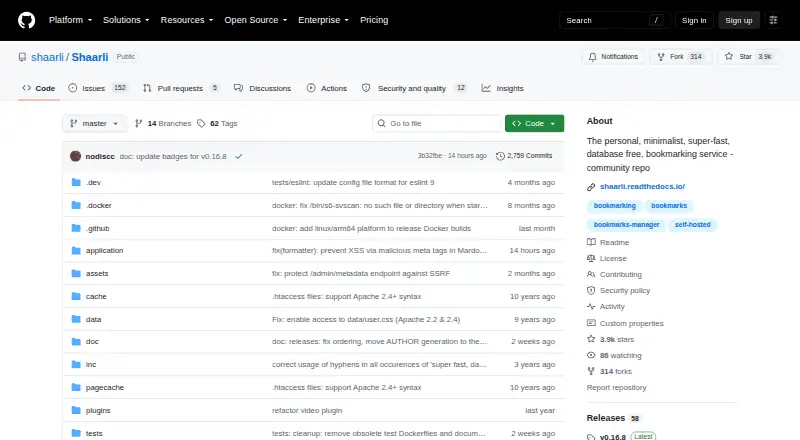
What Shaarli is
Shaarli is free software for personal, single-user bookmarking and link sharing that you install on your own server. Saved items can contain a URL, title, description, tags, and public or private status, with search across those fields, tag views, hidden tags, sticky bookmarks, and tag autocomplete. A blank URL creates a text-only post for notes, snippets, or blog articles. Shaarli supports read-it-later lists, microblogging, knowledge bases, shared clipboards, and online-media playlists. Filterable RSS and Atom feeds, daily digests, HTML import and export, and removal of some tracking parameters help manage saved links. Data is stored in a file rather than a database. The project describes protections including salted and hashed passwords, cross-site request forgery defenses, expiring sessions, and configurable IP bans. LDAP login is supported, while API requests use JWT bearer tokens. A REST API, browser extensions, mobile apps, plugins, and Docker or Docker Compose deployment are documented. Shaarli is designed for one user and is available on Android, iOS, Linux, web, API, extension, and self-hosted platforms.
Good
- Free software with no paid plan
- Self-hosted file storage
- RSS and Atom feeds
- REST API and browser extensions
- Docker and Docker Compose deployment
Watch out
- Designed for a single user
- Requires your own server
- No free trial is listed
- Community support rather than stated commercial support
Who it suits
Shaarli suits individuals who want a self-hosted, single-user bookmark manager. It is useful for people needing personal notes, feeds, APIs, browser capture, and control over hosting.
Verdict
Shaarli provides broad personal bookmarking, note, feed, and integration features while keeping data on your server. Its single-user design and self-hosting requirement define the main scope.
The facts
Each one read from Shaarli's own pages, with the date it was checked.
What it does
- API
- The REST API uses JWT bearer tokens, and the documentation lists Python and Node.js clients plus an Android client example.checked 11 Oct 2026
- Audience and scope
- The project describes Shaarli as personal and single-user, and its documentation covers shared hosting as well as dedicated and virtual servers.checked 11 Oct 2026
- Authentication
- LDAP login is supported for the single-user installation, and API requests require a JWT bearer token.checked 4 Oct 2026
- Bookmarks
- Each saved item can include a URL, title, free-text description, tags, and public or private status.checked 11 Oct 2026
- Capture
- Users can save links through the Shaare button, a browser bookmarklet, apps and browser add-ons, or the REST API.checked 11 Oct 2026
- Deployment
- The project provides installation instructions for release ZIP files and Docker.checked 11 Oct 2026
- Extensions
- The project documents third-party plugins for features including Mastodon and Bluesky posting, webhooks, analytics and custom themes.checked 4 Oct 2026
- Feeds and cleanup
- Shaarli provides filterable ATOM and RSS feeds, a daily digest and automatic removal of some tracking parameters from URLs.checked 4 Oct 2026
- Feeds and export
- Shaarli provides RSS and Atom feeds and lets users export and import bookmarks as HTML.checked 11 Oct 2026
- Hosting
- Shaarli can run on dedicated or virtual servers and shared hosting, with Debian GNU/Linux used for documentation examples.checked 11 Oct 2026
- Installation
- Shaarli can be installed from a release ZIP or source on a web server, or run with Docker and Docker Compose.checked 4 Oct 2026
- License
- The repository describes Shaarli as free software.checked 11 Oct 2026
- Limit
- Shaarli is designed as a personal, single-user service; the docs describe it as an alternative to commercial bookmarking services.checked 4 Oct 2026
- Notes
- Leaving the URL blank creates a text-only post that can be used for notes, snippets, or blog articles, with no character limit stated in the documentation.checked 11 Oct 2026
- Organization
- Users can edit link URLs, titles, descriptions, tags and public or private status, then search across fields and browse tag views.checked 4 Oct 2026
- Organization and search
- Shaarli supports tag autocomplete, tag and text searches, hidden tags, and sticky bookmarks.checked 11 Oct 2026
- Other integrations
- Documented related integrations include Tiny Tiny RSS, Cloudron, YunoHost, Debian packages and browser extensions for Firefox and Chrome.checked 4 Oct 2026
- Plugins
- Built-in plugins include integrations for Archive.org, Isso comments, Piwik tracking, QR codes, and Wallabag; third-party plugins can be installed separately.checked 11 Oct 2026
- Privacy
- The project says Shaarli does not send telemetry, metrics or private information to its developers.checked 4 Oct 2026
- Product
- Shaarli is a personal, single-user link-sharing and bookmarking service that users install on their own server.checked 11 Oct 2026
- Purpose
- Shaarli is a personal, single-user bookmark manager and link-sharing service that you install on your own server.checked 4 Oct 2026
- Security
- The security policy says the latest release receives security support and asks users to report possible vulnerabilities through the repository security tab.checked 11 Oct 2026
- Storage
- Links are stored in a file, so a database is not required and backups are straightforward.checked 4 Oct 2026
Where it runs
- Mobile apps
- The community page lists an iOS share extension and Android apps for sending links to Shaarli.checked 4 Oct 2026
Alternatives to Shaarli
- 1

Raindrop.io
Free planOpen sourceAndroidiOSWebAPI8.6From $27.99 a year - 2

Delinqs
Free planAndroidiOSWebAPI7.8From $9.99 a month - 3
Diigo
Free planAndroidiOSWebExtension7.4From $5 a month - 4

Karakeep
Free planAndroidiOSWebAPI7.4From $4 a month - 5
Avidemux
Free planOpen sourceWebLinuxmacOSWindows7.3Free plan - 6
LinkAce
Free planAndroidiOSWebAPI7.3From €4 a month