SD.Next
SD.Next is a free, open-source server application and web interface for generating, editing, captioning, upscaling, and processing AI images and videos.
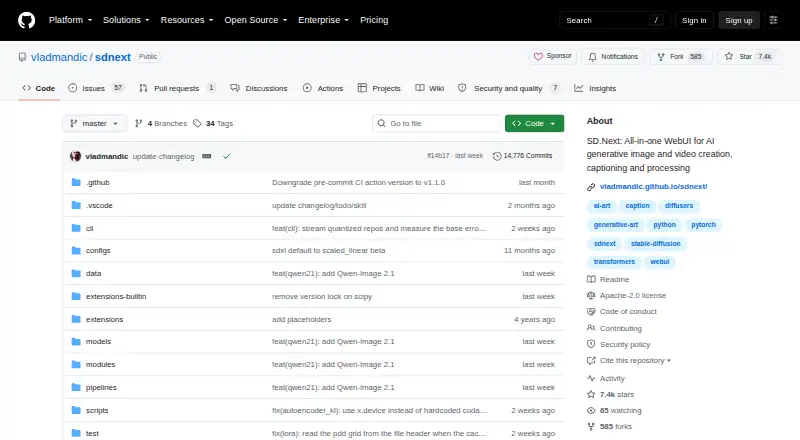
What SD.Next is
SD.Next is a free, open-source server application and web interface for generating, editing, captioning, upscaling, and processing AI images and videos. It supports text-to-image, image-to-image, text-to-video, image-to-video, inpainting, outpainting, and other workflows, with PNG and JPG output. The project supports dozens of diffusion models and can automatically download selected reference models. Guidance includes LoRA, ControlNet, IPAdapters, and Prompt Enhance. Processing tools cover captioning, tagging, upscaling, interpolation, colorization, filtering, and color correction. SDNQ quantization is described as reducing VRAM use by up to 4x, while Balanced Offload balances CPU and GPU memory. Listed hardware backends include CUDA, ROCm, ZLUDA, Intel IPEX XPU, OpenVINO, DirectML, Apple M1/M2 MPS, ONNX/Olive, and CPU-only execution. It runs on Linux, macOS, Windows, web, and self-hosted setups, with API access and Apache-2.0 licensing.
Good
- Supports image and video generation workflows
- Dozens of diffusion models supported
- VRAM reduction through SDNQ quantization
- Broad hardware backend support
- No cost under Apache-2.0 license
Watch out
- Extensions can be downloaded when enabled
- Installation uses platform-specific scripts
- Some model downloads make external connections
Who it suits
SD.Next suits artists, researchers, and AI enthusiasts who want open-source image and video workflows. It is also relevant to users needing varied hardware backends or local processing.
Verdict
SD.Next offers a broad, self-hosted toolkit for AI image and video work. Its model, hardware, and processing options make it suitable for technically oriented users.
Plans and prices
From SD.Next's own pricing page, checked 12 Oct 2026.
| Plan | Price | What it gives you |
|---|---|---|
| SD.Next | Free | Open-source server application and web interface |
The facts
Each one read from SD.Next's own pages, with the date it was checked.
What it does
- API access
- Yeschecked 20 Sep 2026
- Captioning and tagging
- The project lists 25+ built-in LLM and VLM models, OpenCLiP models, and WaifuDiffusion and DeepDanbooru taggers.checked 12 Oct 2026
- Extensions
- The project supports custom scripts and extensions.checked 12 Oct 2026
- External connections
- The security policy says connections may be made for indexes, installation and upgrade packages, enabled extensions, user-requested model downloads from CivitAI or Hugging Face, and user-submitted benchmark information.checked 12 Oct 2026
- Guidance tools
- The project lists LoRA, ControlNet, IPAdapters, and Prompt Enhance among its guidance features.checked 12 Oct 2026
- Hardware support
- The project lists CUDA, ROCm, ZLUDA, Intel IPEX XPU, OpenVINO, DirectML, Apple M1/M2 MPS, ONNX/Olive, and CPU-only execution support.checked 12 Oct 2026
- Image editing
- Yeschecked 20 Sep 2026
- Image processing
- Its processing tools include captioning, tagging, upscaling, interpolation, colorization, filtering, and image color correction.checked 12 Oct 2026
- Installation
- The project provides installation instructions and quick-start scripts for Linux and Mac, Windows batch files, and PowerShell.checked 12 Oct 2026
- Intended users
- The README describes the application as suitable for artists, researchers, and AI enthusiasts.checked 12 Oct 2026
- Interface
- The project describes desktop and mobile interfaces and localization in about 15 languages.checked 12 Oct 2026
- License
- The GitHub repository identifies Apache-2.0 as the project license.checked 12 Oct 2026
- Memory features
- SDNQ quantization is described as reducing VRAM use by up to 4x, and Balanced Offload balances CPU and GPU memory for larger models on limited hardware.checked 12 Oct 2026
- Memory optimization
- Its SDNQ quantization engine can reduce VRAM use by up to 4x, and Balanced Offload balances CPU and GPU memory.checked 12 Oct 2026
- Models
- The project says it supports dozens of advanced models and can automatically download selected reference models.checked 12 Oct 2026
- Model support
- SD.Next supports a broad range of diffusion models and can automatically download selected reference models.checked 12 Oct 2026
- Output formats
- PNG,JPGchecked 20 Sep 2026
- Privacy
- The security policy says the app does not send or share data externally, track user or system data, store user inputs or detection results, or use analytics services.checked 12 Oct 2026
- Purpose
- SD.Next is an open-source server application and web interface for generating, editing, captioning, upscaling, and processing AI images and videos.checked 12 Oct 2026
- Reference images
- Yeschecked 20 Sep 2026
- Security practices
- The security policy says code and included dependencies are automatically scanned for known vulnerabilities and commits are validated before merging.checked 12 Oct 2026
- Support
- The README directs users to documentation, Discord, GitHub issues, and discussions for help.checked 12 Oct 2026
- Text-to-image
- Yeschecked 20 Sep 2026
Where it runs
- Platforms
- The README lists Windows, Linux, and macOS support, with GPU acceleration options and CPU-only execution.checked 12 Oct 2026
Alternatives to SD.Next
- 1

FLUX
Free planOpen sourceWebAPILinuxmacOS9.1$0.01 one-time - 2

Recraft
Free planAndroidiOSWebAPI9.0Free plan - 3

Tensor.Art
Free planAndroidiOSWebAPI8.8Free plan - 4
Sogni
Free planAndroidiOSWebAPI8.8From $20 a month - 5

Adobe Firefly
Free planAndroidiOSWebAPI8.6Free plan - 6

Dream by WOMBO
Free planAndroidiOSWebAPI8.6Free plan