
SCREDIT
SCREDIT is a platform for B2B finance and credit teams managing customer onboarding, credit decisions, financial risk, collections, and portfolio exposure.
What SCREDIT is
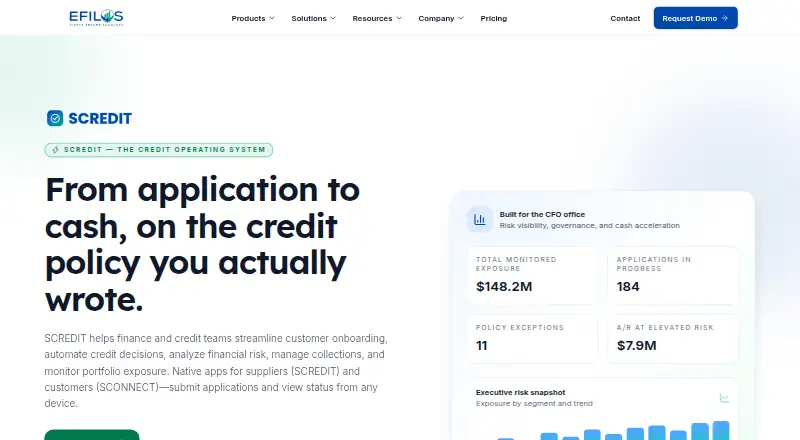
SCREDIT is a platform for B2B finance and credit teams managing customer onboarding, credit decisions, financial risk, collections, and portfolio exposure. Its workflow links digital applications and underwriting with bureau intelligence, approvals, portfolio analytics, accounts-receivable visibility, and collections. Applications can gather documents, e-signatures, and trade references into approval-ready profiles. Construction credit tools track job-level exposure, retainage, lien deadlines, bond status, and project-specific risk. Connectors cover ERP, accounting, CRM, bureau, and other services. SCREDIT leaves the ERP as the record for invoices, terms, due dates, and cash application, while returning credit decisions and approved limits. Every plan includes SCONNECT, where customers can submit applications, upload documents, view invoices and statements, pay, and access executed agreements. It runs on Android, iOS, and web.
Good
- Digital applications collect documents and e-signatures.
- Construction workflows track project-specific exposure and deadlines.
- SCONNECT is included in every plan.
- Connectors cover ERP, CRM, bureaus, and payment services.
Watch out
- No free plan is listed.
- Third-party SOC 2 audit is not yet complete.
- Starter is limited to 25–60 applications monthly.
Who it suits
SCREDIT suits B2B teams handling 50 or more credit applications monthly, including manufacturing, distribution, construction supply, and FMCG/CPG. It may fit organizations seeking credit workflows alongside an ERP that remains their financial system of record.
Verdict
SCREDIT brings onboarding, credit decisions, risk monitoring, and collections into a connected workflow while keeping invoicing and cash application in the ERP. Buyers should account for its annual paid plans and note that the third-party SOC 2 audit remains incomplete.
Plans and prices
From SCREDIT's own pricing page, checked 30 Sep 2026.
| Plan | Price | What it gives you |
|---|---|---|
| Starter | $750 a year | 25–60 applications/month · digital applications · weighted scorecards · core AR views · watchlists · SCONNECT portal · email support · annually |
| Growth | $2,000 a year | Everything in Starter · approval routing · bureau integrations · collections queues · promise-to-pay · disputes workflow · annually |
| Scale | $4,500 a year | Everything in Growth · multi-entity · multi-currency · construction credit · concentration-risk monitoring · priority support · annually |
| Custom | Priced on request | Everything in Scale · board and CFO views · custom integrations · data migration · dedicated environments · security review support |
The facts
Each one read from SCREDIT's own pages, with the date it was checked.
Where it runs
- Applications
- Digital credit applications support document collection, e-signature, trade references, and approval-ready customer profiles.checked 30 Sep 2026
What it does
- Compliance status
- Security controls are designed around SOC 2 principles, but EFILOS states that its third-party SOC 2 audit is not yet complete.checked 30 Sep 2026
- Construction credit
- Construction workflows track job-level exposure, retainage, lien deadlines, bond status, and project-specific risk.checked 30 Sep 2026
- Core workflow
- The platform combines onboarding, underwriting, bureau intelligence, approvals, portfolio analytics, accounts-receivable visibility, and collections execution.checked 30 Sep 2026
- Customer portal
- SCONNECT is included in every plan and lets customers submit applications, upload documents, view invoices and statements, make payments, and access executed agreements.checked 30 Sep 2026
- ERP role
- SCREDIT keeps the ERP as the system of record for invoicing, terms, due dates, and cash application, while sending credit decisions and approved limits back.checked 30 Sep 2026
- Integrations
- Purpose-built connectors cover SAP, NetSuite, Dynamics 365, QuickBooks Online, Salesforce, eight commercial bureaus, Plaid, Middesk, Persona, Avalara, Stripe, Levelset, NCS, and Handle.checked 30 Sep 2026
- Purpose
- SCREDIT helps finance and credit teams manage customer onboarding, automated credit decisions, financial-risk analysis, collections, and portfolio exposure.checked 30 Sep 2026
- Security architecture
- SCREDIT uses schema-per-tenant isolation, role-based access control, least-privilege runtime controls, encryption, monitoring, and audited administrative workflows.checked 30 Sep 2026
- Support and implementation
- Starter includes email support, Scale includes priority support, and implementation is scoped in weeks rather than quarters.checked 30 Sep 2026
- Target users
- SCREDIT is built for B2B teams handling 50 or more credit applications per month, including manufacturing, wholesale distribution, industrial distribution, construction supply, and FMCG/CPG.checked 30 Sep 2026
The company
- Data ownership
- The customer organization remains the owner of customer, financial, and workflow data submitted into SCREDIT.checked 30 Sep 2026
- Headquarters
- Dallas, Texas, United Stateschecked 23 Sep 2026
The full review of SCREDIT
Overview
SCREDIT is a B2B credit-management platform for finance teams handling customer applications, credit decisions, risk monitoring, and collections. It is best suited to organizations processing at least 50 credit applications a month, particularly in distribution, manufacturing, construction supply, and FMCG/CPG. Its connected credit workflow leaves invoicing and cash application in the ERP, a useful boundary for teams that want better credit operations without replacing that system of record.
Key features
Digital applications collect documents, e-signatures, and trade references, then assemble approval-ready customer profiles. Weighted scorecards and approval workflows support credit decisions; bureau intelligence and portfolio analytics extend the view from an individual application to broader exposure. These capabilities make SCREDIT more compelling for teams managing a steady application pipeline than for businesses with only occasional credit reviews.
Construction suppliers get specific controls for job-level exposure, retainage, lien deadlines, bond status, and project risk. That focus is meaningful in a sector where a customer-level view alone can miss project-specific exposure; teams outside construction should not expect that specialization to be a deciding advantage.
Collections queues, promise-to-pay tracking, and dispute workflows connect post-approval work to the credit process. SCONNECT, included with every plan, gives customers a portal to submit applications and documents, view invoices and statements, make payments, and access executed agreements. SCREDIT sends credit decisions and approved limits to the ERP, while the ERP remains responsible for invoices, terms, due dates, and cash application. That division suits organizations that want credit automation alongside established ERP accounting workflows, not a replacement for them.
Connectors cover SAP, NetSuite, Dynamics 365, QuickBooks Online, Salesforce, eight commercial bureaus, Plaid, Middesk, Persona, Avalara, Stripe, Levelset, NCS, and Handle. Credit-limit controls, exposure monitoring, risk scoring, and review workflows round out the operating toolkit. Security measures include tenant-separated schemas, role-based access, encryption, monitoring, and audited administrative workflows. EFILOS says the controls are designed around SOC 2 principles, but its third-party SOC 2 audit is not yet complete—a material consideration for buyers with audit requirements. The customer organization retains ownership of data submitted to SCREDIT.
Pricing
SCREDIT has no free plan, and its plans are billed annually. The stated entry point is From $750/mo (annual), while the plan prices are also presented as annual amounts: confirm the commercial quote and billing basis before committing, especially given the difference in how those figures are expressed.
| Plan | Price and included features | Best fit |
|---|---|---|
| Starter | $750 a year, billed annually. Includes 25–60 applications/month, digital applications, weighted scorecards, core AR views, watchlists, SCONNECT, and email support. | Teams whose application volume fits the stated range and that need core application and monitoring workflows. It gives up approval routing, bureau integrations, and collections workflows found in Growth. |
| Growth | $2,000 a year, billed annually. Includes everything in Starter plus approval routing, bureau integrations, collections queues, promise-to-pay, and dispute workflows. | Teams that need to move beyond basic scoring into routed decisions and structured collections. |
| Scale | $4,500 a year, billed annually. Includes everything in Growth plus multi-entity, multi-currency, construction credit, concentration-risk monitoring, and priority support. | Organizations with multiple entities or currencies, construction exposure, or a need to monitor concentration risk. |
| Custom | Custom pricing. Includes everything in Scale plus board and CFO views, custom integrations, data migration, dedicated environments, and security review support. | Buyers needing executive reporting, migration, bespoke connections, or a dedicated environment. |
Starter specifies a 25–60 applications/month range; buyers near or beyond that range should compare their volume with Growth or discuss fit before purchase. Support also scales by tier: Starter includes email support, while Scale includes priority support. Implementation is scoped in weeks rather than quarters.
Platforms
SCREDIT is available on Android, iOS, and web, giving teams mobile as well as browser access.
Who it's for
SCREDIT is aimed at B2B credit teams processing 50 or more applications monthly, especially in manufacturing, wholesale and industrial distribution, construction supply, and FMCG/CPG. It is a strong fit when application intake, underwriting, portfolio visibility, and collections need to work together while the ERP keeps control of invoicing and cash application. Smaller teams with sporadic applications, or buyers that require a completed third-party SOC 2 audit, have reason to look elsewhere.
Pros and cons
Pros
- Connected credit workflow: Applications, decisions, risk monitoring, and collections sit together, while approved limits and decisions flow back to the ERP.
- Useful vertical depth: Construction-specific tracking covers retainage, lien deadlines, bond status, and project-level risk.
- Customer portal across plans: SCONNECT supports applications, documents, invoices, statements, payments, and executed agreements without requiring a higher tier.
- Clear progression: Growth adds routed approvals and collections execution; Scale adds multi-entity, multi-currency, construction, and concentration-risk capabilities.
Cons
- No free plan: Buyers must take on an annual paid plan rather than evaluate through a free tier.
- Entry pricing needs clarification: The stated From $750/mo (annual) differs in presentation from Starter's $750 a year, billed annually.
- Audit remains incomplete: Security controls are designed around SOC 2 principles, but the third-party SOC 2 audit is not complete.
- Some capabilities are tier-gated: Bureau integrations and collections workflows begin in Growth, while construction credit and concentration monitoring require Scale.
Alternatives
Credit Management Software is the broader category directory for comparing credit-management options.
- Credit Pulse may suit buyers who value an API and web platform, a free trial, and optional credit reports priced at $85 each; its Scale plan has a 1000-account minimum.
- Credisense Trade Credit is a web-based paid option with custom pricing from a New Zealand-based software maker.
- Bilendo Risk may suit buyers seeking a web-based risk product with a free trial and annual Business pricing, though its Business plan has a one-year minimum term.
- CreditRiskMonitor is worth considering for buyers who want a freemium option or API access; its Essentials plan starts at $8,450 a year and includes North American service, FRISK and PAYCE scores, and public and private company coverage.
- Nuvo is another paid, web-based option.
- Serrala FS² Credit & Risk may be a fit for buyers seeking API, web, or Windows access and willing to contact Serrala for pricing.
- Moody’s Trade Credit is another paid, web-based option.
- NetNow is a paid web-based option without a free plan.
Verdict
Choose SCREDIT if your B2B team handles a substantial monthly application flow and needs onboarding, decisions, exposure monitoring, and collections tied to—but not replacing—the ERP. Its strongest case is the breadth of that workflow, with extra value for construction credit and teams needing multi-entity or multi-currency support. Look elsewhere if a free plan or completed third-party SOC 2 audit is essential, or if your application volume is too low to justify an annual paid platform.
Alternatives to SCREDIT
- 1

HighRadius
AndroidiOSWebAPI7.1 - 2
 6.1From $150 a month
- 3

NetNow
Web6.1 - 46.1From C$49 a month
- 5
CreditRiskMonitor
WebAPI5.9From $8,450 a year - 6

Bilendo Risk
Web5.8