
SayaLab
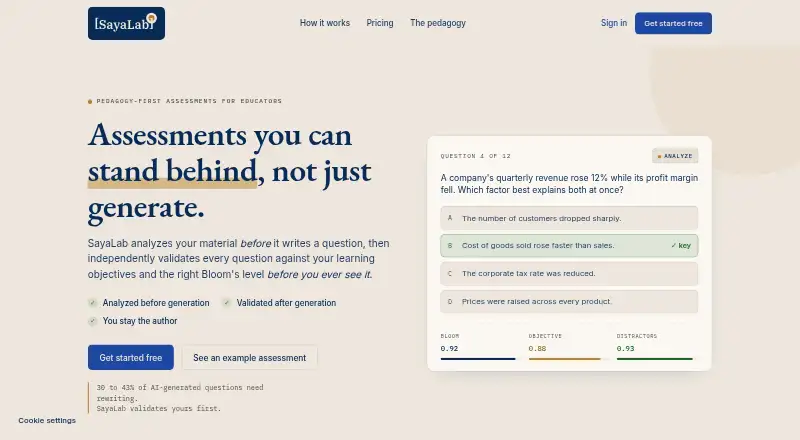
SayaLab is a web tool that analyzes educational material and creates assessment questions aligned with learning objectives and Bloom’s taxonomy.
What SayaLab is
SayaLab is a web tool that analyzes educational material and creates assessment questions aligned with learning objectives and Bloom’s taxonomy. Before generating questions, it extracts objectives, identifies the Bloom’s levels supported by the material, and flags material that is insufficient for assessment. It checks cognitive level, objective and source alignment, distractor plausibility, and clarity; weak questions regenerate automatically. Inputs include PDF, DOCX, PPTX, text, and lecture images. The Free plan allows 30 questions per 30-day cycle, includes every question type including essay, and exports PDF, CSV, and JSON. Pro allows 300 questions per cycle, adds QTI and Google Forms export, and permits regeneration of any question. The site lists Google Forms, Canvas through QTI, and Moodle through QTI as integrations. Free requires no card, while Pro can be cancelled anytime. Pro is listed at $20 a month or $200 a year.
Good
- Analyzes learning objectives
- Checks question quality automatically
- Supports documents, text, and images
- Free plan requires no card
- QTI and Google Forms export on Pro
Watch out
- Free plan limited to 30 questions per cycle
- Pro costs $20 a month
- Advanced exports require Pro
Who it suits
SayaLab suits university lecturers, instructional designers, and corporate learning and development teams creating assessments from existing materials. It is useful when objective alignment and Bloom’s taxonomy matter.
Verdict
SayaLab focuses on turning source material into validated assessment questions with explicit pedagogical checks. Its free allowance supports limited use, while Pro expands question volume and export options.
Plans and prices
From SayaLab's own pricing page, checked 7 Oct 2026.
| Plan | Price | What it gives you |
|---|---|---|
| Free | Free | 30 questions / 30-day cycle · every question type, including essay · PDF, CSV, and JSON export · full content analysis and validation · forever |
| Pro | $20 a month | 300 questions / cycle · QTI and Google Form export · regenerate any question · $20 / mo; or $200 / year |
The facts
Each one read from SayaLab's own pages, with the date it was checked.
What it does
- API
- The site invites people building on its API to contact the company.checked 7 Oct 2026
- Canvas and Moodle
- The site lists Canvas (QTI) and Moodle (QTI) integrations.checked 7 Oct 2026
- Exports
- The Free plan includes PDF, CSV, and JSON export; Pro adds QTI and Google Forms export.checked 7 Oct 2026
- Google Forms
- The site lists Google Forms as an integration and says Pro includes Google Form export.checked 7 Oct 2026
- Intended users
- The site names university lecturers, instructional designers, and corporate learning and development teams as intended users.checked 7 Oct 2026
- Material analysis
- Before generating questions, it extracts learning objectives, identifies the Bloom’s levels the content supports, and flags when material is insufficient to assess.checked 7 Oct 2026
- Payment and cancellation
- The site says the free tier requires no card and Pro can be cancelled anytime.checked 7 Oct 2026
- Purpose
- SayaLab analyzes educational material and creates assessment questions aligned to learning objectives and Bloom’s taxonomy.checked 7 Oct 2026
- Question validation
- It checks each question’s cognitive level, objective alignment, distractor plausibility, source alignment, and clarity, and weak questions regenerate automatically.checked 7 Oct 2026
- Uploads
- Supported input formats listed are PDF, DOCX, PPTX, text, and lecture images.checked 7 Oct 2026
Where it runs
- Pedagogical approach
- The site says its validation uses Bloom’s taxonomy, Biggs’ Constructive Alignment, and item-writing research to assess cognitive level, alignment, and distractor quality.checked 7 Oct 2026
Money
- Plan limits
- Free includes 30 questions per 30-day cycle, while Pro includes 300 questions per cycle.checked 7 Oct 2026