sabledocs
Sabledocs is a free, open-source command-line generator that produces static HTML documentation for Protobuf and gRPC contracts.
What sabledocs is
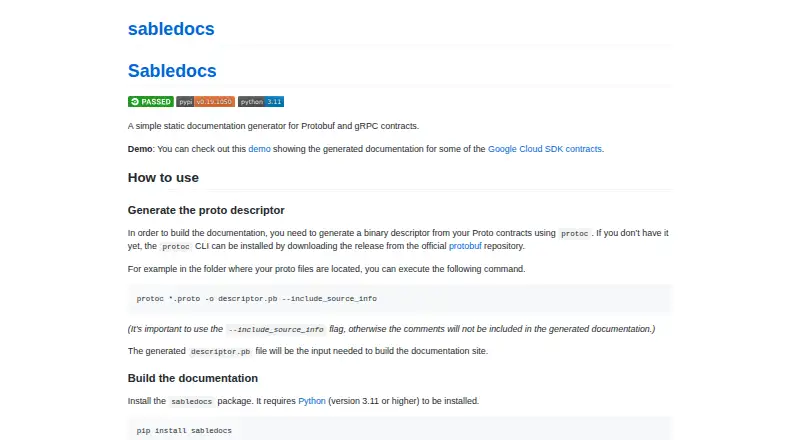
Sabledocs is a free, open-source command-line generator that produces static HTML documentation for Protobuf and gRPC contracts. It can combine several packages in one site, and its input is a binary Protobuf descriptor produced with protoc. To include comments, the descriptor must be generated with the --include_source_info flag. Search is enabled by default and can use a prebuilt Lunr index; Markdown is supported in the main content page and Protobuf comments. Configuration in sabledocs.toml covers titles, paths, package visibility, member ordering, comment filtering, and other generation options. Users can customize Jinja templates, add templates to the output, and configure source links for Protobuf model members in GitHub, Bitbucket, Bitbucket Data Center, or GitLab repositories. The generated site is placed in sabledocs_output and can be opened through index.html. Sabledocs requires Python 3.11 or higher, and a Docker image with protoc and Sabledocs preinstalled is available. Its documented workflow is aimed at reference documentation, including CI builds.
Good
- Combines multiple packages in one documentation site
- Supports both Protobuf and gRPC contracts
- Search is enabled by default
- Jinja templates can be customized
- Docker image includes protoc and Sabledocs
Watch out
- Requires Python 3.11 or higher
- Needs a binary descriptor generated with protoc
- Comments require the --include_source_info flag
Who it suits
Sabledocs suits people generating and publishing reference documentation for Protobuf and gRPC contracts. It is also relevant to teams that want to include documentation generation in CI builds.
Verdict
Sabledocs provides configurable static HTML generation for Protobuf and gRPC reference material. Its workflow depends on protoc descriptors and Python 3.11 or later.
Plans and prices
From sabledocs's own pricing page, checked 7 Oct 2026.
| Plan | Price | What it gives you |
|---|---|---|
| Sabledocs | Free | Open-source static generator · requires Python 3.11+ and a Protobuf descriptor file |
The facts
Each one read from sabledocs's own pages, with the date it was checked.
What it does
- Audience
- The documented workflow is for people generating and publishing reference documentation for Protobuf and gRPC contracts, including in CI builds.checked 7 Oct 2026
- Comment parsing
- An advanced option lets users preprocess Protobuf comments with a custom Python parser; the page cautions that this may make whitespace-sensitive formatting harder.checked 4 Oct 2026
- Contract support
- It can combine Protobuf and gRPC contracts in generated documentation.checked 4 Oct 2026
- Customization
- Users can configure titles, input and output paths, package visibility, member ordering, comment filtering, and other generation options in sabledocs.toml.checked 7 Oct 2026
- Custom templates
- Users can configure Jinja templates for primary content and add extra templates to generated output.checked 4 Oct 2026
- Distribution
- The documentation instructs users to install the package with pip install sabledocs.checked 7 Oct 2026
- Docker
- A Docker image is available for CI and other workflows, with protoc and Sabledocs preinstalled.checked 7 Oct 2026
- Generation
- Sabledocs uses a command-line interface to generate static HTML documentation.checked 4 Oct 2026
- Input
- It builds documentation from a binary Protobuf descriptor generated with protoc, and comments require the --include_source_info flag to be included.checked 7 Oct 2026
- License and project status
- The maker’s site describes the project as open source.checked 7 Oct 2026
- Markdown
- Markdown is supported in the main content page and Protobuf comments, including fenced and indented code blocks.checked 7 Oct 2026
- Multiple packages
- It can build one documentation site for multiple packages.checked 4 Oct 2026
- Output
- The generator creates a documentation site in sabledocs_output that can be opened through index.html.checked 7 Oct 2026
- Prerequisite
- The package requires Python 3.11 or higher, and the build process uses a binary descriptor generated with protoc.checked 4 Oct 2026
- Purpose
- Sabledocs is a static documentation generator for Protobuf and gRPC contracts.checked 7 Oct 2026
- Runtime requirement
- The package requires Python version 3.11 or higher.checked 7 Oct 2026
- Search
- A prebuilt Lunr search index can be enabled or disabled through configuration and defaults to enabled.checked 7 Oct 2026
- Security
- The maker’s site does not state security certifications or compliance claims.checked 7 Oct 2026
- Source links
- Configuration can create links from documented Protobuf model members to source code repositories on GitHub, Bitbucket, Bitbucket Data Center, or GitLab.checked 7 Oct 2026
- Templates
- Jinja templates can be customized, and extra templates can be added to generated output.checked 7 Oct 2026
Money
- Free and open source
- The demo page describes Sabledocs as free and open source.checked 4 Oct 2026
The full review of sabledocs
Sabledocs is a command-line generator for publishing static reference documentation from Protobuf and gRPC contracts. It is best for teams that own their contract build and want documentation produced locally or in CI, rather than for developers seeking an interactive service client. The zero-cost, open-source distribution is compelling, but its descriptor-based workflow and Python requirement make it a deliberate infrastructure choice.
Overview
Sabledocs turns a binary Protobuf descriptor into a static HTML site saved in sabledocs_output, with index.html as the entry point. That output can be deployed through whatever publishing process a team already uses, without a hosted documentation service. It can represent both Protobuf definitions and gRPC contracts, so a single reference site can cover an API surface that spans several packages.
The build is tightly coupled to protoc. A descriptor must be generated first, and Protobuf comments are included only when --include_source_info is passed. Teams that already control descriptor generation should find this predictable; projects without that pipeline must add and maintain another build step. Sabledocs is therefore a documentation tool, not a replacement for a gRPC requester, debugger, or API test console.
Key features
Multiple packages can be assembled into one documentation site, which is useful for organizations maintaining related contracts that would be awkward to publish separately. Search is enabled by default through a prebuilt Lunr index, giving readers client-side discovery without a hosted search backend.
Markdown works in the main content page and in Protobuf comments, allowing narrative guidance alongside generated members. Configuration in sabledocs.toml controls titles, input and output paths, package visibility, member ordering, comment filtering, and other generation choices. These settings make the output adaptable to house conventions instead of forcing a fixed presentation.
Jinja templates can be replaced for primary content, and additional templates can be added to the generated output. Source links can also be configured for model members, with GitHub, Bitbucket, Bitbucket Data Center, and GitLab repository types supported. An advanced hook can preprocess comments with a custom Python parser; that is useful for specialized comment formats, although the project warns that whitespace-sensitive formatting becomes harder to manage.
A Docker image bundles both protoc and Sabledocs. It provides a more reproducible build boundary for CI and reduces the need to provision those tools separately, while the regular installation path remains pip install sabledocs.
Pricing
Sabledocs — free. The free, open-source plan includes the static generator and requires Python 3.11 or later plus a Protobuf descriptor file. There are no paid tiers, seat charges, renewal terms, trial limits, or quota-based caps stated for this offering. It fits individual maintainers and teams that can self-host the generated site and manage their own build environment. Organizations wanting a vendor-managed service, support contract, or hosted publishing layer will need a different product or their own surrounding infrastructure.
Platforms
Sabledocs supports Linux, macOS, and Windows. It is self-hosted software: the generator runs in your environment, and the resulting files are opened or published from the generated directory. The Docker image is particularly relevant to Linux-based CI, while Python 3.11 or newer remains the runtime requirement for the package itself.
Who it's for
Choose Sabledocs when your team publishes Protobuf or gRPC contracts, already produces descriptors with protoc, and wants a repeatable static site from a local or CI build. Its multi-package output, configurable templates, source links, and built-in search suit internal platforms and public API references that need consistent navigation.
Look elsewhere if the primary job is sending RPC calls, inspecting live services, or maintaining interactive request history. Sabledocs also demands more pipeline ownership than a hosted documentation product: descriptor flags, Python versions, templates, and deployment are your responsibility.
Pros and cons
Pros
- Free and open source: there is no subscription, seat accounting, or renewal overhead for self-hosted use.
- Strong contract coverage: Protobuf and gRPC definitions from multiple packages can share one reference site.
- Practical customization: TOML settings, Jinja templates, extra templates, Markdown, comment filtering, ordering, and repository source links support tailored documentation.
- Build-friendly distribution: a Docker image includes both required command-line components, and the generated result is ordinary static HTML.
Cons
- Specific toolchain dependency: Python 3.11 or later and a binary descriptor are mandatory.
- Comment metadata is easy to omit: without --include_source_info, Protobuf comments do not reach the documentation.
- Self-hosting is part of the deal: publishing, runtime upkeep, and CI integration remain with the adopting team.
- Not an interactive client: it does not address workflows centered on calling or testing gRPC services.
Alternatives
Browse gRPC Tools for a broader category view. Pick gRPC CLI when you need unary RPC calls from a free, cross-platform command-line tool rather than generated documentation. grpcui is the better direction for an open-source, cross-platform web UI for interacting with services.
Kreya suits individuals wanting a freemium desktop client with request history, while protoc-gen-doc is a natural alternative when an MIT-licensed documentation generator is the priority. Choose Bandura for a free tool with personal and commercial use and no account, or FintX for an open-source client workflow with saved requests and multiple tabs. grpcmd is aimed at sending requests, starting a server, reflection, and scripting; ProtoCall is another freemium option with GitHub imports and manually created workspaces.
Verdict
Sabledocs is the right choice for teams that want free, self-hosted Protobuf and gRPC reference sites generated as part of a controlled build pipeline. Its strongest reasons to choose it are multi-package contract coverage and unusually broad output customization without a license bill. Look elsewhere if you need live RPC interaction, a managed publishing service, or a workflow that does not already produce protoc descriptors and run Python 3.11 or newer.
Alternatives to sabledocs
- 1
Kreya
Free planLinuxmacOSWindows7.1Free plan - 2

Bandura
Free planLinuxmacOSSelf-hostedWindows6.7$59 one-time - 3
grpcmd
Free planLinuxmacOSWindows6.7From $9 a year - 4

FintX
Free planLinuxmacOSWindows6.6Free plan - 5
grpcui
Free planWebLinuxmacOSSelf-hosted6.6Free plan - 6
protoc-gen-doc
Free planLinuxmacOSSelf-hostedWindows6.5Free plan