protoc-gen-doc
protoc-gen-doc is a documentation generator plugin for the Google Protocol Buffers compiler.
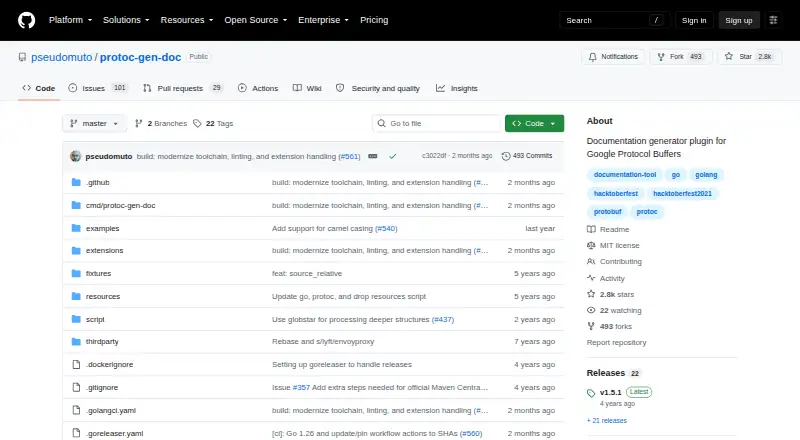
What protoc-gen-doc is
protoc-gen-doc is a documentation generator plugin for the Google Protocol Buffers compiler. It turns comments in .proto files into HTML, JSON, DocBook, or Markdown documentation. It supports proto2 and proto3, including their use in the same context, and can document files, messages, fields, services, methods, enums, values, and extensions. Users can exclude files with path patterns or omit comments marked with the @exclude prefix. The plugin is invoked through protoc with the --doc_out and --doc_opt options. The source_relative flag places generated output in the same relative directory as the input file. A custom Go template can define output, and a stylesheet.css file beside the output can customize HTML appearance. Installation options include Go, prebuilt releases, Docker, and Maven Central. The project is self-hosted and runs on Linux, macOS, and Windows. It is distributed under the MIT License, which allows use, copying, modification, distribution, sublicensing, and sale subject to its terms; the license provides the software without warranty. The repository has no SECURITY.md policy and no published security advisories.
Good
- Generates HTML, JSON, DocBook, and Markdown.
- Supports proto2 and proto3.
- Can filter files and comments.
- Offers Go, Docker, prebuilt, and Maven Central installation options.
Watch out
- The repository has no SECURITY.md policy.
- No security advisories are published.
- The MIT License provides the software without warranty.
Who it suits
It suits developers generating reference documentation from Protocol Buffers comments. Its template and filtering options may also suit projects that need customized output.
Verdict
protoc-gen-doc is a focused option for producing documentation from Protocol Buffers comments in several formats. Its self-hosted setup, output customization, and filtering provide control, while the repository’s lack of a security policy is a consideration.
Plans and prices
From protoc-gen-doc's own pricing page, checked 8 Oct 2026.
| Plan | Price | What it gives you |
|---|---|---|
| MIT-licensed software | Free | Use, copy, modify, merge, publish, distribute, sublicense, and sell under the MIT License · provided “AS IS” without warranty |
The facts
Each one read from protoc-gen-doc's own pages, with the date it was checked.
What it does
- Comment filtering
- Comments prefixed with @exclude can be omitted from generated documentation.checked 8 Oct 2026
- Customization
- Users can supply a custom Go template and can customize HTML output with a stylesheet.css file.checked 4 Oct 2026
- Custom templates
- The output format can be a custom Go template, and CSS placed beside the output file can customize HTML appearance.checked 8 Oct 2026
- Deployment
- The README describes a Docker image with /out and /protos volumes for documentation output and proto inputs.checked 8 Oct 2026
- Documentable elements
- Comments can document files, messages, fields, services and methods, enums and values, and extensions.checked 8 Oct 2026
- Filtering
- The plugin supports excluding files by path patterns and excluding comments with the @exclude prefix.checked 4 Oct 2026
- Installation
- The project offers a Docker image, Go installation, prebuilt releases, and a Maven Central package.checked 4 Oct 2026
- Install options
- The README documents installation with Go, prebuilt releases, a Docker image, and Maven Central.checked 8 Oct 2026
- Integration
- The plugin is invoked through protoc using the --doc_out and --doc_opt options.checked 8 Oct 2026
- License
- The software is distributed under the MIT License, which permits use, copying, modification, distribution, sublicensing, and sale subject to its terms.checked 4 Oct 2026
- License and warranty
- The project uses the MIT License, which provides the software “AS IS” without warranty.checked 8 Oct 2026
- Maintainer
- The GitHub profile identifies the maintainer as David Muto and lists Ottawa, Ontario, Canada.checked 8 Oct 2026
- Output formats
- It can generate HTML, JSON, DocBook, and Markdown documentation from comments in .proto files.checked 8 Oct 2026
- Output path option
- The source_relative flag writes generated output in the same relative directory as the input file.checked 4 Oct 2026
- Proto support
- It supports proto2 and proto3, including both in the same context.checked 8 Oct 2026
- Purpose
- protoc-gen-doc is a documentation generator plugin for the Google Protocol Buffers compiler.checked 8 Oct 2026
- Release
- The releases page lists v1.5.1 as the latest release and shows its tag as signed with a verified committer signature.checked 8 Oct 2026
- Release signature
- The v1.5.1 release page says its tag was signed with the committer’s verified signature.checked 4 Oct 2026
- Security
- GitHub reports that the project has no SECURITY.md policy and no published security advisories.checked 8 Oct 2026
Where it runs
- Release platforms
- The v1.0.0 release notes say the program was ported to Go and precompiled for Linux, OSX, and Windows.checked 8 Oct 2026
The full review of protoc-gen-doc
protoc-gen-doc turns comments in Protocol Buffers definitions into reference documentation. It is best suited to developers already using protoc who want a self-hosted generator they can adapt to a project’s publishing workflow. Its format and filtering controls are useful, but it is a documentation tool, not a general-purpose gRPC client.
Overview
The plugin generates HTML, JSON, DocBook, or Markdown from comments in .proto files. It supports proto2 and proto3, including projects that use both, and can document files, messages, fields, services, methods, enums, values, and extensions. That breadth lets teams keep reference material close to the definitions it describes, rather than maintaining a separate account of each element.
It is invoked through protoc with the --doc_out and --doc_opt options. The source_relative flag keeps generated output in the same relative directory as its input, which is practical for repositories that organize source and generated documents together. This workflow is a natural fit for compiler-based projects, but assumes familiarity with Protocol Buffers tooling.
Key features
The four built-in formats cover distinct publishing needs: HTML for browser-readable references, JSON for structured output, DocBook for document workflows, and Markdown for text-based publishing. A custom Go template can define a different output format, while a stylesheet.css file beside generated HTML can change its appearance. These options give teams control when defaults do not match their publishing setup, at the cost of maintaining custom templates and styles.
Filtering keeps generated references focused. The plugin can exclude files by path patterns and omit comments marked with @exclude, useful when internal or irrelevant material should not appear in the output. Installation choices include Go, prebuilt releases, Docker, and a Maven Central package; the Docker setup uses /out and /protos volumes for output and input. The range of installation paths helps accommodate different build environments, though deployment and ongoing operation remain the user's responsibility.
The project is distributed under the MIT License, which permits use, modification, distribution, sublicensing, and sale subject to its terms. It provides the software “AS IS” without warranty. The repository has no SECURITY.md policy and no published security advisories; organizations that require a documented security process should account for that gap rather than treating the absence of advisories as a guarantee.
Pricing
protoc-gen-doc is open-source software with a free plan: free. The plan permits use, copying, modification, merging, publication, distribution, sublicensing, and sale under the MIT License, and is provided “AS IS” without warranty. There are no paid tiers or seat limits in the stated plan; the trade-off is self-hosting and the absence of warranty.
Platforms
It supports Linux, macOS, and Windows, and uses a self-hosted deployment model. That suits teams able to incorporate a compiler plugin into their own development environment; it is not a hosted service that removes deployment work.
Who it's for
Choose protoc-gen-doc if your project maintains .proto definitions and you want comments to generate reference material in a format your publishing process can use. It is especially appropriate when you need both proto2 and proto3 support, control over templates or styling, or filtering of files and comments. If the main need is to call or inspect gRPC services through a graphical interface, this focused generator is the wrong category of tool.
Pros and cons
- Four output formats plus custom templates: teams can use built-in publishing formats or shape output around their own workflow.
- Broad comment coverage and syntax support: documentation can span major Protocol Buffers elements across proto2 and proto3 definitions.
- Useful filtering: path patterns and the @exclude prefix help prevent unwanted content from reaching generated references.
- Self-hosted and MIT-licensed: the free tool permits broad reuse, but requires the team to manage installation and operation.
- No repository security policy: organizations that expect a published security contact or process may prefer software with one.
Alternatives
For more options in this category, browse gRPC Tools. The alternatives below serve different needs from generating reference documentation:
- gRPC CLI is a free Linux, macOS, and Windows option for unary RPC calls, and is a better fit when making those calls is the goal.
- grpcui is a free, open-source option spanning desktop, web, and self-hosted platforms; choose it when that alternative better fits your gRPC workflow.
- Kreya offers a free individual plan with request history limited to the latest request, plus a free trial; consider it when a freemium tool is preferable to a documentation generator.
- sabledocs is a free open-source static generator requiring Python 3.11+ and a Protobuf descriptor file; choose it if that input and runtime suit your documentation process.
- Bandura has a free plan for personal and commercial use with no account, paid seats, or feature tiers; its commercial licence is $59, paid once. Consider it if its licensing arrangement better matches your use.
- FintX has a free/open-source plan with unlimited gRPC clients, request auto-save, import/export, tabs per method, a JSON editor, and projects; choose it for those client workflows rather than generated reference documentation.
- grpcmd is free per year and supports sending requests, starting a server, reflection, method discovery, and JavaScript scripting; its listed capabilities make it an option for interactive gRPC work.
- ProtoCall has a free app supporting GitHub imports and manually created workspaces; consider it if those workspace options better fit your workflow.
Verdict
Choose protoc-gen-doc if you maintain Protocol Buffers definitions and want a free, self-hosted way to turn their comments into customizable reference documentation. Its strongest case is the combination of multiple formats, broad element coverage, and practical filtering. Look elsewhere if you need a graphical gRPC client, or if your organization requires a published repository security policy.