
Review Board
Review Board is a web-based tool for reviewing code and other project materials, including images, documentation, presentations, and marketing files.
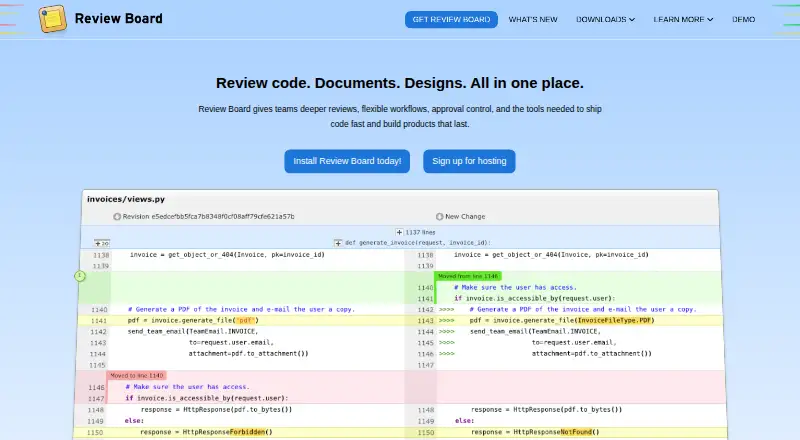
What Review Board is
Review Board is a web-based tool for reviewing code and other project materials, including images, documentation, presentations, and marketing files. Teams can set workflows, control approvals, and retain an audit trail of review decisions. Review Bot automates reviews through lint, static-analysis, compliance, and security-checking tools. A Python extension framework, REST APIs, webhooks, and RBTools support workflow and integration customization. Review Board can be self-hosted on compatible Linux systems, macOS, or WSL for Windows, including Docker deployments, and can run on private networks or in air-gapped environments. Its self-hosted servers do not send data to outside services unless administrators configure them to do so. It supports source-control systems including Git, GitHub, GitLab, Bitbucket, Perforce, Mercurial, Subversion, Azure DevOps, and ClearCase. Review Board is open source under the MIT license, and its Community plan is free. Basic costs $6.00 per month, billed month-to-month. A 60-day Power Pack trial is available for unlimited users; afterward, two users can continue using it free.
Good
- Reviews code, documents, images, and presentations.
- Automates checks through lint and analysis tools.
- Can run in air-gapped environments.
- Supports multiple source-control systems.
- Community plan is free.
Watch out
- Basic plan includes two integrations.
- AI review is not available.
- Plus costs $1,215.00 per month.
- Enterprise costs $1,518.00 per month.
Who it suits
Review Board suits teams reviewing code or a wider range of project materials. It may be a fit for teams needing self-hosted or air-gapped review, approval tracking, and support for multiple source-control systems.
Verdict
Review Board combines review workflows, audit tracking, automated checks, and self-hosting options. Its free Community plan is available, while Basic starts at $6.00 per month month-to-month; higher-tier plans list substantially higher monthly prices.
Plans and prices
From Review Board's own pricing page, checked 1 Oct 2026.
| Plan | Price | What it gives you |
|---|---|---|
| Community | Free | Code, image, and Markdown review · automated code review · REST API · LDAP, Active Directory, and SAML SSO · wide repository support · CI and collaboration integrations |
| Basic | $6 a month | Unlimited linked repositories · 2 integrations · code, image, and Markdown review · REST API · CI and collaboration integrations · month-to-month |
| Business | $12 a month | Everything in Basic · 50 integrations · document review · code review reports · Azure DevOps · ClearCase · GitHub Enterprise · Keysight SOS · month-to-month |
| Plus | $1,215 a month | Everything in Community · basic dedicated support · document review · code review reports · enterprise repository integrations · improved server scalability · annual or monthly |
| Enterprise | $1,518 a month | Everything in Plus · 24/7 premium support · priority fixes and features · urgent-fix backports · custom builds · deployment assistance · video chat support · annual or monthly |
The facts
Each one read from Review Board's own pages, with the date it was checked.
Where it runs
- Air-gapped use
- Review Board can run on private networks and in air-gapped environments.checked 1 Oct 2026
What it does
- Automation
- Review Bot provides automated reviews through lint, static-analysis, compliance, and security-checking tools.checked 1 Oct 2026
- Best suited for
- It is particularly suited to teams needing on-premises or air-gapped review, repository-independent workflows, audit tracking, and support for multiple source-control systems.checked 1 Oct 2026
- Compliance
- sso samlchecked 22 Sep 2026
- Customization
- A Python extension framework, REST APIs, webhooks, and RBTools can be used to customize workflows and integrations.checked 1 Oct 2026
- Data control
- Self-hosted servers do not send data to outside services unless administrators configure them to do so.checked 1 Oct 2026
- Deployment
- cloud, self hostedchecked 22 Sep 2026
- Integrations
- The integrations directory lists 10 version-control, 13 hosting-service, 6 authentication, 4 continuous-integration, and 8 collaboration-tool integrations.checked 1 Oct 2026
- Open source
- Review Board is open source under the MIT license, and its Community plan is free.checked 1 Oct 2026
- Privacy
- The product site states that Review Board does not train on customer data.checked 1 Oct 2026
- Purpose
- Review Board is a web-based tool for code and document review.checked 1 Oct 2026
- Review scope
- Teams can review code, images, documentation, presentations, marketing materials, and other project files.checked 1 Oct 2026
- Security
- Review Board releases are signed with the project’s official PGP key so downloads can be verified as genuine and untampered.checked 1 Oct 2026
- Self-hosting
- Review Board can run on compatible Linux systems, macOS, or WSL for Windows, including Docker deployments.checked 1 Oct 2026
- Support
- Plus includes basic dedicated support, while Enterprise includes same-day premium support seven days a week, emergency repairs, priority fixes, older-version support, and custom builds.checked 1 Oct 2026
- Support channels
- email, chat, phone, ticket, docschecked 22 Sep 2026
- Workflow
- Review Board provides flexible workflows, approval control, and an audit trail of review decisions.checked 1 Oct 2026
The company
- Company size fit
- solo, small, mid market, enterprisechecked 22 Sep 2026
- Founded
- 2006checked 28 Sep 2026
- Headquarters
- Palo Alto, California, United Stateschecked 28 Sep 2026
Money
- Power Pack trial
- Power Pack can be tried free for 60 days for unlimited users, after which two users can continue using it free forever.checked 1 Oct 2026
The full review of Review Board
Overview
Review Board is a web-based review tool for teams that need to examine code and other project materials, not just pull requests. It suits organizations that value control over deployment, repository choice, and approval records; its lack of AI review makes it a less natural fit for teams seeking AI-generated feedback.
Flexible workflows, approval controls, and an audit trail help teams manage sign-off across code, images, Markdown, and other files. Review Bot can connect reviews to linting, static-analysis, compliance, and security checks, while extension and API options give teams room to adapt the process.
Key features
- Reviews beyond code: Teams can review code, images, Markdown, documentation, presentations, marketing materials, and other project files. Document review requires a higher plan, so organizations with mixed engineering and business reviews should account for that tier boundary.
- Workflow control: Configurable workflows, approval control, and an audit trail make Review Board a good match for teams that need a record of review decisions rather than a lightweight comment-only process.
- Automated checks: Review Bot supports checks through lint, static-analysis, compliance, and security tools. Custom rules, security analysis, and review analytics suit teams seeking structured oversight; there is no AI review for teams that specifically want AI-generated feedback.
- Adaptability and repository choice: A Python extension framework, REST APIs, webhooks, and RBTools support customized workflows and integrations. Supported hosts include Git, GitHub, GitLab, Bitbucket, Perforce, Mercurial, Subversion, Breezy, CVS, Azure DevOps, ClearCase, and Keysight SOS, making it useful for teams working across source-control systems.
- Deployment and data control: Review Board can run in the cloud or self-hosted, including on private networks and air-gapped environments. Self-hosted servers do not send data to outside services unless administrators configure them to, which matters to organizations with strict data-control needs. Releases are signed with the project's official PGP key, and the product states it does not train on customer data.
Pricing
The free Community plan includes code, image, and Markdown review, automated code review, REST API access, LDAP, Active Directory, and SAML SSO, broad repository support, and CI and collaboration integrations. It is a substantial starting point for teams that can work without document review or paid support. The Power Pack trial runs for 60 days for unlimited users; afterward, two users can continue using it free.
Basic costs $6 a month, billed month-to-month. It adds unlimited linked repositories and includes two integrations, alongside code, image, and Markdown review, REST API access, and CI and collaboration integrations. The two-integration ceiling is a meaningful constraint for teams relying on many connected tools.
Business costs $12 a month, billed month-to-month. It includes everything in Basic plus 50 integrations, document review, code review reports, Azure DevOps, ClearCase, GitHub Enterprise, and Keysight SOS. It is the more capable month-to-month choice for teams that need document review or those repository integrations.
Plus costs $1,215 a month, billed annually or monthly. It includes everything in Community, basic dedicated support, document review, code review reports, enterprise repository integrations, and improved server scalability. It is aimed at organizations that need support and scale beyond the lower tiers, but its price is a substantial step up.
Enterprise costs $1,518 a month, billed annually or monthly. It adds 24/7 premium support, priority fixes and features, urgent-fix backports, custom builds, deployment assistance, and video chat support to Plus. This tier makes sense when those service commitments matter; teams that do not need them can avoid a steep premium. A 60-day Power Pack trial is also available.
Platforms
Review Board supports web, API, Linux, macOS, and Windows platforms. Self-hosted deployment works on compatible Linux systems, macOS, or WSL for Windows, including Docker deployments. Private-network and air-gapped operation makes it a practical option where cloud-hosted review is not acceptable.
Who it's for
Review Board is best suited to teams that need on-premises or air-gapped review, repository-independent workflows, an audit trail, or support across several source-control systems. Its broad review scope also suits groups that approve project files beyond code. Teams primarily looking for AI code review, or those that do not need deployment control and process customization, may find its breadth unnecessary.
Pros and cons
- Pro: Self-hosting and air-gapped use give security-conscious organizations control over where review data stays.
- Pro: Broad repository support and review of non-code materials accommodate varied engineering and project workflows.
- Pro: The free Community plan includes SSO options, automated review, and REST API access.
- Con: Document review is not included in Basic, so teams needing it must choose Business or above.
- Con: Basic allows only two integrations, limiting teams that need a wider connected toolchain.
- Con: Plus and Enterprise carry much higher monthly prices than the entry plans, so their support and scale benefits need to justify the cost.
- Con: There is no AI review for teams seeking AI-generated review feedback.
Alternatives
Browse Code review software for more options. Consider CodeRabbit if its public-repository Open-source plan, with free reviews forever, matches your needs. Graphite offers a free Hobby plan with personal-account repositories, notifications, CLI, MCP, and a VS Code extension. CodeAnt AI is a paid option with a 14-day free trial and no credit card required. Gitar offers a free plan for qualifying public open-source repositories. Greptile has a free Starter plan with 50 credits per month, one active developer, and unlimited repositories. Sourcery offers a free Open Source plan for public repositories with AI reviews, summaries, diagrams, one-click fixes, and custom rules. Bito lists an AI Code Reviews Team annual plan at $12 a year, billed at $12 monthly per seat, billed annually, with 5K lines per seat per month included. P4 Code Review offers a free plan for up to five users and 20 workspaces, making it an alternative for teams within those limits.
Verdict
Choose Review Board if your priority is controlled, auditable review across repositories and project materials, especially in self-hosted or air-gapped environments. Its free Community plan and customization options make it a capable starting point, but teams should look elsewhere if AI review is central or if the upper-tier support and scalability do not justify their cost.
Getting started
- Visit the Review Board website.
- Choose cloud deployment or self-host on a compatible Linux system, macOS, or WSL for Windows; Docker deployments are supported.
- Select the free Community plan or a paid plan that matches the required review and integration features.
- Connect supported repositories and CI or collaboration integrations.
- Use the REST API, webhooks, Python extension framework, or RBTools to customize workflows and integrations if needed.
- Try Power Pack free for 60 days for unlimited users; after the trial, two users can continue using it free.
Limits worth knowing
The Community plan provides code, image, and Markdown review. Basic costs $6/user/mo and includes two integrations; document review appears in Business and Plus. Power Pack's free trial lasts 60 days for unlimited users, after which two users can continue using it free.
Questions
Is Review Board free?
Yes. The Community plan is free and open source under the MIT license.
What does a paid plan cost?
Basic is $6 a month, billed month-to-month. Business is $12 a month, also billed month-to-month; Plus is $1,215 a month, and Enterprise is $1,518 a month, with annual or monthly billing.
Which platforms and deployment options does it support?
Listed platforms include API, Linux, macOS, self-hosted, web, and Windows. Deployment options are cloud and self-hosted; compatible Linux systems, macOS, WSL for Windows, and Docker are named for self-hosting.
Can Review Board run in an air-gapped environment?
Yes. It can run on private networks and in air-gapped environments. Self-hosted servers do not send data to outside services unless administrators configure them to.
What integrations and code hosts are supported?
Named code hosts include Git, GitHub, GitLab, Bitbucket, Perforce, Mercurial, Subversion, Breezy, CVS, Azure DevOps, ClearCase, and Keysight SOS. Integrations include Asana, CircleCI, Discord, Jenkins CI, Slack, Trello, and others.
What support comes with the higher tiers?
Plus includes basic dedicated support. Enterprise includes same-day premium support seven days a week, emergency repairs, priority fixes, older-version support, custom builds, deployment assistance, and video chat support.
Alternatives to Review Board
- 1

RhodeCode Enterprise
Free planOpen sourceWebAPILinuxSelf-hosted8.3From $75 a year - 2

Cubic
Free planWebAPILinuxmacOS7.9From $30 a month - 3

Sourcery
Free planWebAPIExtensionLinux7.9From $12 a month - 4

Ellipsis
Free planWebAPILinuxmacOS7.8Free plan - 5

Gerrit Code Review
Free planOpen sourceWebAPILinuxmacOS7.7Free plan - 6

Greptile
Free planWebAPIExtensionLinux7.7From $30 a month