replenishment
replenishment is an open-source Python library for simulating stock replenishment, optimizing policies, and visualizing policy behavior.
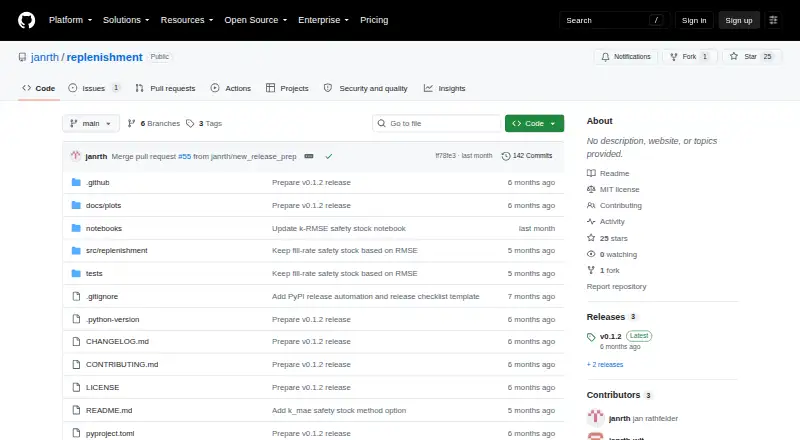
What replenishment is
replenishment is an open-source Python library for simulating stock replenishment, optimizing policies, and visualizing policy behavior. It is intended for teams comparing approaches using historical or synthetic demand. Optimization workflows include safety stock based on mean forecasts, k*RMSE or k*MAE, and percentile targets. For k*RMSE and k*MAE policies, safety stock can optionally increase when lead-time forecast quantities rise above a baseline. The library supports moving between CSV or DataFrame inputs and simulation configurations, and it can compare policies visually on replenishment time series. Install it from PyPI with `pip install replenishment`. The project says it is tested on Python 3.10, 3.11, 3.12, and 3.13; listed dependencies include pandas, Polars, PyArrow, matplotlib, ipykernel, and scienceplots. Repository notebooks cover policy variants, synthetic data generation, and stock replenishment data loading. The package uses the MIT license and is classified as Alpha. The README welcomes contributions and links to guidance and the issue tracker. Minimum order quantities, case-pack constraints, and promotion-aware demand handling are listed as areas for future contribution.
Good
- Optimizes safety stock with several listed policy approaches.
- Compares policies on replenishment time series.
- Supports CSV and DataFrame workflows.
- Tested on Python 3.10 through 3.13.
Watch out
- Package is classified as Alpha.
- Minimum order quantities are listed for future contribution.
- Case-pack constraints are listed for future contribution.
Who it suits
It suits Python teams modeling stock replenishment against historical or synthetic demand and comparing policy choices. Users needing minimum order quantities, case-pack constraints, or promotion-aware demand handling should note those are areas for future contribution.
Verdict
replenishment provides a focused Python workflow for stock simulations, policy optimization, and visual comparison. Its Alpha status and listed future-contribution areas are worth considering before relying on it for specific constraints.
Plans and prices
From replenishment's own pricing page, checked 10 Oct 2026.
| Plan | Price | What it gives you |
|---|---|---|
| Open source library | Free | Python package · MIT license |
The facts
Each one read from replenishment's own pages, with the date it was checked.
What it does
- Contribution
- The README welcomes contributions and links to guidance for setup, tests, and pull requests.checked 10 Oct 2026
- Data handling
- The README describes workflows for moving between CSV/DataFrame inputs and simulation configs.checked 4 Oct 2026
- Data workflows
- The project describes workflows moving between CSV or DataFrame inputs and simulation configs.checked 10 Oct 2026
- Dependencies
- The package metadata lists pandas, Polars, PyArrow, Matplotlib, and SciencePlots among its dependencies.checked 10 Oct 2026
- Development status
- The project metadata classifies the package as Alpha.checked 4 Oct 2026
- Distribution
- The README documents installation from PyPI with pip install replenishment.checked 10 Oct 2026
- Forecast buffering
- The README says k*RMSE or k*MAE safety stock can optionally increase when lead-time forecast quantities rise above a baseline.checked 4 Oct 2026
- Installation
- The README gives `pip install replenishment` as the PyPI installation command.checked 4 Oct 2026
- Intended use
- The README says it is designed for teams that simulate replenishment policies against historical or synthetic demand.checked 4 Oct 2026
- License
- The project metadata identifies the license as MIT.checked 4 Oct 2026
- License and maturity
- The package metadata identifies the license as MIT and development status as Alpha.checked 10 Oct 2026
- Notable limits
- The README lists minimum order quantities, case-pack constraints, and promotion-aware demand handling as areas for future contribution.checked 10 Oct 2026
- Policy optimization
- It supports optimizing mean-forecast safety stock, k*RMSE/k*MAE, and percentile-target policies.checked 10 Oct 2026
- Purpose
- The project describes replenishment as a Python library for stock replenishment simulation, policy optimization, and decision visualization.checked 4 Oct 2026
- Python support
- The project says it is tested on Python 3.10, 3.11, 3.12, and 3.13.checked 10 Oct 2026
- Python versions
- The README says the project is tested on Python 3.10, 3.11, 3.12, and 3.13.checked 4 Oct 2026
- Support and contribution
- The README welcomes contributions and links to contribution guidance and the repository issue tracker.checked 4 Oct 2026
- Visualization
- It can compare replenishment policies visually on time series.checked 10 Oct 2026
- Walkthroughs
- The repository includes notebooks for policy variants, synthetic data generation, and stock replenishment data loading.checked 10 Oct 2026
- What it does
- replenishment is a Python library for stock replenishment simulation, policy optimization, and decision visualization.checked 10 Oct 2026
Where it runs
- Demand scenarios
- It simulates replenishment policies against historical or synthetic demand.checked 10 Oct 2026
The full review of replenishment
Overview
Replenishment is a Python package for modeling stock decisions rather than managing them through a finished planning interface. It suits analysts and teams who want to compare replenishment policies using demand data and are comfortable building a workflow in Python. Its analytical focus is useful, but Alpha maturity and unaddressed operational constraints make it a cautious choice for production-critical planning.
Key features
The library simulates policies against historical or synthetic demand, then supports visual comparison across replenishment time series. That combination helps teams explore how a policy behaves under different demand scenarios, though it is oriented toward analysis rather than a complete inventory-operations system.
Optimization workflows include mean-forecast safety stock, k*RMSE or k*MAE, and percentile-target policies. For k*RMSE and k*MAE, safety stock can optionally increase when lead-time forecast quantities rise above a baseline. This gives analysts several buffer-setting approaches to compare, with a specific mechanism for responding to higher forecast quantities.
Data workflows connect CSV or DataFrame inputs with simulation configurations. The repository includes notebooks on policy variants, synthetic data generation, and stock-data loading, useful starting points for Python users adapting the library to their own analysis. Installation is through PyPI with pip install replenishment. The package is tested on Python 3.10, 3.11, 3.12, and 3.13; its dependencies include pandas, Polars, PyArrow, matplotlib, ipykernel, and scienceplots.
Minimum order quantities, case-pack constraints, and promotion-aware demand handling are future contribution areas. Teams whose decisions depend on those rules should look for a more complete fit or plan to extend the package. Its MIT license and invitation to contribute make customization possible, but the Alpha classification is reason to assess suitability before relying on it for constrained workflows.
Pricing
Open source library — free. The free Python package is MIT-licensed, with no paid tier described. It fits individual analysts and teams able to install and work with a Python library; there is no separate lower plan with reduced features. The cost is not the main trade-off: users need the technical capability to build their own workflow and should account for the package’s Alpha status and the stated gaps around operational constraints.
Platforms
Replenishment is distributed as a Python package through PyPI, rather than as a standalone desktop or mobile application. Its tested Python versions are 3.10 through 3.13. The listed dependencies span data handling, visualization, and notebook work, so it is best suited to an existing Python analysis environment.
Who it's for
Choose replenishment if your team can work in Python and needs to compare stock policies against historical or generated demand, explore safety-stock approaches, or visualize replenishment behavior. It is less suitable when you need a ready-made operational system or decisions must directly account for minimum orders, case packs, or promotion effects.
Pros and cons
Pros
- Multiple policy-optimization workflows: mean-forecast safety stock, k*RMSE or k*MAE, and percentile targets let analysts compare different buffer-setting approaches.
- Scenario and visual analysis: historical and synthetic demand simulations paired with time-series comparisons support policy exploration.
- Flexible data path: CSV and DataFrame inputs can be connected to simulation configurations, with notebooks for common exploration tasks.
- MIT-licensed and free: teams can use the package without a subscription and are invited to contribute.
Cons
- Alpha status: teams should assess its readiness before making it a dependency for critical planning.
- Operational constraints remain gaps: minimum order quantities, case packs, and promotion-aware demand are future contribution areas.
- Python-oriented delivery: users need a Python environment and the ability to assemble their own analysis workflow.
Alternatives
Inventory Optimization Software is a useful category starting point if you want to compare options beyond a Python library.
Choose ZebraDesigner instead if your need is basic barcode label and tag design and printing, including support for Zebra Link-OS and Link-OS Basic printers; it is a different kind of tool, with paid plans as well as a free Essentials plan. supplychainpy is another free Python package distributed through PyPI to consider alongside replenishment. Stockpyl is a free, MIT-licensed Python package credited to Lawrence V. Snyder.
Creo, Manhattan Active Inventory Replenishment, Bluemingo Production Planning & Scheduling, E2open Planning, and GAINS are paid alternatives for readers comparing other software options; their listed pricing is custom pricing or available through a sales or demo request.
Verdict
Replenishment is a good fit for Python-capable analysts who want a free, MIT-licensed way to simulate demand scenarios, compare safety-stock policies, and visualize results. Its strongest reason to choose it is that focused analytical workflow; its strongest reason to look elsewhere is Alpha status combined with future-work gaps in constraints such as case packs and promotions.
Getting started
- Install the package from PyPI with `pip install replenishment`
- Use Python 3.10, 3.11, 3.12, or 3.13
- Prepare historical or synthetic demand data
- Load CSV or DataFrame inputs into simulation configurations
- Explore notebooks for policy variants and data loading
Questions
Is replenishment free?
Yes. It is an open-source Python package under the MIT license, listed as free plan.
How do I install it?
Install it from PyPI with `pip install replenishment`.
Which Python versions are supported?
The project says it is tested on Python 3.10, 3.11, 3.12, and 3.13.
What policies can it optimize?
Listed workflows include mean-forecast safety stock, k*RMSE, k*MAE, and percentile-target policies.
What data formats does it use?
The project describes workflows connecting CSV or DataFrame inputs with simulation configurations.
Is the project open source?
Yes. Its package metadata identifies the MIT license and Alpha development status.
Alternatives to replenishment
- 1

Flowlity
WebAPI6.9From €249 a month - 2
Anaplan
AndroidiOSWebAPI6.5 - 3

o9 Digital Brain
AndroidiOSWebAPI6.5 - 4
supplychainpy
Free planAPILinuxmacOSSelf-hosted6.4Free plan - 5
StockTrim
WebAPI6.3From $298 a month - 6
buffers.ai
Web6.1From $25 a month